
Sign In. Ethics and climate policy: John Dryzek and Clive Hamilton. 20Climate%20Change%20Vol1No1%20KCPF. Climate Change and Virtue: An Apologetic. NOAAClimate : Sea surface temperatures are ... EN... SO? Forecasters at the Climate Prediction Center haven’t declared El Niño conditions, even though the Niño3.4 index is currently around 0.5°C above normal, and has been for the past two months.
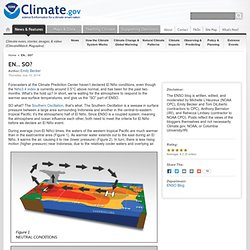
What’s the hold up? In short, we’re waiting for the atmosphere to respond to the warmer sea-surface temperatures, and give us the “SO” part of ENSO. SO what? The Southern Oscillation, that’s what. The Southern Oscillation is a seesaw in surface pressure between a large area surrounding Indonesia and another in the central-to-eastern tropical Pacific; it’s the atmospheric half of El Niño. During average (non-El Niño) times, the waters of the western tropical Pacific are much warmer than in the east/central area (Figure 1). The pressure changes influence the wind patterns. During El Niño, the system shifts: we see weaker trade winds over the Pacific, less rain than usual over Indonesia, and more rain than usual over the central or eastern Pacific.
Thanks to David Stroud for his help with this post. IPCC - Intergovernmental Panel on Climate Change. U.N. climate panel: Governments, businesses need to take action now against growing risks. A U.N. report released Monday in Japan said global warming is affecting food and water shortages, economic livelihoods and raising the risk of wars.
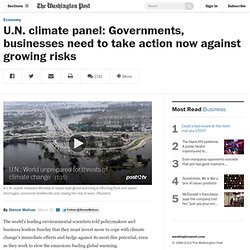
(Reuters) The world’s leading environmental scientists told policymakers and business leaders Sunday that they must invest more to cope with climate change’s immediate effects and hedge against its most dire potential, even as they work to slow the emissions fueling global warming. The U.N. Intergovernmental Panel on Climate Change said that climate change is already hurting the poor, wreaking havoc on the infrastructure of coastal cities, lowering crop yields, endangering various plant and animal species, and forcing many marine organisms to flee hundreds of miles to cooler waters.
But the Nobel Peace Prize-winning group said that climate change’s effects will grow more severe and that spending and planning are needed to guard against future costs, much as people insure themselves against possible accidents or health problems. Understanding the IPCC Reports. The Intergovernmental Panel on Climate Change (IPCC) is the world’s foremost collection of climate scientists.

Throughout 2013 and 2014, the group will release its Fifth Assessment Report in four installments, highlighting the current state of the climate system and climate change, its environmental and socio-economic impacts, and mitigation strategies that can limit emissions. Here, WRI provides ongoing analysis of this groundbreaking climate change research—and its potential implications on communities, the economy, and the environment. 12 Graphics that Contain Everything You Need to Know about Climate Change. Climate change is real, it’s here and it will be affecting the planet for a long, long time.
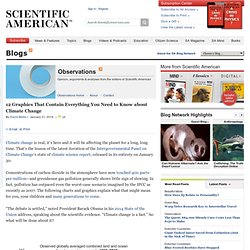
That’s the lesson of the latest iteration of the Intergovernmental Panel on Climate Change‘s state of climate science report, released in its entirety on January 30. Concentrations of carbon dioxide in the atmosphere have now touched 400 parts-per-million—and greenhouse gas pollution generally shows little sign of slowing.
In fact, pollution has outpaced even the worst-case scenario imagined by the IPCC as recently as 2007. The following charts and graphics explain what that might mean for you, your children and many generations to come. Book launch: Media and the Politics of Arctic Climate Change. Sea ice in broken sheets off the coast of Alaska in late April, 2005.
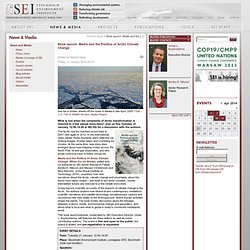
Flickr / U.S. Fish & Wildlife Service, Alaska Region. What is lost when the complexity of Arctic transformation is reduced to a few simple story-lines? Join us this Tuesday, 21 January, 12:00-14:00 at SEI HQ for a discussion with the authors. The Arctic sea ice reached record lows in 2007, and again in 2012. Carbon report puts SA in the hot seat. A new report on carbon emissions shows that only 90 international entities are responsible for two-thirds of all the greenhouse gas emissions in the past 250 years.
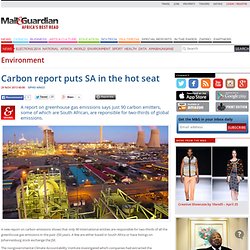
A few are either based in South Africa or have listings on Johannesburg stock exchange the JSE. The nongovernmental Climate Accountability Institute investigated which companies had extracted the carbon-based fuels that have driven climate change. According to its report, 90 international entities have emitted 914-billion tonnes of carbon dioxide equivalent (every greenhouse gas is equated to carbon for easy calculating) in the past 259 years. The worst offenders are oil companies, with Chevron topping the list with 3.5% of all historical emissions. Only seven of the 90 do not work in the coal, oil and gas sectors. Anglo American has been responsible for 0.5% of all historical emissions and Xstrata for 0.15%. South Africa has traditionally been labelled a developing country in climate negotiations. Global Policy Journal - Practitioner, Academic, Global Governance, International Law, Economics, Security, Institutions, Comment & Opinion, Media, Events, Journal.
Jamie Clarke - 26th November 2013 Jamie Clarke points out that it is people’s value, rather than scientific knowledge are heart of the climate change debate, especially to skepticism. psychological evidence is provided.
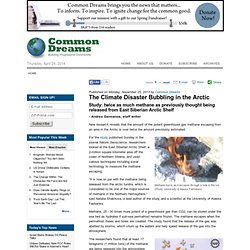
Last Friday’s launch of the UN Intergovernmental Panel on Climate Change (IPCC) Fifth Assessment report was met with significant media coverage and much activity in the climate change world – but will it change the mind of anyone not already supportive of the issue? At COIN we argue that climate change campaigners need to do more than explain the science: they need to inspire people by speaking to their values. AAA Global Climate Change Taskforce. The Climate Disaster Bubbling in the Arctic. New research reveals that the amount of the potent greenhouse gas methane escaping from an area in the Arctic is over twice the amount previously estimated.
Warsaw climate talks – final day live blog. UN climate talks bogged down over CO2 cuts, aid, on last day. Delegates attend the Convention on Climate Change COP19 conference at the National Stadium in Warsaw on November 19, 2013.

REUTERS/Kacper Pempel * Clear timetable to 2015 deal not expected * No major emissions goals set, funding not enough By Nina Chestney and Megan Rowling WARSAW, Nov 22 (Reuters) - Disputes over when rich and poor nations will set greenhouse gas targets and over climate aid to the developing world threatened to sink U.N. climate talks on the final day on Friday. Negotiators from around 195 countries are working to lay the foundations for a new global climate accord that is due to be agreed in 2015 in Paris, and come into force after 2020, but few concrete steps have emerged from two weeks of talks in Warsaw. Green groups walk out of UN climate talks.
Environment and development groups together with young people, trade unions and social movements walked out of the UN climate talks on Thursday in protest at what they say is the slow speed and lack of ambition of the negotiations in Warsaw.

Wearing T-shirts reading "Volverermos" (We will return), around 800 people from organisations including Greenpeace, WWF, Oxfam, 350.org, Friends of the Earth, the Confederation and ActionAid, handed back their registration badges to the UN and left Poland's national stadium, where the talks are being held. "Movements representing people from every corner of the Earth have decided that the best use of our time is to voluntarily withdraw from the Warsaw climate talks. This will be the first time ever that there has been a mass withdrawal from a COP," said a WWF spokesman. "Warsaw, which should have been an important step in the just transition to a sustainable future, is on track to deliver virtually nothing. Rt. UN Climate Talks - COP19. A Song of Our Warming Planet. UN climate jargon buster: a guide to deciphering the Warsaw talks. Interesting links: August – October 2013. I had high hopes of regular blogging when we started the journey of the Thuthuka-project.
But the second part of the year got much more busy than I initially anticipated, and thus my postings on the blog dropped right off. But now the teaching term has come to an end, students are preparing for exams, and I have moments for deeper breathing and looking up to the expansive blue sky for thinking inspiration. Why does climate change adaptation in Africa ignore politics? Great broadside from Matthew Lockwood.
My friend Matthew Lockwood has a habit of asking really big, sensible questions about politics that change the way you see the world. He was so fed up with what he saw as the lazy, apolitical thinking behind aid in general and Make Poverty History in particular, that he abandoned the development scene, writing The State They’re In: An Agenda for International Action on Poverty in Africa. It’s a brilliant discussion of Africa’s political economy, and a forerunner to much of the work on governance and institutions that I’ve been writing about on this blog. Since then he’s devoted himself to climate change, first at IDS and now at Exeter University.
But he’s found himself facing similar problems – a lack of political analysis that leads to ‘magical thinking’ in which climate lobbyists churn out endless blueprints (greenprints?) Naomi Klein: How science is telling us all to revolt. In December 2012, a pink-haired complex systems researcher named Brad Werner made his way through the throng of 24,000 earth and space scientists at the Fall Meeting of the American Geophysical Union, held annually in San Francisco.
This year’s conference had some big-name participants, from Ed Stone of Nasa’s Voyager project, explaining a new milestone on the path to interstellar space, to the film-maker James Cameron, discussing his adventures in deep-sea submersibles. But it was Werner’s own session that was attracting much of the buzz. It was titled “Is Earth F**ked?” (full title: “Is Earth F**ked? Dynamical Futility of Global Environmental Management and Possibilities for Sustainability via Direct Action Activism”). Introducing the Eldis Climate Change Resource Guide. Interesting links: July 2013. In the last few weeks of July I came across the following links that are relevant to our research project. (I got bogged down with admin, and didn’t get to publish this posting earlier.) On RCTs in development, systematic reviews, evidence, and policy: - In two blog postings in July, Kirsty discusses the anti-RCT sentiment in the development field by highlighting a few myths about RCTs, and she gives a number of tips for presenting synthesised evidence.
Coursera.org. Climate change said affecting global spread of infectious diseases. ATHENS, Ga., Aug. 2 (UPI) -- Climate change affects the spread of infectious diseases worldwide with serious impacts to human health and biodiversity conservation, disease ecologists say. Climate change. Transitions in practice. Infographic: What Climate Change Means for Africa and Asia. iChange Video Competition - new deadline: May 15th. Putting the 400 ppm CO2 thing in perspective. Extreme Weather Swings From Record Drought To Flood May Be Sign Of Climate Change.
Cool heads needed in Bonn for five-day talks on climate change - Environmental News. Home Page. Antarctic nematodes and climate change. 26 April 2013Last updated at 23:04 GMT By Jane O'Brien BBC News, Washington. Capturing Women's Voices on Climate Change Through Participatory Video. Amazon’s indigenous people already experiencing early effects of climate change. 22 April 2013. Interesting links 7 April 2013. During the last week I came across some interesting links and discussions related to changing climate and/or evidence. Watch 62 Years of Global Warming in 13 Seconds. Climate change threatens food security of urban poor. James E. Hansen Retiring From NASA to Fight Global Warming. An Error Occurred Setting Your User Cookie. Exploring Climate Change through Science and in Society: An anthology of Mike Hulme's essays, interviews and speeches.
3S%20WP%202012-15. Talking to the UN Security Council about Climate Change. Peter Gleick cleared of forging documents in Heartland expose. Science says: Cut that steak in half to keep the climate in check. Trailers - SURVIVING PROGRESS. Climate code red: Science update. The verdict is in on climate change - latimes.com. Development - Pachakuti: Indigenous perspectives, buen vivir, sumaq kawsay and degrowth. Capitalism vs. the Climate.
12 heads of state to attend COP 17 talks. Check out the COPpuccino COP17 talks. News. ISS - Monograph 184: Carbon Trading in Africa, A Critical Review, Edited by Trusha Reddy. GDA comment: Rehad Desai. Democracy Now! Mobile. Broadcast Yourself. Patrick Bond, speaking at OccupyCOP17, 10th December 2011. n24. World. Is South Africa addicted to coal? What really happenend at Durban City Hall COP. While COP17 hailed 'a success', SA slammed as mediator. Climate change conference in trouble as China rejects proposals for new treaty. Analyst Blasts U.S. Negotiator at Climate Talks: Warns of “Eco-Apartheid” Capitalism vs. the Climate. 20 World Cities Reflected in Water. Challenging climate apartheid. Open Data Resources for Climate Change. If carbon markets boom, who will benefit? Meet the trillion dollar club.
Global Climate Change: NASA's Eyes on the Earth. Intergovernmental Panel on Climate Change. Greenpeace Climate Change Resources. 350.org. Journal home : Nature Climate Change.