
Raison d'être. Raison d'être may refer to:
Make a rod for own back. Cutting off the nose to spite the face. "Cutting off the nose to spite the face" is an expression used to describe a needlessly self-destructive over-reaction to a problem: "Don't cut off your nose to spite your face" is a warning against acting out of pique, or against pursuing revenge in a way that would damage oneself more than the object of one's anger.[1] Origins[edit] The phrase is known to have been used in the 12th century.
It may be associated with the numerous legends of pious women disfiguring themselves in order to protect their virginity. These cases include Saint Eusebia, Saint Ebba, Saint Oda of Hainault and Saint Margaret of Hungary.[2] The most famous[citation needed] of these cases was that of Æbbe the Younger, the Mother Superior of the monastery of Coldingham. The expression has since become a blanket term for (often unwise) self-destructive actions motivated purely by anger or desire for revenge. Historical examples[edit] See also[edit] References[edit] Straw man. A straw man, also known in the UK as an Aunt Sally,[1][2] is a common type of argument and is an informal fallacy based on the misrepresentation of the original topic of argument.
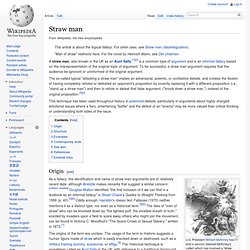
To be successful, a straw man argument requires that the audience be ignorant or uninformed of the original argument. The so-called typical "attacking a straw man" implies an adversarial, polemic, or combative debate, and creates the illusion of having completely refuted or defeated an opponent's proposition by covertly replacing it with a different proposition (i.e., "stand up a straw man") and then to refute or defeat that false argument, ("knock down a straw man,") instead of the original proposition.[3][4] This technique has been used throughout history in polemical debate, particularly in arguments about highly charged emotional issues where a fiery, entertaining "battle" and the defeat of an "enemy" may be more valued than critical thinking or understanding both sides of the issue.
Origin[edit] The British Equivalent of “That’s What She Said” Today I Found Out there is a British equivalent to “that’s what she said” that’s been around for over a century, namely, “said the actress to the bishop”.
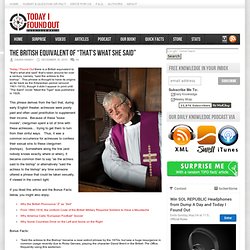
This phrase is thought to have its origins as far back as the Edwardian period (around 1901-1910), though it didn’t appear in print until “The Saint” novel “Meet the Tiger” was published in 1928. This phrase derives from the fact that, during early English theater, actresses were poorly paid and often used prostitution to supplement their income. Because of these “loose morals”, clergymen spent a lot of time with these actresses… trying to get them to turn from their sinful ways. Thus, it was a common occurrence for actresses to confess their sexual sins to these clergymen (bishops). If you liked this article and the Bonus Facts below, you might also enjoy: Bonus Facts: Expand for References:
Needs must when the devil drives.