
Cellular network. Top of a cellular radio tower A cellular network or mobile network is a wireless network distributed over land areas called cells, each served by at least one fixed-location transceiver, known as a cell site or base station.

In a cellular network, each cell uses a different set of frequencies from neighboring cells, to avoid interference and provide guaranteed bandwidth within each cell. When joined together these cells provide radio coverage over a wide geographic area. This enables a large number of portable transceivers (e.g., mobile phones, pagers, etc.) to communicate with each other and with fixed transceivers and telephones anywhere in the network, via base stations, even if some of the transceivers are moving through more than one cell during transmission.
Cellular networks offer a number of desirable features: Major telecommunications providers have deployed voice and data cellular networks over most of the inhabited land area of the Earth.
Subscriber identity module. A typical SIM card (mini-SIM) A mini-SIM card next to its electrical contacts in a Nokia 6233 A TracFone Wireless SIM card has no distinctive carrier markings and is only marked as a "SIM CARD" JAVA. International Mobile Subscriber Identity. The International mobile Subscriber Identity or IMSI /ˈɪmziː/ is used to identify the user of a cellular network and is a unique identification associated with all cellular networks.
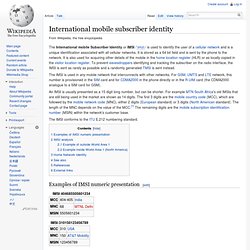
It is stored as a 64 bit field and is sent by the phone to the network. It is also used for acquiring other details of the mobile in the home location register (HLR) or as locally copied in the visitor location register. To prevent eavesdroppers identifying and tracking the subscriber on the radio interface, the IMSI is sent as rarely as possible and a randomly generated TMSI is sent instead. The IMSI conforms to the ITU E.212 numbering standard. GSM. The GSM logo is used to identify compatible handsets and equipment.

The dots symbolize three clients in the home network and one roaming client.[1] GSM (Global System for Mobile Communications, originally Groupe Spécial Mobile), is a standard developed by the European Telecommunications Standards Institute (ETSI) to describe protocols for second-generation (2G) digital cellular networks used by mobile phones.
As of 2014[update] it has become the default global standard for mobile communications - with over 90% market share, operating in over 219 countries and territories.[2] Mobile telephony. Mobile phone tower Mobile telephony is the provision of telephone services to phones which may move around freely rather than stay fixed in one location.

Mobile phones connect to a terrestrial cellular network of base stations (cell sites), whereas satellite phones connect to orbiting satellites. Both networks are interconnected to the public switched telephone network (PSTN) to allow any phone in the world to be dialed. In 2010 there were estimated to be five billion mobile cellular subscriptions in the world.
History[edit] According to internal memos, American Telephone & Telegraph discussed developing a wireless phone in 1915, but were afraid that deployment of the technology could undermine its monopoly on wired service in the U.S.[1] Public mobile phone systems were first introduced in the years after the Second World War and made use of technology developed before and during the conflict. Cellular systems[edit] Mobile phone subscriptions, not subscribers, per 100 inhabitants 1997-2007. Time division multiple access. This article is about the channel access method.
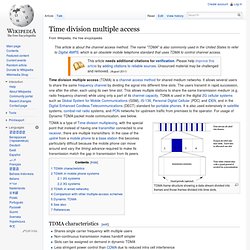
The name "TDMA" is also commonly used in the United States to refer to Digital AMPS, which is an obsolete mobile telephone standard that uses TDMA to control channel access. Time division multiple access (TDMA) is a channel access method for shared medium networks. It allows several users to share the same frequency channel by dividing the signal into different time slots. The users transmit in rapid succession, one after the other, each using its own time slot. This allows multiple stations to share the same transmission medium (e.g. radio frequency channel) while using only a part of its channel capacity. TDMA frame structure showing a data stream divided into frames and those frames divided into time slots. 3G. 3GPP. The 3rd Generation Partnership Project (3GPP) is a collaboration between groups of telecommunications associations, known as the Organizational Partners.
The initial scope of 3GPP was to make a globally applicable third-generation (3G) mobile phone system specification based on evolved Global System for Mobile Communications (GSM) specifications within the scope of the International Mobile Telecommunications-2000 project of the International Telecommunication Union (ITU). The scope was later enlarged[1] to include the development and maintenance of: the Global System for Mobile Communications (GSM) including GSM evolved radio access technologies (e.g. History[edit] The 3rd Generation Partnership Project initiative eventually arose from a strategic initiative between Nortel Networks and AT&T Wireless. Organizational Partners[edit] The six 3GPP Organizational Partners are from Asia, Europe and North America. Market Representation Partners[edit]
Enhanced Data Rates for GSM Evolution. Enhanced Data rates for GSM Evolution (EDGE) (also known as Enhanced GPRS (EGPRS), or IMT Single Carrier (IMT-SC), or Enhanced Data rates for Global Evolution) is a digital mobile phone technology that allows improved data transmission rates as a backward-compatible extension of GSM.

EDGE is considered a pre-3G radio technology and is part of ITU's 3G definition.[1] EDGE was deployed on GSM networks beginning in 2003 – initially by Cingular (now AT&T) in the United States.[2] EDGE is standardized also by 3GPP as part of the GSM family. A variant, so called Compact-EDGE, was developed for use in a portion of Digital AMPS network spectrum.[3] Through the introduction of sophisticated methods of coding and transmitting data, EDGE delivers higher bit-rates per radio channel, resulting in a threefold increase in capacity and performance compared with an ordinary GSM/GPRS connection.
EDGE can be used for any packet switched application, such as an Internet connection. Service Manual free download,schematics,datasheets,eeprom bins,pcb,repair info for test equipment and electronics.