
Alaska-St. Elias Range tundra. The Alaska-St.

Elias Range tundra is an ecoregion of northwestern North America. Setting[edit] Landforms of the Tundra. Plant cover, rocks and bodies of water retard natural thawing and freezing patterns of the ground.

The ground is abnormally pushed and pulled, producing tiny hills, valleys, slopes and porous regions. Frost mounds exist extensively on open terrain and consist of 10 to 15 feet ice cores covered by soil or peat that do not penetrate permafrost. Permafrost - What Is Permafrost. Permafrost is any soil or rock that remains frozen—below 32°F—throughout the year.

For a soil to be considered permafrost, it must be frozen for at least two consecutive years or longer. Permafrost can be found in cold climates where the mean annual temperature is less than the freezing point of water. Such climates are found near the North and South poles and in some alpine regions.
Some soils in areas that experience warmer temperatures thaw for a short time during warmer months. What Is A Biome? - Science - Questions & Answers. A biome is a large geographical area characterized by certain types of plants and animals.

A biome is defined by the complex interactions of plants and animals with the climate, geology (rock formations), soil types, water resources, and latitude (position north or south on the globe) of an area. One example of a biome is a desert. Deserts are the world's driest regions. Most of the vegetation there takes the form of drought-resistant plants such as cacti (plural form of cactus), which store water in their stems and have waxy coverings, and scrubby plants like the creosote bush, that have extensive root systems.
The animals that live in the desert are able to survive with little or no water. Other examples of important biomes include tundra (bitterly cold regions with little plant growth), coniferous (evergreen) forests, deciduous (trees that usually lose their leaves in the fall) forests, grasslands, and tropical rain forests. Sources: Engelbert, Phillis. Tundra biome. Tundra Landforms Pictures. Click here to show (or hide) search and display options [ For a large image and details: click on photo to stay in current window, click on photo ID to open new window.]

There are 40 pictures on this page out of 172 pictures of Tundra Landforms, available as stock photos and fine art prints. Extreme Climates. World Biomes - Tundra. The Tundra Biome. The Tundra Biome In the tundra, conditions are cold, with an annual average temperature less than 5 C, and precipitation (mostly in the form of snow) less than 100 mm per year (see figure at right).

The summer is brief, with temperatures above freezing lasting for only a few weeks at most. However, this "warm" summer coincides with periods of almost 24 hour daylight, so plant growth can be explosive. KDE Santa Barbara. Location | Weather | Plants | Animals | People | Games | Links LOCATION: The tundra biome is the coldest of all biomes.
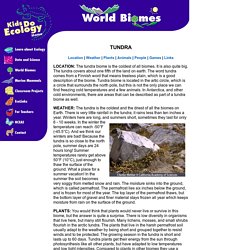
It is also quite big. The tundra covers about one fifth of the land on earth. The word tundra comes from a Finnish word that means treeless plain, which is a good description of the biome. Tundra biome is located in the artic circle, which is a circle that surrounds the north pole, but this is not the only place we can find freezing cold temperatures and a few animals. WEATHER: The tundra is the coldest and the driest of all the biomes on Earth. For only 6 - 10 weeks. PLANTS: You would think that plants would never live or survive in this biome, but the answer is quite a surprise. ANIMALS: You may think that the tundra is too chilly for animals, but guess what - it’s not. Tundra Biome FactsTundra Biome Facts. Tundra Biome. Tundra. In physical geography, tundra is type of biome where the tree growth is hindered by low temperatures and short growing seasons.

The term tundra comes through Russian тундра from the Kildin Sami word tūndâr "uplands", "treeless mountain tract".[1] There are three types of tundra: arctic tundra,[2] alpine tundra,[2] and Antarctic tundra.[3] In tundra, the vegetation is composed of dwarf shrubs, sedges and grasses, mosses, and lichens. Scattered trees grow in some tundra regions. The ecotone (or ecological boundary region) between the tundra and the forest is known as the tree line or timberline. Arctic Tundra tends to be windy, with winds often blowing upwards of 50–100 km/h (30–60 mph). The biodiversity of tundra is low: 1,700 species of vascular plants and only 48 species of land mammals can be found, although millions of birds migrate there each year for the marshes.[5] There are also a few fish species.
Relationship with global warming Antarctic Alpine. Tundra Plants. Tundra Animals. The tundra biome. Online exhibits : The world's biomes The tundra biome Tundra is the coldest of all the biomes.
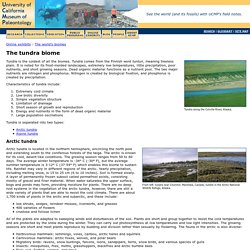
Tundra comes from the Finnish word tunturi, meaning treeless plain. It is noted for its frost-molded landscapes, extremely low temperatures, little precipitation, poor nutrients, and short growing seasons. Dead organic material functions as a nutrient pool. Tundra. Taiga Biome. The taiga biome is one that has very long and cold winters.
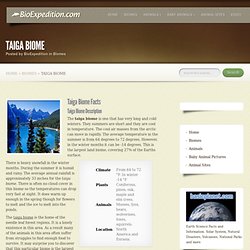
They summers are short and they are cool in temperature. The cool air masses from the arctic can move in rapidly. The average temperature in the summer is from 64 degrees to 72 degrees. However, in the winter months it can be -14 degrees. Tundra Biome.