
Wheel of the Year. The Wheel of the Year is an annual cycle of seasonal festivals, observed by many modern Pagans, consisting of the year's chief solar events (solstices and equinoxes) and the midpoints between them.
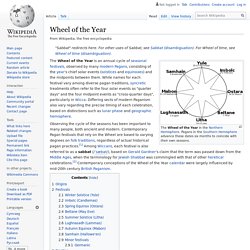
While names for each festival vary among diverse pagan traditions, syncretic treatments often refer to the four solar events as "quarter days" and the four midpoint events as "cross-quarter days", particularly in Wicca. Differing sects of modern Paganism also vary regarding the precise timing of each celebration, based on distinctions such as lunar phase and geographic hemisphere. Origins[edit]
Witches Glamour - Halloween Fashion from 1900 to 1960. Visiting Seattle - Seattle.gov. New!
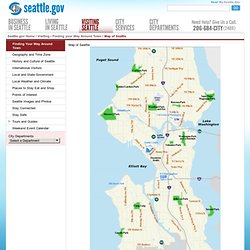
My.Seattle.Gov Seattle.gov Home / Visiting / Finding your Way Around Town / Map of Seattle City Departments. SeattleDowntown. Witchcraft. The belief in and the practice of magic has been present since the earliest human cultures and continues to have an important religious and medicinal role in many cultures today.[1] "Magic is central not only in 'primitive' societies but in 'high cultural' societies as well...
"[2] The concept of witchcraft as harmful is often treated as a cultural ideology providing a scapegoat for human misfortune.[3][4] This was particularly the case in the early modern period of Europe where witchcraft came to be seen as part of a vast diabolical conspiracy of individuals in league with the Devil undermining Christianity, eventually leading to large-scale witch-hunts, especially in Protestant Europe. Etymology[edit] From the Old English wiccecræft, compound of "wicce" ("witch") and "cræft" ("craft").[7] Definitions[edit] As in anthropology, European witchcraft is seen by historians as an ideology for explaining misfortune; however, this ideology manifested in diverse ways. Demonology[edit] Elizabethan Witchcraft and Witches. Elizabethan Superstitions Who were the people accused of being Elizabethan Witches?
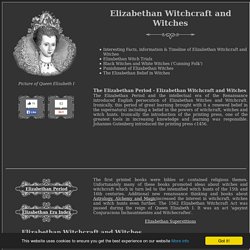
Women were those most often accused of being witches. There were 270 Elizabethan witch trials of 247 were women and only 23 were men. Those accused of witchcraft were generally: OldPoorUnprotectedSingle women or widows (many kept pets for company - their 'familiars') Witchcraft In Elizabethan England. Up until the Renaissance, the knowledge of “Wise Women” was not only accepted, but sought out.
These women were seen as an invaluable part of the community. Their knowledge of herbs and plants allowed them to be the medical professionals of their time. This knowledge was passed from generation to generation, mother to daughter, or sometimes to an apprentice. There were no medical texts, it was all taught by oral tradition, and practical experience. This was true Witchcraft in Elizabethan England. These ‘White’ Witches were set apart from the ‘Black’ Witches who were said to consort with, and get their abilities from the Devil. Access to doctors and medicines was minimal. Before the Renaissance period, towns and cities were small. The reawakening of technology, such as the heavy plow, that helped start the Renaissance, also allowed fewer people to do more work.
This caused a shift from living mostly in the country, to living in towns or cities. The Alchemist's Garden. Today I got to work on the illustrations for my herbal witchcraft book.
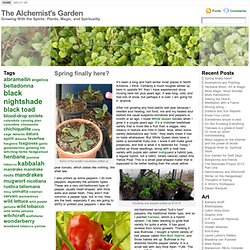
Does it ever feel great! The first chapter is on poppy, so I started there. I did sketches of a bud, a pod, a seedling, and a flower. I’m going to start the paintings based on them tomorrow and do some more sketches in the meanwhile. For reference, I used photos I took of my own Elka poppies that I grew year before last. On an art forum I’m a member of, trolls asserted that the reason why artists paint abstract art is because they can’t draw–and pretty much the same goes for people who even just LIKE abstract art, which I do. Today I ordered this book on fantasy illustration in watercolor. The Alchemist's Garden. Essential Oils: Descriptions, Profiles & Uses.
Essential Oil Directory a • b • c • e • f • g • h • j • l • m • n • o • p • r • s • t • v • w • y Allspice Berry - The oil has a warm, spicy-sweet aroma.
It is used in spicy or masculine scents. It combines well with orange, ginger, patchouli and all of the spice oils including cinnamon, cassia and clove. Aromatherapy benefits: warming, cheering, comforting, nurturing. Amyris - Amyris is also known as West Indian sandalwood, although unrelated to the true Indian sandalwood. Anise - The oil of anise and star anise are often used and sold interchangeably because they are similar in aroma and chemical make-up. he primary constituent of both is anethole, a sweet substance that solidifies at room temperature. Basil, Sweet – There are many types of basil: linalool basil, exotic basil and sweet basil.
Bay — Bay oil is distilled from the leaves and small twigs of the bay rum tree. Bergamot — Bergamot oil is cold-pressed from the peel of the nearly ripe fruit. Back to top. Vetiver Essential Oil - Health Benefits of Vetiver Oil.