
Dutch Rainmaker. Groasis, let's green the world! A solution to reverse Africa's growing deserts. I've often said that the most sophisticated "green" technology on the planet is the humble tree.
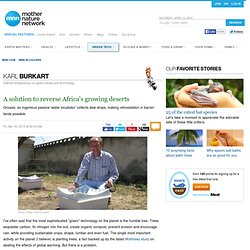
Trees sequester carbon, fix nitrogen into the soil, create organic compost, prevent erosion and encourage rain, while providing sustainable crops, shape, lumber and even fuel. The single most important activity on the planet (I believe) is planting trees, a fact backed up by the latest McKinsey study on abating the effects of global warming. But there is a problem. Reforestation efforts in denuded lands such as Africa, Mexico, India and China have never been taken seriously as a means to abate climate change because young saplings are very difficult to establish. They take a lot of water and require regular maintenance — two things that are in scarce supply in precisely the regions where they are needed most.
Watered by the Sun. If you’re like most Americans, you spend about 12 percent of your annual income each year in grocery stores and restaurants.

It may sound like a lot, but now imagine shelling out 50 to 80 percent of your hard-earned cash each year just on food and drink. That’s commonplace in sub-Saharan Africa, where per capita income is much, much lower than just about anywhere else on Earth, and a huge chunk of it is spent on staple nourishment. Lessening the food-related financial burden that many Africans bear is a multi-layered problem—spanning global trade, market access, and gender politics, to name a few. But given that most sub-Saharan communities rely on rain-fed agriculture, and given that it only rains between three and six months out of the year in that part of the world, better irrigation is emerging as a simple method for combating poverty and malnutrition.
Irrigation schemes come in many flavors, of course.