
Untitled. Keeping Up Kids’ Immunity Naturally. Image by Vince Alongi By Dr.

Tyson, Contributing Writer It”s that time again…Back to School. This is the time of year when children tend to get sick more often, which can be a real drag for both the child and the parents. If you listen to the conventional advice of your pediatrician or TV doctor, you will probably be told to make sure that your kids wash their hands frequently & are up to date on their vaccinations, as if that were the best or only way to prevent sickness. Diet Of primary importance is your child”s diet. Exercise Unfortunately, too many microgaming casinos of today”s youth spend way too much time in front of their TVs, computer screens, or smart phones and not enough time in the great outdoors. Stress & Sleep Never minimize the importance of sleep & stress on a child”s immune function.
Nervous System As a chiropractor, I know that the most overlooked aspect of immunity is the function of the nervous system. Remember, it”s okay for kids to get sick once in a while. Vitamin D Therapy - a natural, holistic, nutrition therapy to replace the flu shot. Vitamin D Therapy Instructions Vitamin D Therapy Protocol I Recommend this protocol as a safe alternative to the flu vaccination.

It also works very well for those with active viral and bacterial infections. You can use this protocol at the first sign of the flu or as a prophylactic natural flu shot. If using in this way, I recommend taking your first regimen the first week of school followed by a second regimen in mid December. This therapy has been used for years by doctors in Europe for many years and is very safe. I recommend using 50,000 IU dose capsules. Dosage instructions: For adults that weigh 150 pounds or more Take 150,000 IU per day for three days. 150,000 IU/day for 3 days followed by… 100,000 IU/day for 3 days followed… Discontinue. For Adults under 150 pounds and for Children Start with 1,000 IU of vitamin D per pound of body weight for three days.
For Infants (0-1 year of age) Infants should not need to supplement with vitamin D provided they are being breast fed. New Study: Vitamin D is Better than Vaccines at Preventing Flu. The Times of London recently published an article covering the effects of Vitamin D in children as a flu preventative [1].

While it may not be a huge surprise to those of you who regularly frequent this blog, to much of the medical scientific community, it is. Researchers at Japan’s Jikei University School of Medicine in Tokyo conducted the double blind, fully randomized study during the 2008-2009 winter season [2]. All said, 354 children whom participated in the study were administered 1200 IUs of either vitamin D or placebo for a 3-month period. By the second month of the test, the research team began to notice some initial changes in the experimental group as compared to the control sample. Even though the original write-up found in the Times does a great job of summarizing the overall findings of the study, here is the official conclusion from the researchers: Conclusion of the study, as published in the American Journal of Clinical Nutrition: Flu Vaccines vs.
. - Dr. References: Vitamin D proven far better than vaccines at preventing influenza infections. Echinacea – A “Must Have” Medicinal Herb. You probably recognize this wonderful herb as a beautiful and popular garden flower.
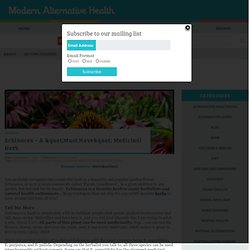
Echinacea, or as it is more commonly called ‘Purple Coneflower’, is a great addition to any garden, but not just for its beauty. Echinacea is a favorite herb to many herbalists and natural health enthusiasts… Keep reading to find out why it’s one of MY favorite herbs to have around this time of year! Tell Me More Echinacea is hard to misidentify with its brilliant purple-pink petals, peaked brown center and tall, fuzzy stems. Butterflies and bees love it, and you will too! There are several species of medicinal Echinacea with the most common being E. angustifolia, E. purpurea, and E. pallida. What Is Echinacea Used For? “I keep hearing that Echinacea is good for me and my family. Echinacea is one of the best herbs for the upcoming “cold and flu” seasons! Echinacea is also an excellent antibacterial, anti-fungal, antiviral and anti-inflammatory!