
Introduction to Databases - Stanford University. Thomas Neumann: D5: Databases and Information Systems (Max-Planck-Institut für Informatik) Orient - NoSQL document database light, portable and fast. Supports ACID Tx, Indexes, asynch queries, SQL layer, clustering, etc. Orient Technologies - Open source solutions built around the Orient DB.
Neo4j open source nosql graph database. Object-Oriented Database (OODBMS) Entity-relationship model. An entity–relationship diagram using Chen's notation In software engineering, an entity–relationship model (ER model) is a data model for describing the data or information aspects of a business domain or its process requirements, in an abstract way that lends itself to ultimately being implemented in a database such as a relational database.
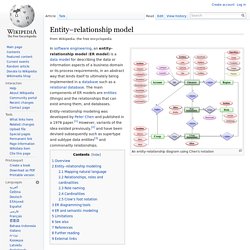
The main components of ER models are entities (things) and the relationships that can exist among them, and databases. Entity–relationship modeling was developed by Peter Chen and published in a 1976 paper.[1] However, variants of the idea existed previously,[2] and have been devised subsequently such as supertype and subtype data entities[3] and commonality relationships. Overview[edit] An entity–relationship model is a systematic way of describing and defining a business process. An ER model is typically implemented as a database. The three schema approach to software engineering uses three levels of ER models that may be developed. Role naming[edit] The Apache Cassandra Project. YAGO-NAGA - D5: Databases and Information Systems (Max-Planck-Institut für Informatik)
Overview YAGO is a huge semantic knowledge base, derived from Wikipedia WordNet and GeoNames.
Currently, YAGO has knowledge of more than 10 million entities (like persons, organizations, cities, etc.) and contains more than 120 million facts about these entities. YAGO is special in several ways: The accuracy of YAGO has been manually evaluated, proving a confirmed accuracy of 95%. Every relation is annotated with its confidence value.YAGO combines the clean taxonomy of WordNet with the richness of the Wikipedia category system, assigning the entities to more than 350,000 classes.YAGO is an ontology that is anchored in time and space. YAGO is developed jointly with the DBWeb group at Télécom ParisTech University.
Unified Modeling Language. The Unified Modeling Language (UML) is a general-purpose modeling language in the field of software engineering, which is designed to provide a standard way to visualize the design of a system.[1] It was created and developed by Grady Booch, Ivar Jacobson and James Rumbaugh at Rational Software during 1994–95 with further development led by them through 1996.[1] In 1997 it was adopted as a standard by the Object Management Group (OMG), and has been managed by this organization ever since.
In 2000 the Unified Modeling Language was also accepted by the International Organization for Standardization (ISO) as an approved ISO standard. Since then it has been periodically revised to cover the latest revision of UML.[2] MongoDB. Graph-database.org. Jeremy Zawodny's blog. I found myself reading NoSQL is a Premature Optimization a few minutes ago and threw up in my mouth a little.

That article is so far off base that I’m not even sure where to start, so I guess I’ll go in order. In fact, I would argue that starting with NoSQL because you think you might someday have enough traffic and scale to warrant it is a premature optimization, and as such, should be avoided by smaller and even medium sized organizations. You will have plenty of time to switch to NoSQL as and if it becomes helpful. Until that time, NoSQL is an expensive distraction you don’t need. Uhm… WHAT?! I’ve spent more than a few years using MySQL and have been using some NoSQL systems for the last year or so in a fairly busy environment.
NoSQL exists for a reason–because they ARE useful to a lot of people. And to make switching data stores sound like something that “you will have plenty of time for” is outright nuts. Gee, let me get this straight. Database Models: Hierarcical, Network, Relational, Object-Oriented, Semistructured, Associative and Context. The context data model combines features of all the above models.
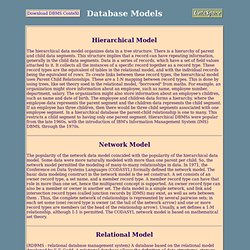
It can be considered as a collection of object-oriented, network and semistructured models or as some kind of object database. In other words this is a flexible model, you can use any type of database structure depending on task. Such data model has been implemented in DBMS ConteXt. The fundamental unit of information storage of ConteXt is a CLASS. Class contains METHODS and describes OBJECT. Types of Fields A context model comprises three main data types: REGULAR, VIRTUAL and REFERENCE. Like a NETWORK database, apart from the fields containing the information directly, context database has fields storing a place where this information can be found, i.e. In contrast to pure object-oriented databases, context databases is not so coupled to the programming language and doesn't support methods directly. Home - GitHub.
Associative model of data. The associative model of data is an alternative data model for database systems.
Other data models, such as the relational model and the object data model, are record-based.