
Character development questionnaire. One of the first things you need to do in fiction online creative writing is to develop a character that the readers will care about. Well-written character will hook a reader and create a lasting impression. Sometimes a great character is even more important than the story itself. When you have an idea about the story you want to tell, you need to develop characters that will carry the story and make it interesting. You need to devote the most attention to your main character and create a multidimensional persona that will convince the readers and attract their attention.
List of Hobbies and Interests. There is something really unusual about hobbies and interests.

They vary from person to person distinguishing one personality from the other. They also bring different people together, taking the mind off the monotony that sets in with the daily routine. The best thing that can happen to you is to be able to live your hobby everyday, making a living out of doing what gives you a sense of pleasure and satisfaction. Did you know that there are so many millionaires in this world, who would never have achieved what they did, if there field of success was not their hobby! Let's take an example of an application that was created as a hobby, and is now a part of everyone's life - Facebook. The Massive List of Hobbies. This is the biggest list of hobbies that exists!

The goal of this list is to help you find a hobby that you might like to try or explore. A hobby can be something that enriches your life. Take your time and look through the list to see what kinds of hobbies might be appealing to you. The list is also cross-referenced in several unique ways that will help you search by new ways rather than just category. What is a hobby? The Internet and Hobbies - One of the greatest things about the internet is how readily it helps newcomers in a new pursuit. <a href=" Widgets</a> My Website - StormTheCastle.com has a whole lot of articles, tutorials, videos and information about many of these hobbies.
Custom Search. Funny hobbies and interests. Character Background Ideas. The following are a series of questions to try to help prompt players when they are writing character backgrounds.

None of these questions represent required info, I just find such a list helpful to anyone writing a character's history. Some of these questions are partially redundant. Others will be influenced greatly by the campaign world. — e.g. 100 Free Fictional Character Ideas. Characterization: 50 Random Character Quirk Ideas - A Book Comes to Life. Your Plot, Step by Step. By Melanie Anne Phillipscreator StoryWeaver, co-creator Dramatica Here are some general guidelines to help you structure your story's plot, step by step.

Act One Beginning The beginning of act one is the teaser. It may or may not have anything to do with the actual plot of the story. This is where you get the feel of the story and the feel of the main character. Act One Middle. Rising Tension in Character Relationships. Character relationships should come under strain over the course of your novel or screenplay so that tension in the relationship rises.

To accomplish this, you need to create dramatic moments in which outside pressures put each relationship in an increasing vice-grip. Conversely, overemphasizing tension might be detrimental, especially in particular genres. For example, in light comedy, action stories, and so on, relationship issues are not likely to be all that crucial or central. Nonetheless, relationship stress should still rise, just not to the same depth and degree.
In short, keep an eye toward the overall mood you want for your story, and within that scope, bring tension to its maximum by the end of the third act. Characters' Changing Emotional Relationships. Perhaps the most complex relationships among characters are the emotional ones because they can grow to any degree in any direction AND because both characters don't have to feel the same way about each other!

For example, how many stories are written about "unrequited love" where one character is infatuated with the other, but the other is repulsed by them, yet in the end both may love each other, both hate each other, or they may have swapped positions, emotionally. Another example is the younger brother who tags along with the older brother. To the younger, the older brother is his hero. To the older, the younger brother is a pest. Now, suppose the younger brother is attacked by a bully.
Introducing Characters - First Impressions. Character Relationships Baselines. Relationships begin with a "baseline" and then evolve.

You will need to establish how your characters feel about one another at the beginning of your story. Later, in as things unfold, you'll describe the growth of these emotional relationships over the course of the story. Both characters need not be present to establish a relationship between them. You might your readers a look at one character's room where he keeps a score of framed pictures of the second character, his female co-worker, in a little shrine.
Then, you describe the second character's room where there is but a single picture of the first character which has been made into a dart board. Building believeble relationships between characters in fiction. Conflict between your characters is the essence of every romance story.

It drives the story forward and characters apart. Although it doesn't stop your hero and heroine from failing in love with each other, it stops them from falling into each other's arms in Chapter one. Conflict comes from your characters' character. It's about what they care about, strive for, what they're scared of. What is at stake in the conflict, as Kate Walker in her '12 point guide to writing romance' writes, has to be important enough for your characters to be worth arguing over and even taking the risk to lose the love of their life.
Happily ever after is as much the essence of romantic fiction as conflict. So how can we build a relationship that will last, at least on paper? Scene - Checklist. Beginner writers tend to write essays when they first start writing novels.
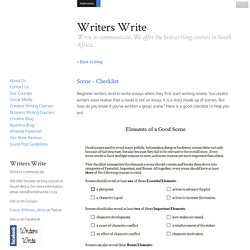
Successful writers soon realise that a novel is not an essay. It is a story made up of scenes. But how do you know if you've written a great scene? Here is a good checklist to help you out. 10 Days of Character Building: Character Bio Sheets. Character bio sheets are not only a simple way to create characters, they are a great way to keep track of the characters you develop.
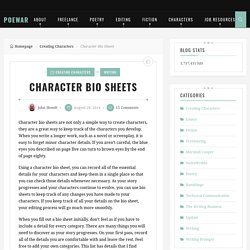
When you write a longer work, such as a novel or screenplay, it is easy to forget minor character details. If you aren’t careful, the blue eyes you described on page five can turn to brown eyes by the end of page eighty. 10 Days of Character Building: Brainstorming. 10 Days of Character Building: Basing Characters on Real People. See Also: Defining Characters By Their Roles Basing characters on actual people is a fairly common literary practice. 10 Days of Character Building: Building a Character Using Multiple Perspectives. See Also: Basing Characters on Real People This character building idea turns the concept of the interview around. Instead of interviewing a character about themselves, you interview the other characters in your story about one particular character. This gives you a profile of the character as seen by other people. It can also help you set up potential conflicts and plot points by revealing hidden bonds and tensions between characters.
A character might consider herself to be insightful, brave and authoritative, while that character’s sister might view her as bossy, opinionated and unreliable. 10 Days of Character Building: 12 Questions. 10 Days of Character Building: Defining Characters By Their Roles. 10 Days of Character Building: A Day in the Life. 10 Days of Character Building: Possessions. 10 Days of Character Building: Interview. 10 Days of Character Building: Biography. Writing.