
Swords and Sorcery Magazine - Home. Leigh Brackett. Life[edit] Leigh Brackett was born December 7, 1915 in Los Angeles, California and grew up there.

On December 31, 1946, at age 31, she married Edmond Hamilton in San Gabriel, California, and moved with him to Kinsman, Ohio. She died of cancer in 1978 in Lancaster, California.[1] Career[edit] Author[edit] Brackett was first published in her mid-twenties. Leigh Brackett (ology) Glen Cook. Glen Cook (born July 9, 1944) is a contemporary American science fiction and fantasy author, best known for his fantasy series, The Black Company.

Cook currently resides in St. Louis, Missouri. Biography[edit] Glen Cook's love of writing began in grade school, and in high school he wrote the occasional article for his school's newspaper. After high school, Cook spent time in the United States Navy and later worked his way through college, leaving little time for his writing endeavors. The Black Company. Cover of the first novel in the series, "The Black Company".

Ambrose & Elsewhere. Saladin Ahmed's website. Throne of the Crescent Moon (Crescent Moon Kingdoms): Saladin Ahmed: 9780756407780: Amazon.com. Jack Vance. Dying Earth. Dying Earth is a fantasy series by the American author Jack Vance, comprising four books originally published 1950 to 1984.[2] Some have been called picaresque.

They vary from short story collection to fix-up (novel created from older short stories) perhaps all the way to novel.[2] Setting[edit] The stories of the Dying Earth series are set in the distant future, at a point when the sun is almost exhausted and magic has reasserted itself as a dominant force. The Moon has disappeared and the Sun is in danger of burning out at any time, often flickering as if about to go out, before shining again. The various civilizations of Earth have collapsed for the most part into decadence and its inhabitants overcome with a fatalistic outlook. Origins[edit] Vance wrote the stories while he served in the United States Merchant Marine during World War II.
Series[edit] The series comprises four books by Vance and some sequels by other authors that may be or may have been canonical. Michael Moorcock. Michael John Moorcock (born 18 December 1939) is an English writer, primarily of science fiction and fantasy, who has also published literary novels.

Moorcock's Miscellany. Elric of Melniboné. Elric of Melniboné[1] is a fictional character created by Michael Moorcock, and the antihero of a series of sword and sorcery stories centring in an alternate Earth.

The proper name and title of the character is Elric VIII, 428th Emperor of Melniboné. Later novels by Moorcock mark Elric as a facet of the Eternal Champion. Elric first appeared in print in Moorcock's novella, "The Dreaming City" (Science Fantasy No. 47, June 1961); subsequent novellas were reformatted as the novel Stormbringer (1965), but his first appearance in an original novel wasn't until 1973 in Elric of Melniboné. The Elric Saga. The story of Elric, the last emperor of Melniboné, ruler of the dreaming city and keeper of the ruby throne, brings together many images of life and death, fate versus free will, generations of tradition and the destruction of that tradition, thought versus action, evil versus good , law versus chaos, and the difficulties faced when trying to reconcile and make meaning out of one's own existence.

It is also a vehicle for Michael Moorcock to expound on yet another incarnation of "The Eternal Champion", a theme that runs throughout many of his fantasy novels. On this page I hope to give a brief overview and opinion of this tragic, yet action packed series. It is certainly one of the best offerings from Michael Moorcock, and changed my views on good fantasy forever. Having discovered the Elric Saga back in 1980 it introduced me to the new idea of an anti-hero and showed me that everything does not have to turn out "OK" in every book that I read. Cymoril: Elric's cousin and consort. Dorian Hawkmoon. Dorian Hawkmoon, Duke of Köln is one of the fictional characters created by Michael Moorcock in his series of the Eternal Champion books.

Overview[edit] Dorian Hawkmoon is one of the less "problematic" characters Moorcock ever created a series around. Unlike the anti-hero Elric of Melniboné, or the alienated and tragic Corum, or the sometimes savage Erekosë, Hawkmoon is described as being very much close to an all-around "good guy", despite lacking some subtlety (or perhaps, for this very reason).[1] Hawkmoon is captured by the evil forces of Granbretan who implant by means of arcane technology (devised by a caste of 'sorcerer-scientists') a sinister black jewel in his skull.
He is sent to The Kamarg (a future version of the southern French region of Camargue) to perform reconnaissance prior to invasion. Eternal Champion. The Eternal Champion is a fictional creation of the author Michael Moorcock and is a recurrent feature in many of his novels.

About the Eternal Champion[edit] The fictional Multiverse, which consists of several universes, many layered dimensions, spheres, and alternative worlds, is the place where the eternal struggle between Law and Chaos, the two main forces of Moorcock's worlds, takes place. In all these dimensions and worlds, these forces constantly war for supremacy.
Fritz Leiber. Fafhrd and the Gray Mouser. Swords and Deviltry, the first short story collection exclusively featuring Fafhrd and the Gray Mouser.
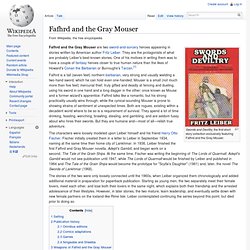
Fafhrd and the Gray Mouser are two sword-and-sorcery heroes appearing in stories written by American author Fritz Leiber. They are the protagonists of what are probably Leiber's best-known stories. One of his motives in writing them was to have a couple of fantasy heroes closer to true human nature than the likes of Howard's Conan the Barbarian or Burroughs's Tarzan.[1] Fafhrd is a tall (seven feet) northern barbarian, very strong and usually wielding a two-hand sword, which he can hold even one-handed; Mouser is a small (not much more than five feet) mercurial thief, truly gifted and deadly at fencing and dueling, using his sword in one hand and a long dagger in the other; once known as Mouse and a former wizard's apprentice.
The characters were loosely modeled upon Leiber himself and his friend Harry Otto Fischer. The Scrolls of Lankhmar: Fritz Leiber Wiki and Message Board. Welcome to the Scrolls of Lankhmar. This is a community project to do two things. Create and provide a wiki about Fritz Leiber and his writings, and to finish the RPG Guide to Nehwon which is a knowledge base for all role-players playing or running a Nehwon-based role-playing game.
Add your knowledge! Have you read any Fritz Leiber stories? Fritz Leiber. Robert E. Howard. Robert Ervin Howard (January 22, 1906 – June 11, 1936) was an American author who wrote pulp fiction in a diverse range of genres. The Works of Robert E. Howard. Pigeons from Hell - Robert E. Howard. This document was prepared with borrowed Blackmask Online etext for Arthur's Classic Novels. XHTML markup by Arthur Wendover. Feb 10, 2005. EText courtesy mikronous. (See source text for details.) Conan the Barbarian. Publication history[edit] Having digested these prior influences after he returned from his trip, Howard rewrote the rejected story "By This Axe I Rule!
" (May 1929), replacing his existing character Kull of Atlantis with his new hero, and retitling it "The Phoenix on the Sword". Howard also wrote "The Frost-Giant's Daughter", inspired by the Greek myth of Daphne,[citation needed] and submitted both stories to Weird Tales magazine. Red Nails by Robert E. Howard. Conan the Barbarian (1982. Conan the Destroyer (1984. Conan the Barbarian (2011. Kull of Atlantis. Kull of Atlantis or Kull the Conqueror is a fictional character created by American writer Robert E.
Howard, also creator of Conan the Barbarian, Solomon Kane, and Bran Mak Morn. Kull the Conqueror (1997. Solomon Kane. Solomon Kane is a fictional character created by the pulp-era writer Robert E. Howard. A late 16th/early 17th century Puritan, Solomon Kane is a somber-looking man who wanders the world with no apparent goal other than to vanquish evil in all its forms. Charles Saunders Writer. Imaro (novel) Imaro is a sword and sorcery novel written by Charles R. Sword and Sorcery. This term – describing a subgenre of Fantasy embracing adventures with swordplay and Magic – is usually attributed to Fritz Leiber, who is said to have coined it in 1960 in response to Michael Moorcock's request for such a capsule description; but the kind of story it refers to is much older than that. Black Gate. Swords & Dark Magic: The New Sword and Sorcery: Jonathan Strahan, Lou Anders.
The Sword & Sorcery Anthology: Robert E. Howard, C. L. Moore, Fritz Leiber, Poul Anderson, Michael Moorcock, Joanna Russ, Charles R. Saunders, Karl Edward Wagner, Ramsey Campbell, David G. Hartwell, Jacob Weisman: 9781616960698: Amazon.com. Beneath Ceaseless Skies - Literary Adventure Fantasy. Heroic Fantasy Quarterly - Prose. Poetry. Pulp. Swords and Sorcery Magazine - Home.