
The Official Site of Chuck Berry. Rock and Blues. Tom Waits. Bonnie Raitt. Billie Holiday: The Official Site of Lady Day. A Short History of the Blues. The Dockery Plantation contributed extensively to the develpment of the blues in Mississipppi.
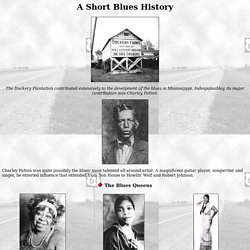
Indesputeabley, its major contribution was Charley Patton. Charley Patton was quite possibily the blues' most talented all-around artist. A magnificent guitar player, songwriter and singer, he exterted influence that extended from Son House to Howlin' Wolf and Robert Johnson. A History Of Blues Pt1. Origins of the blues. Little is known about the exact origin of the music now known as the blues.[1] No specific year can be cited as the origin of the blues, largely because the style evolved over a long period and existed in approaching its modern form before the term blues was introduced, before the style was thoroughly documented.
Ethnomusicologist Gerhard Kubik traces the roots of many of the elements that were to develop into the blues back to the African continent, the "cradle of the blues".[2] One important early mention of something closely resembling the blues comes from 1901, when an archaeologist in Mississippi described the songs of black workers which had lyrical themes and technical elements in common with the blues.[3] African roots[edit]