
Ymir. In the Prose Edda, a narrative is provided that draws from, adds to, and differs from the accounts in the Poetic Edda.

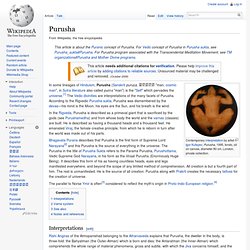
According to the Prose Edda, after Ymir was formed from the elemental drops, so too was Auðumbla, a primeval cow, whose milk Ymir fed from. The Prose Edda states that three gods killed Ymir; the brothers Odin, Vili, and Vé, and details that, upon Ymir's death, his blood caused an immense flood. Scholars have debated as to what extent Snorri's account of Ymir is an attempt to synthesize a coherent narrative for the purpose of the Prose Edda and to what extent Snorri drew from traditional material outside of the corpus that he cites. By way of historical linguistics and comparative mythology, scholars have linked Ymir to Tuisto, the Proto-Germanic being attested by Tacitus in his 1st century AD work Germania and have identified Ymir as an echo of a primordial being reconstructed in Proto-Indo-European mythology. Purusha. Contemporary interpretation by artist Igor Kufayev, Purusha, 1995, tondo, oil on canvas, diameter 80 cm, London, private collection.
Bhagavata Purana describes that Purusha is the first form of Supreme Lord Narayana[2] and this Purusha is the source of everything in the universe. The Purusha in the title of Purusha Sukta refers to the Parama Purusha, Purushottama, Vedic Supreme God Narayana, in his form as the Viraat Purusha (Enormously Huge Being). It describes this form of his as having countless heads, eyes and legs manifested everywhere, and beyond the scope of any limited method of comprehension. All creation is but a fourth part of him. The rest is unmanifested. The parallel to Norse Ymir is often[3] considered to reflect the myth's origin in Proto-Indo-European religion.[4] Interpretations[edit] The Vedanta Sutras state janmādy asya yatah, meaning that 'The Absolute Truth is that from which everything else emanates' Bhagavata Purana [S.1.1.1].
Varna system[edit] See also[edit] Pangu. Pangu (simplified Chinese: 盘古; traditional Chinese: 盤古; pinyin: Pángǔ; Wade–Giles: P'an ku; literally "Plate Ancient") was the first living being and the creator of all in some versions of Chinese mythology.
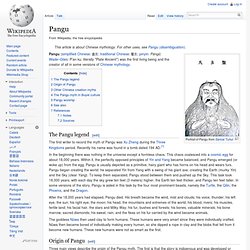
The Pangu legend[edit] In the beginning there was nothing in the universe except a formless chaos. This chaos coalesced into a cosmic egg for about 18,000 years. Within it, the perfectly opposed principles of Yin and Yang became balanced, and Pangu emerged (or woke up) from the egg. Pangu is usually depicted as a primitive, hairy giant who has horns on his head and wears furs. After the 18,000 years had elapsed, Pangu died. The goddess Nüwa then used clay to form humans. Origin of Pangu[edit] Derk Bodde linked the myth to the ancestral mythologies of the Miao people and Yao people in southern China.[2] An indirect but possibly more substantive conclusion is that China is unique in not "creating" its creator. Paul Carus writes this: Other Chinese creation myths[edit] Hainuwele. Hainuwele defecating valuable objects Coconut flower Hainuwele, 'The Coconut Girl', is a figure from the Wemale and Alune folklore of the island of Seram in the Maluku Islands, Indonesia.

Her story is an origin myth.[1] The myth of Hainuwele was recorded by German ethnologist Adolf E. Jensen following the Frobenius Institute's 1937–8 expedition to the Maluku Islands.[2] The study of this myth during his research on religious sacrifice led Jensen to the introduction of the concept of Dema Deity in ethnology.[3] Joseph Campbell first narrated the Hainuwele legend to an English-speaking audience in his work "The Masks of God".[4] Myth[edit] While hunting one day a man named Ameta found a coconut, something never before seen on Seram, that had been caught in the tusk of a wild boar. In the successive dances the men circled around the women at the center of the dance ground, Hainuwele amongst them, who handed out gifts. Ameta, missing Hainuwele, went in search for her. Dema deity myth[edit]