How To Electrify Your Brain To Be Smarter With a 9-Volt Battery (Updated) Electrode Positioning and Montage in Transcranial Direct Current Stimulation. Transcranial direct current stimulation (tDCS) is an established technique to modulate cortical excitability1,2.

It has been used as an investigative tool in neuroscience due to its effects on cortical plasticity, easy operation, and safe profile. One area that tDCS has been showing encouraging results is pain alleviation 3-5. Date Published: 5/23/2011, Issue 51; doi: 10.3791/2744 Keywords: Neuroscience, Issue 51, Transcranial direct current stimulation, pain, chronic pain, noninvasive brain stimulation, neuromodulation DaSilva, A. Transcranial direct current stimulation (tDCS) is a technique that has been intensively investigated in the past decade as this method offers a non-invasive and safe alternative to change cortical excitability2. 1. Check if you have all materials needed (Table 1, Figure 1). 2.
Make sure the subject is seated comfortably. 3. Inspect the skin for any pre-exiting irritation, cuts, or lesions - avoid stimulating over damaged skin and over skull lesions. NEWS FROM THE FUTURE – Transcranial direct current stimulation (tDCS) kits. NEWS FROM THE FUTURE – Transcranial direct current stimulation (tDCS) kits… via Joel. tDCS is one of the coolest pieces of health/ self improvement technology available today.
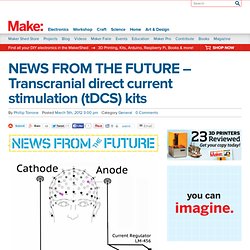
The US Army and DARPA both currently use tDCS devices to train snipers and drone pilots, and have recorded 2.5x increases in learning rates. This incredible phenomenon is achieved through a very simple device called a tDCS machine.Today if you want to buy a tDCS machine it’s nearly impossible to find one for less than $600, and you are typically required to have a prescription to order one. We wanted a simpler cheaper option. So we made one. Looks like it’s not that hard to make your own… Phillip Torrone Editor at large – Make magazine. Related. Give your brain an electric shock, learn stuff faster. In recent years, the medical community has been experimenting with what you might call targeted, direct interventions with the brain.

Things like drugs will affect any nerve cells that express the protein they interact with, but biology has identified a number of areas of the brain that are associated with specific functions or diseases, and medical researchers are starting to try to manipulate their electrical activity. Later this week, the Proceedings of the National Academies of Science will publish a paper that describes how stimulating the primary motor cortex can help people learn to perform a challenging task involving fine muscle control. There are a number of ways of performing electrical brain stimulation. Cranial stimulation. Transcranial direct current stimulation is a type of nonivasive cortical modulations technique witch use low DC current in order 25-80uA/cm2(more in HD-tdcs) via skalp electrodes to change resitng potentials of neurones.This chanages depend of polarity of stimulation = orintation od el. field to the neurones,the anodal (+) stimulation increases the neuronal excitability and Cathodal (-) neuronal excitability.When positive stimulation causes a depolarization of the resting membrane potential, which increases neuronal excitability and allows for more spontaneous cell firing.
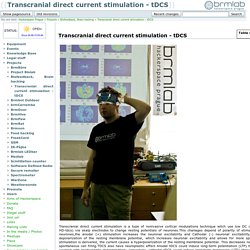
When negative stimulation is delivered, the current causes a hyperpolarization of the resting membrane potential. Safety considerations for tDCS this part only shows various factors influencing the effect in end you must consider all this factors at once with all its concetivity and dependences Stimulation current In studes you find value 1 or 2 mA but what this tell you about effect of stimulation? Anode + Cathode - Electrode placement - Tensway. Electrode placement for TENS units The electrode placement is essential to be able to get the best result out of a TENS treatment (pain relief).

The electrodes are placed over or nearby the painful area. If possible place the electrode with the black pin over the most painful area since it is the most active one. Cefar offers different sizes of electrodes. Small electrodes are preferably used on smaller muscles and large electrodes on larger muscles. The pictures shown here are for pain relief.
Tension headache Shoulder pain Elbow pain Back pain Menstrual cramps Ischias Hip pain Knee pain Neck pain Electrode placement for EMS units To receive maximum results from your stimulation, it is important to place the electrodes correctly. The pictures shown here are for muscle stimulation. Calf (back)