
30 hits of LSD!!! Spongebob-drug-chart. Meth - Methamphetamine. Methamphetamine[note 1] (pronunciation: /ˌmɛθæmˈfɛtəmiːn/; contracted from N-methyl-alpha-methylphenethylamine) is a neurotoxin and potent psychostimulant of the phenethylamine and amphetamine classes that is used to treat attention deficit hyperactivity disorder (ADHD) and obesity. Methamphetamine exists as two enantiomers, dextrorotary and levorotary.
[note 2] Dextromethamphetamine is a stronger central nervous system (CNS) stimulant than levomethamphetamine; however, both are addictive and produce the same toxicity symptoms at high doses. Although rarely prescribed due to the potential risks, methamphetamine hydrochloride is approved by the United States Food and Drug Administration (USFDA) under the trade name Desoxyn. N20 - Nitrous oxide. Nitrous oxide, commonly known as laughing gas, nitrous, nitro, or NOS[1] is a chemical compound with the formula N 2O.
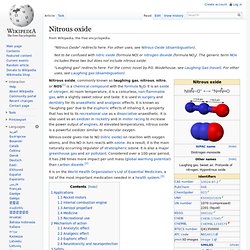
It is an oxide of nitrogen. At room temperature, it is a colourless, non-flammable gas, with a slightly sweet odour and taste. It is used in surgery and dentistry for its anaesthetic and analgesic effects. It is known as "laughing gas" due to the euphoric effects of inhaling it, a property that has led to its recreational use as a dissociative anaesthetic. It is also used as an oxidizer in rocketry and in motor racing to increase the power output of engines. Nitrous oxide gives rise to NO (nitric oxide) on reaction with oxygen atoms, and this NO in turn reacts with ozone. Mescaline. Mescaline or 3,4,5-trimethoxyphenethylamine is a naturally occurring psychedelic alkaloid of the phenethylamine class, known for its hallucinogenic effects similar to those of LSD and psilocybin.
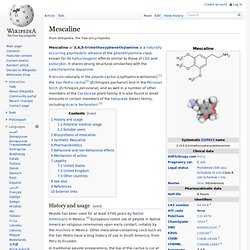
It shares strong structural similarities with the catecholamine dopamine. It occurs naturally in the peyote cactus (Lophophora williamsii),[1] the San Pedro cactus[2] (Echinopsis pachanoi) and in the Peruvian torch (Echinopsis peruviana), and as well in a number of other members of the Cactaceae plant family. It is also found in small amounts in certain members of the Fabaceae (bean) family, including Acacia berlandieri.[3] Naturally derived mescaline powder extract. Psilocin. Psilocin (also known as 4-OH-DMT, psilocine, psilocyn, or psilotsin), is a substituted tryptamine alkaloid and a serotonergic psychedelic substance.

It is present in most psychedelic mushrooms together with its phosphorylated counterpart psilocybin. Psilocin is a Schedule I drug under the Convention on Psychotropic Substances.[2] The mind-altering effects of psilocin are highly variable and subjective and resemble those of LSD and DMT. Methadone. Methadone (also known as Symoron, Dolophine, Amidone, Methadose, Physeptone, Heptadon and many other names) is a synthetic opioid.

It is used medically as an analgesic and a maintenance anti-addictive and reductive preparation for use by patients with opioid dependency. It was developed in Germany in 1937, mainly because Germany required a reliable internal source of opiates. Amphetamine & Speed. Crack - Crack cocaine. Crack cocaine ‘rocks’.

Appearance and characteristics In purer forms, crack rocks appear as off-white nuggets with jagged edges,[3] with a slightly higher density than candle wax. Purer forms of crack resemble a hard brittle plastic, in crystalline form[3] (snaps when broken). A crack rock acts as a local anesthetic (see: cocaine), numbing the tongue or mouth only where directly placed. Purer forms of crack will sink in water or melt at the edges when near a flame (crack vaporizes at 90 °C, 194 °F).[2] Crack cocaine as sold on the streets may be adulterated or "cut" with other substances mimicking the appearance of crack cocaine to increase bulk. Chemistry In order for cocaine (in plastic bag at bottom) to be converted to crack, several supplies are needed. A close up of the "cooking" process that creates crack. Sodium bicarbonate (NaHCO3, common baking soda) is a base used in preparation of crack, although other weak bases may substitute for it.
Coc-H+Cl− + NaHCO3 → Coc + H2O + CO2 + NaCl. Cocaine. Cocaine (INN) (benzoylmethylecgonine, an ecgonine derivative) is a crystalline tropane alkaloid that is obtained from the leaves of the coca plant.[5] The name comes from "coca" and the alkaloid suffix "-ine", forming "cocaine".
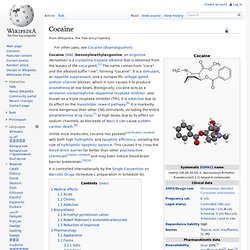
It is a stimulant, an appetite suppressant, and a nonspecific voltage gated sodium channel blocker, which in turn causes it to produce anaesthesia at low doses. Biologically, cocaine acts as a serotonin–norepinephrine–dopamine reuptake inhibitor, also known as a triple reuptake inhibitor (TRI). It is addictive due to its effect on the mesolimbic reward pathway.[6] It is markedly more dangerous than other CNS stimulants, including the entire amphetamine drug class,[7] at high doses due to its effect on sodium channels, as blockade of Nav1.5 can cause sudden cardiac death. Unlike most molecules, cocaine has pockets[clarification needed] with both high hydrophilic and lipophilic efficiency, violating the rule of hydrophilic-lipophilic balance. Medical effects Acute. Heroin. Heroin /ˈhɛroʊɪn/ (diacetylmorphine or morphine diacetate, also known as diamorphine (BAN, INN[4]) and commonly known by its street names of H, smack, boy, horse, brown, black, tar, and others[5] is an opioid analgesic originally synthesized by C.R.
Alder Wright in 1874 by adding two acetyl groups to the molecule morphine, which is found naturally in the opium poppy. Barb - Barbiturate. Barbiturates are drugs that act as central nervous system depressants, and can therefore produce a wide spectrum of effects, from mild sedation to total anesthesia.

They are also effective as anxiolytics, hypnotics, and anticonvulsants. Barbiturates also have analgesic effects; however, these effects are somewhat weak, preventing barbiturates from being used in surgery in the absence of other analgesics. They have addiction potential, both physical and psychological. Barbiturates have now largely been replaced by benzodiazepines in routine medical practice – for example, in the treatment of anxiety and insomnia – mainly because benzodiazepines are significantly less dangerous in overdose. Ketamine.
Cardiovascular: Arrythmias, bradycardia or tachycardia, hyper or hypotensionCentral nervous system: Increased intracranial pressureDermatologic: Transient erythema, transient morbilliform rashGastrointestinal: Anorexia, nausea, increased salivation, vomitingLocal: Pain or exanthema of the injection siteNeuromuscular & skeletal: Increased skeletal muscle tone (tonic-clonic movements)Ocular: Diplopia, increased intraocular pressure, nystagmusRespiratory: Airway obstruction, apnea, increased bronchial secretions, respiratory depression, laryngospasmOther: Anaphylaxis, dependence, emergence reaction Emergence reactions manifest as vivid dreams, hallucinations, and delirium and occur in 12% of patients.

These reactions are much less common in patients <15 years old and >65 years old and when administered intramuscularly. Emergence reactions can occur up to 24 hours postoperatively. Long term[edit] Neurological effects[edit] Urinary tract effects[edit] Ecstasy - MDMA. MDMA (3,4-methylenedioxy-N-methylamphetamine) is an empathogenic drug of the phenethylamine and amphetamine classes of drugs.
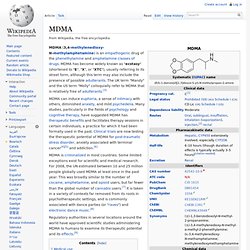
MDMA has become widely known as "ecstasy" (shortened to "E", "X", or "XTC"), usually referring to its street form, although this term may also include the presence of possible adulterants. The UK term "Mandy" and the US term "Molly" colloquially refer to MDMA that is relatively free of adulterants.[3] LSD - Lysergic acid diethylamide.
Lysergic acid diethylamide, abbreviated LSD or LSD-25, also known as lysergide (INN) and colloquially as acid, is a semisynthetic psychedelic drug of the ergoline family, well known for its psychological effects which can include altered thinking processes, closed- and open-eye visuals, synesthesia, an altered sense of time and spiritual experiences, as well as for its key role in 1960s counterculture.
It is used mainly as an entheogen, recreational drug, and as an agent in psychedelic therapy. LSD is non-addictive, is not known to cause brain damage, and has extremely low toxicity relative to dose.[3] However, acute adverse psychiatric reactions such as anxiety, paranoia, and delusions are possible.[4] LSD was first synthesized by Albert Hofmann in 1938 from ergotamine, a chemical derived by Arthur Stoll from ergot, a grain fungus that typically grows on rye. Effects Physical. GHB - gamma-Hydroxybutyric acid. GHB has been used in a medical setting as a general anesthetic, to treat conditions such as insomnia, clinical depression, narcolepsy, and alcoholism, and to improve athletic performance.[5] It is also used as an intoxicant (illegally in many jurisdictions) or as a date rape drug.[6] GHB is naturally produced in the human body's cells and is structurally related to the ketone body beta-hydroxybutyrate.
As a supplement or drug, it is used most commonly in the form of a salt, such as sodium gamma-hydroxybutyrate (Na.GHB, sodium oxybate, or Xyrem) or potassium gamma-hydroxybutyrate (K.GHB, potassium oxybate). GHB is also produced as a result of fermentation, and so is found in small quantities in some beers and wines. Succinic semialdehyde dehydrogenase deficiency is a disease that causes GHB to accumulate in the blood. Medical use[edit] The only common medical applications for GHB today are in the treatment of narcolepsy and more rarely alcoholism.[7] Recreational use[edit] Caffeine. Caffeine is a central nervous system (CNS) stimulant of the methylxanthine class.[10] It is the world's most widely consumed psychoactive drug. Unlike many other psychoactive substances, it is legal and unregulated in nearly all parts of the world. There are several known mechanisms of action to explain the effects of caffeine. The most prominent is that it reversibly blocks the action of adenosine on its receptor and consequently prevents the onset of drowsiness induced by adenosine.
Caffeine also stimulates certain portions of the autonomic nervous system. MCat - Mephedrone. Cannabis sativa. Common uses[edit] A sack made from hemp fiber. Alcohol. Ball-and-stick model of the hydroxyl (-OH) functional group in an alcohol molecule (R3COH). The three "R's" stand for carbon substituents or hydrogen atoms.[1] The hydroxyl (-OH) functional group with bond angle. An important class of alcohols are the simple acyclic alcohols, the general formula for which is CnH2n+1OH. Of these ethanol (C2H5OH) is the alcohol found in alcoholic beverages; in common speech the word alcohol refers to ethanol. Sativa - Cannabis sativa. Common uses[edit] A sack made from hemp fiber. Indica - Cannabis drug strains. Types of varieties[edit] Major variety types[edit] Relative size of cannabis types The two species of the Cannabis genus that are most commonly grown are Cannabis indica and Cannabis sativa.[1] A third species, Cannabis ruderalis is very short and produces only trace amounts of tetrahydrocannabinol (THC), and thus is not commonly grown for industrial, recreational or medicinal use.
However, because Cannabis ruderalis flowers independently of the photoperiod and according to age, it has been used to breed autoflowering strains.[2]