
Celebrity Types - Overview. Table of similar systems of comparison of temperaments. Beginnings[edit] The Roman physician Galen mapped the four temperaments (sanguine, phlegmatic, choleric and melancholic) to a matrix of hot/cold and dry/wet, taken from the four classical elements.[1] Two of these temperaments, sanguine and choleric, shared a common trait: quickness of response (corresponding to "heat"), while the melancholic and phlegmatic shared the opposite, a longer response (coldness).
The melancholic and choleric, however, shared a sustained response (dryness), and the sanguine and phlegmatic shared a short-lived response (wetness). This meant that the choleric and melancholic both would tend to hang on to emotions like anger, and thus appear more serious and critical than the fun-loving sanguine, and the peaceful phlegmatic. However, the choleric would be characterized by quick expressions of anger (like the sanguine, with the difference being that the sanguine cools off); while the melancholic would build up anger slowly, silently, before exploding. David W. Myers-Briggs Type Indicator. Model of personality types A chart with descriptions of each Myers–Briggs personality type and the four dichotomies central to the theory The Myers–Briggs Type Indicator (MBTI) is an introspective self-report questionnaire indicating differing psychological preferences in how people perceive the world and make decisions.[1][2][3] The original versions of the MBTI were constructed by two Americans, Katharine Cook Briggs and her daughter Isabel Briggs Myers.[4] The MBTI is based on the conceptual theory proposed by Swiss psychiatrist Carl Jung,[5] who had speculated that people experience the world using four principal psychological functions – sensation, intuition, feeling, and thinking – and that one of these four functions is dominant for a person most of the time.[6] The four categories are Introversion/Extraversion, Sensing/Intuition, Thinking/Feeling, Judging/Perception.
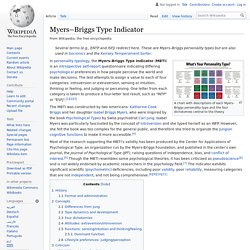
Each person is said to have one preferred quality from each category, producing 16 unique types. History[edit] Complete relationship chart between psychological ("personality") types. Personality Quiz. Great Ideas in Personality. Category:Personality tests. 16 Personality Factors. The Sixteen Personality Factor Questionnaire (or 16PF),[1] is a multiple-choice personality questionnaire which was developed over several decades of research by Raymond B.
Cattell, Maurice Tatsuoka and Herbert Eber. Beginning in the 1940s, Cattell used the new techniques of factor analysis (based on the correlation coefficient) in an attempt to try to discover and measure the source traits of human personality (Cattell, 1946)(Nevid, 2009).[2][3] The questionnaire measures the 16 primary traits, and the Big Five secondary traits,[4][5] which have become popularized by other authors in recent years.
From early in his research, Cattell found that the structure of personality was multi-level and hierarchical, with a structure of interdependent primary and secondary level traits (Cattell, 1946, 1957).[2][6] The sixteen primary factors were a result of factor-analyzing hundreds of measures of everyday behaviors to find the fundamental traits behind them. Outline of Test[edit] Chart of the Enneagram of Personality. 9types.com - Enneagram tests, type descriptions, forums. Personality types.