
Unsolved Problems. Nature by Numbers. 13 Useful Math Cheat Sheets. Posted by Antonio Cangiano in Applied Math, Math Education, Software, Tutorial on September 20th, 2008 | 38 responses Cheat sheets can be very useful and make for great posters around your room.

The following is a collection of 13 cheat sheets for several mathematical topics and programs: And since most of us like to show our math pride off when out and about as well, Amazon sells this awesome Math Cheat Sheet T-shirt with formulas on both sides (Also available for Science and Engineering). How awesome is this? Sponsor’s message: Looking for online algebra homework solutions? Ethiopian multiplication. Ethiopian multiplication You are encouraged to solve this task according to the task description, using any language you may know. A method of multiplying integers using only addition, doubling, and halving. Method: Take two numbers to be multiplied and write them down at the top of two columns. In the left-hand column repeatedly halve the last number, discarding any remainders, and write the result below the last in the same column, until you write a value of 1.
In the right-hand column repeatedly double the last number and write the result below. stop when you add a result in the same row as where the left hand column shows 1. For example: 17 × 34 Halving the first column: What's Special About This Number? Alpha: Computational Knowledge Engine. Maze Generator. Phi 1.618. Ø PHI: The Golden Ratio or Golden Section (In Nature, Art, Science and Religion) The Golden Section is a unique Ratio (or relationship between parts) that seems to be preferred by Nature as the best geometry for growth, energy conservation, elegance and has some fundamental relationships to the platonic solids and the Mandelbrot set.
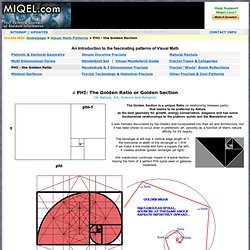
It was formally discovered by the Greeks and incorporated into their art and architecture, but it has been shown to occur even in prehistoric art, possibly as a function of Man's natural affinity for it's beauty. The rectangle at left has a vertical edge length of 1 the horizontal or width of the rectangle is 1.618 If we make a line inside and form a square (far left) it creates another 'golden rectangle' (at right) this subdivision continues inward in a spiral fashion tracing the form of a perfect PHI spiral seen in galaxies, seashells .... Even your hand, arm, ear, teeth, etc are in PHI Proportions!
Images above are © (image credit: Gary Meisner) Introduction to Algorithms. Mandelbulb: The Unravelling of the Real 3D Mandelbrot Fractal. Opening Pandora's Box For the Second Time ur story starts with a guy named Rudy Rucker, an American mathematician, computer scientist and science fiction author (and in fact one of the founders of the cyberpunk science-fiction movement).
Around 20 years ago, along with other approaches, he first imagined the concept behind the potential 3D Mandelbulb (barring a small mistake in the formula, which nevertheless still can produce very interesting results - see later), and also wrote a short story about the 3D Mandelbrot in 1987 entitled "As Above, So Below" (also see his blog entry and notebook). Back then of course, the hardware was barely up to the task of rendering the 2D Mandelbrot, let alone the 3D version - which would require billions of calculations to see the results, making research in the area a painstaking process to say the least.
So the idea slumbered for 20 years until around 2007. Full size shown here. Is this merely a fool's quest? Mandelbulb (order 8) WOW! Resulting renders.