
Easter. The last week of Lent is called Holy Week, and it contains the days of the Easter Triduum, including Maundy Thursday (also known as Holy Thursday), commemorating the Last Supper and its preceding foot washing,[8][9] as well as Good Friday, commemorating the crucifixion and death of Jesus.[10] Easter is followed by a fifty-day period called Eastertide, or the Easter Season, ending with Pentecost Sunday.
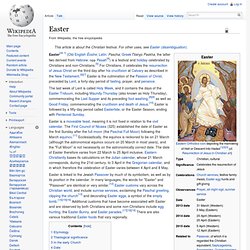
Easter is a moveable feast, meaning it is not fixed in relation to the civil calendar. The First Council of Nicaea (325) established the date of Easter as the first Sunday after the full moon (the Paschal Full Moon) following the March equinox.[11] Ecclesiastically, the equinox is reckoned to be on 21 March (although the astronomical equinox occurs on 20 March in most years), and the "Full Moon" is not necessarily on the astronomically correct date. The date of Easter therefore varies from 22 March to 25 April inclusive. Paschal Full Moon. Notionally, the paschal full moon refers to the ecclesiastical full moon of the northern spring used in the determination of the date of Easter.

The name "paschal" is derived from "Pascha", a transliteration of the Greek word, which is itself a transliteration of the Hebrew pesach, both words meaning Passover. The date of Easter is determined as the first Sunday after the first paschal full moon falling on or after the Spring Equinox (March 21). This "full moon" does not currently correspond directly to any astronomical event, but is instead the 14th day of a lunar month, determined from tables. It may differ from the date of the actual full moon by up to two days.[1] The use of tables instead of actual observations of the full moon is useful and necessary since the full moon may occur on different dates depending where one is in the world.
The calculations to determine the date of the paschal full moon are somewhat complex, but can be described briefly as follows: Equinox. The other definitions are based on several related simultaneous astronomical events, and refer either to the events themselves or to the days on which they occur.
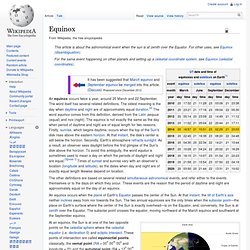
These events are the reason that the period of daytime and night are approximately equal on the day of an equinox. During an equinox, the Earth's North and South poles are not tilted toward or away from the Sun, and the duration of daylight is theoretically the same at all points on Earth's surface. Equinoxes on the Earth Illumination of Earth by the Sun at the March equinoxThe Earth in its orbit around the Sun causes the Sun to appear on the celestial sphere moving over the ecliptic (red), which is tilted on the Equator (white)Diagram of the Earth's seasons as seen from the north.
Far right: December solstice.Diagram of the Earth's seasons as seen from the south.