
Crisis lessons from Irving Fisher. Enrique G.
Mendoza, 12 February 2009 This column rehabilitates Irving Fisher’s debt-deflation theory to explain the current crisis. The credit crunch may cause another great depression. The crisis is shaping up to be a perfect storm – a huge surge in uncertainty that is generating a rapid slow-down in activity, a collapse of banking preventing many of the few remaining firms and consumers that want to invest from doing so, and a shift in the political landscape locking in the damage through protectionism and anti-competitive policies.
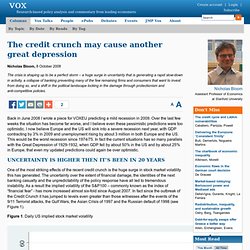
Back in June 2008 I wrote a piece for VOXEU predicting a mild recession in 2009. The crisis of 2008: Structural lessons for and from economics. Foreign Policy: Why China's Currency Manipulation Doesn't Matter. With just a few words in his Senate confirmation hearing, U.S. Treasury Secretary Timothy Geithner resurrected the long-held American accusation that China's penchant for money management is hurting the U.S. economy. President Obama -- backed by the conclusions of a broad range of economists -- believes that China is manipulating its currency, Geithner wrote in his prepared remarks. As the argument goes, an undervalued Chinese currency makes the country's exports artificially cheap, giving Chinese goods an unfair competitive edge. Reduced demand for American goods hurts U.S. manufacturers and limits the size of the U.S. job market.
China is taking jobs from the American heartland. Blaming China for flailing U.S. manufacturing may be good domestic politics, but Geithner should hold his tongue. Geithner's is certainly not the last Western complaint we will hear of China's currency, particularly now with an economic crisis in full swing. It Was the Saving Glut? The paradox of thrift. Or, how come you used to say that if consumers don’t save more, it will wreck the economy, and now you say, if consumers do save more, it will wreck the economy?
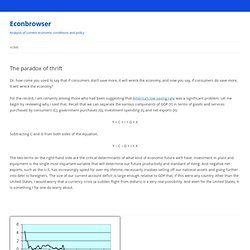
For the record, I am certainly among those who had been suggesting that America’s low saving rate was a significant problem. Let me begin by reviewing why I said that. Recall that we can separate the various components of GDP (Y) in terms of goods and services purchased by consumers (C), government purchases (G), investment spending (I), and net exports (X): Opinion: Expect a Prolonged Slump - WSJ.com - Mozilla Firefox. Perhaps the Obama administration will be able to bring a surprisingly early end to the ongoing U.S. financial crisis.
We hope so, but it is not going to be easy. Until now, the U.S. economy has been driving straight down the tracks of past severe financial crises, at least according to a variety of standard macroeconomic indicators we evaluated in a study for the National Bureau of Economic Research (NBER) last December. In particular, when one compares the U.S. crisis to serious financial crises in developed countries (e.g., Spain 1977, Norway 1987, Finland 1991, Sweden 1991, and Japan 1992), or even to banking crises in major emerging-market economies, the parallels are nothing short of stunning. Mortgage Rates Likely Headed to 4.5%: Pimco's Gross - Economy * Pimco's Gross on the Current Financial Crisis The shift in economic growth has most of the world's connected economies and their citizens in shock, says William Gross, Pimco co-chief investment officer/founder In addition to driving down mortgage rates and stimulating home-buying, the government's efforts also could include a move to cap Treasurys rates to encourage investors to take more risk, Gross said during a live interview on CNBC.

Bank Balance Sheet: Liquidity and Solvency, Par. By Bill McBride on 4/26/2009 11:57:00 AM Note: I took some short cuts to make this simple - think of this conceptually.
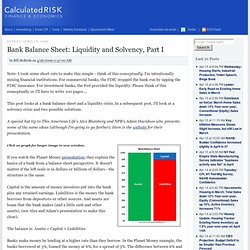
I'm intentionally mixing financial institutions. For commercial banks, the FDIC stopped the bank run by upping the FDIC insurance. For investment banks, the Fed provided the liquidity. Economics and the crisis of 2008. The global crisis is a challenge to and an opportunity for the economics profession.
No, Greenspan Was Not Right. Nick Rowe asks an interesting question: In 2003, Alan Greenspan argued that the Fed needed to set low interest rates to prevent falling into a liquidity trap and deflationary spiral...
In 2008, Greenspan's critics argue that those same low interest rates caused an asset bubble, which burst, causing the economy to fall into a liquidity trap and deflationary spiral. Is it possible that Greenspan and his critics were both right? A New Depression? The Lessons of the 1930s. Now that Janet Yellen is to be Chair of the US Federal Reserve Board, attention has turned to the candidate to succeed her as Vice Chair. Stanley Fischer would be the perfect choice. He has an ideal combination of all the desirable qualities, unique in the literal sense that nobody else has them. During his academic career, Fischer was one of the most accomplished scholars of monetary economics. Subsequently he served as Chief Economist of the World Bank, number two at the International Monetary Fund, and most recently Governor of the central bank of Israel.
Richard Rorty and the efficient markets debat. I use the efficient markets hypothesis in my research and in my blog.
Once I started looking at the world through the EMH lens, I found it much easier to understand the relationship between policy and the financial markets—particularly in my research on the Depression. Here I’d like to do three things; indicate why I believe markets are more efficient than they seem, acknowledge that there are events that look like market inefficiency, and then argue that those perceived inefficiencies, even if real, don’t have the policy implications that many people assume they have. Last Sunday I discussed cognitive illusions, aspects of economic theory that are highly counter-intuitive. I regard the EMH as one such economic theory—strange, but (almost) true. Far From Over - Mozilla Firefox. The crisis and how to fix it: Part 1, causes. This is a financial crisis to remember.
The financial losses are measured in trillions of dollars; elite financial institutions have fallen; fear and mistrust are widespread among investors and lenders; credit markets are not operating except for those with very short maturities; massive and unorthodox policy interventions are an every day occurrence; and we have been, and continue to be, on the verge of a global financial meltdown. REFLECTIONS ON A CRISIS Daniel Kahneman & Nassim Taleb, Mo. FOCUS ONLINE January 28, 2009 ARE BANKERS CHARLATANS? Sind Banker Scharlatane? (German Original) At blame for the financial crisis is the nature of man, say two renowned scientists: Nobel Prize winner Daniel Kahneman and bestselling author Nassim Taleb ( "The Black Swan").
Buffett's Letter to Shareholders. By Bill McBride on 2/28/2009 08:27:00 AM. The First Global Financial Crisis of the 21st Century Part II: J. Carmen M Reinhart, Andrew Felton, 23 February 2009 A second compilation of Vox columns dealing with the ongoing crisis, in three parts: How did the crisis spread around the world? How has the crisis upended traditional thinking about financial economics? How should we fix the economy and financial system? The crisis and how to fix it: Part 2, solutions. My first column argued that the global financial crisis is really a run on all explicit and implicit forms of insurance, which is showing up as a freezing of credit markets at all but the shortest maturity. How We Were Ruined & What We Can Do - The New York Review of Boo. The Trillion Dollar Meltdown: Easy Money, High Rollers, and the Great Credit Crash. Empirical evidence on the monetary policy trilemma since 1970. Joshua Aizenman, Menzie D.
Chinn , Hiro Ito, 9 January 2009. An $800 Billion Mistake.