
5 ways China's WeChat is more innovative than you think. Tech in Asia has been covering WeChat, China’s most popular mobile message app, before it even had an English name.

Meanwhile, international tech media outlets (including ourselves) have also been following the evolution of other messaging apps such as WhatsApp, Line, Facebook Messenger, and many, many others. Over the past year or so there’s been lots of talk about how these messengers are maturing into “platforms” – or, apps that users will use to buy things, and that business and organizations can use to reach an audience. However, as others have correctly pointed out, it’s not appropriate to lump China’s WeChat alongside these other chat apps. This is in large part because it’s simply far ahead of its like-minded competitors with respect to the “platform” side of things. When a user opens up WeChat in any language other than Chinese, they’ll likely see a messaging app that, for the most part, looks and works just like Line or Viber. 1.
Stamping Chinese banknotes with censorship-busting QR codes. An anonymous anti-censorship group is stamping Chinese banknotes with a QR code and the message "Scan and download software to break the Internet firewall.

" The stamps encode a URL for Freegate, a firewall-busting service. The stamps are widely suspected to be the work of Falun Gong, an outlawed religious sect that has a long history of supplying anti-censorship technology inside of mainland China, both to supply access to its own censored websites and to advertise the virtues of its belief-system to Chinese Internet users who are more interested in beating censorship than religion. The money-stamping story has been big news in China, even attracting reportage in state-run media, where the comment-sections are full of Chinese Internet users complaining that the photos of the stamped money are too low-rez to be scanned in. “We found this usage of the QR codes interesting,” Xia said. China builds own phone OS, aims to be more secure than Android or iPhone. China, wary of operating systems from the Western world, has built a new smartphone OS that it believes will be more secure than the likes of Android and the iPhone.

While China claims it as its own, the OS looks like it's based on Android. China Operating System, or COS, was unveiled last week by the Chinese Academy of Sciences and the Shanghai-based Liantong Network Communications Technology, the New York Times reported. COS is "designed for use on many devices including smartphones and personal computers" and was called "a strategic product for national security," the Times said. Chinese photoshop trolls work their magic. Chinese Travelers Mobile App Search Behavior in 2013. Former Google China boss takes new job at rival Qihoo. How Baidu battled to diversify and stay relevant in 2013.
Many Chinese tech giants continued to diversify beyond their flagship products in 2013, and Baidu (NASDAQ:BIDU), best known for its search engine, was no exception to this trend.
While the company acted more conservatively than some of its peers in China, by the end of the year, it became crystal clear that Baidu was no longer just a “search company,” though it’s not yet obvious what type of company it has transitioned to. Peeking over the fence Like other Chinese tech giants, Baidu made several entrances in markets beyond mainland China. However, it’s difficult to assess how aggressive or successful its international expansion has been thus far. Early in 2013, Baidu told Tech In Asia that Southeast Asia, the Middle East and North Africa were the company’s three target regions for growth, and the year mostly saw it continue to take conservative steps in those territories, much like it did in 2012, with a range of web services and apps – but not its search engine.
Mobile and the cloud. In extraordinary scenes, outspoken blogger apologizes on Chinese state TV. Chinese authorities have recently been clamping down on some of the nation’s outspoken celebrity bloggers and Sina Weibo users, trying to temper down a possible rise in online activism.

Prominent investor Charles Xue, a Chinese-American, was arrested in Beijing in late August on charges of soliciting prostitution – but many observers fear it’s a trumped up charge aimed at silencing influential Weibo users. It also comes amid a clamp-down on rumors spreading over the internet. China's official train ticket site makes travel harder. ICANN approves two new Chinese-language web domain endings.
At a signing ceremony this morning in Beijing, ICANN, the organization that oversees internet domain registries, has approved two new Chinese-language web domain endings (ie: gTLDs).
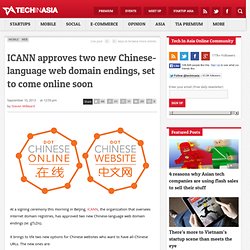
It brings to life two new options for Chinese websites who want to have all-Chinese URLs. The new ones are: .在线 (“zai xian”) – which means “online”.中文网 (“zhong wen wang”) – which means “Chinese site” The idea for these new domain endings came from a bunch of Finnish entrepreneurs who felt that the new Chinese language options would “bring tremendous, long-term benefits to China’s 650 million internet users” in terms of making the web more accessible to people who cannot understand Roman characters or who do not want to write in English. For example, MSN China’s current URL is cn.msn.com; so these Finnish entrepreneurs hope that Microsoft would opt for one of their new gTLDs – perhaps the “zhong wen wang” one, since the Chinese name of the site is already “MSN Zhong Wen Wang”.
Taking the English out of the web. Chinese social critic and microblogger detained on economic charges. Most Chinese internet users probably wouldn’t recognize the name Dong Rubin, but many know the man by his online handle, bianmin (“frontiersman”).
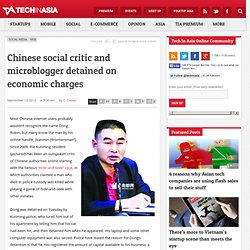
Since 2009, the Kunming resident (pictured) has been an outspoken critic of Chinese authorities online starting with the famous “hide-and-seek” case, in which authorities claimed a man who died in police custody was killed while playing a game of hide-and-seek with other inmates. Dong was detained on Tuesday by Kunming police, who lured him out of his apartment by telling him that his car had been hit, and then detained him when he appeared. His laptop and some other computer equipment was also seized. Police have stated the reason for Dong’s detention is that he mis-registered the amount of capital available to his business, a “crime” which Dong himself admitted to online the previous week. And indeed, if mis-registering his business’s capital is all he’s done wrong, it seems that Dong oughtn’t be in too much trouble. Mesh networks can help Asia avoid censorship and recover from disasters.
A graphical representation of a mesh network connected to the regular internet through several nodes.

Imagine accessing a new internet; an internet that is controlled and maintained by your neighbors instead of ISPs and the government. Does that sound appealing? That probably depends in large part on who you are and where you are, but the fact is, this isn’t just a fantasy. Old tech hands probably know all about wireless mesh networking, but I’ll admit I wasn’t too familiar with the concept before I read this recent article on Mother Jones. Chinese "black PR" firm controlled hundreds of verified Weibo users, raked in millions. Mr.
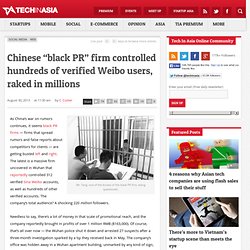
Tang, one of the bosses of the black PR firm, being questioned. As China’s war on rumors continues, it seems black PR firms — firms that spread rumors and false reports about competitors for clients — are getting busted left and right. The latest is a massive firm uncovered in Wuhan that reportedly controlled 312 verified Sina Weibo accounts, as well as hundreds of other verified accounts. Chinese "black PR" firm controlled hundreds of verified Weibo users, raked in millions.
Check out the netizens and companies behind China's $39 billion search engine market (INFOGRAPHIC) Now that China has 591 million web users and 460 million mobile netizens, it’s inevitable that the nation’s search engine market is a huge one as well.

As shown in this infographic by Go-Globe that neatly summarizes the landscape, China’s search engine industry is effectively worth $39 billion this year, rising to an estimated $75 billion in 2016. Yahoo's email service is now closed in China. Yahoo’s (NASDAQ:YHOO) email service in China is now shut, in line with an announcement of its closure that came in April. After that four-month warning, yesterday was the final day for Yahoo China email users to login and migrate their email to an alternative service. Since Yahoo China is run by local e-commerce titan Alibaba, that company is aiming to get all Chinese Yahoo mail users onto its own Aliyun email service instead, with the added advantage of email forwarding from your old account until December 31 this year. Alternatively, people could switch over (minus that useful forwarding feature) to more popular email services such as Tencent’s QQ Mail or Netease’s 163 Mail, both of which have the advantage of being supported by the email app in Apple’s iOS.
Haptix does away with your mouse; gives you a 3D multitouch surface anywhere. How does the idea of being able to pinch to zoom on a screen, without it being a touchscreen, sound to you? Now a new device, Haptix (video above), says it has the capability to turn any surface into a multitouch screen, and the experience is supposedly close to what one would expect from smartphone and tablets. Created by Singaporean Darren Lim and Chinese Lai Xue, Haptix has 3D sensing to make users be aware of where their fingers are on the screen without actually touching the surface itself. Why is 4G adoption in Asia’s emerging markets still so slow? As of last year, 63 percent of telcos across all Asian countries had rolled out or were developing 4G mobile data services. This proves that mobile, internet, and more specifically, LTE, are the new most important things in Asia’s telco space. But while LTE adoption in Asia is doing well in developed countries such Japan and Korea, what’s happening in emerging markets?
With a mere 34.6 million LTE subscribers in Asia-Pacific of the total 3.45 billion mobile subscribers in the region at the beginning of this year, 4G is far from commonplace. What’s lacking? We talked to Leslie Shannon, strategic marketing manager at LTE solutions provider Nokia Solutions and Networks (NSN), and she gave us insights with possible reasons for 4G’s slow emergence in the region. Game changers for LTE adoption.
嗶哩嗶哩 - ( ゜- ゜)つロ 乾杯~ - bilibili.tv. 5 mobile apps in Asia that give users access to cheap flights. Asian consumers are now trusting online booking as a means to purchase transportation tickets and hotel accommodation. Attesting to this is the huge boom in startups and companies that offer online booking. But somehow, providing a web-based booking solution won’t be enough for Asian consumers. These people are now relying on their smartphones to do daily tasks and transactions, and they expect to do more with their smartphones. Competition is getting tighter in this space, with budget airlines joining the battle as well. So the apps need to shine and the prices have to be right.
Ctrip. Flipboard is Now Blocked In China, But Chinese Edition Of App Is Left Unmolested. WeChat v5.0 Update Brings Social Gaming, Mobile Payments, and Sticker Store. Steven Millward | August 5, 2013 The long awaited update to WeChat, the popular China-made messaging app, has arrived. This morning WeChat v5.0 for iOS is rolling out (to be followed by the Android iteration soon) with social gaming, mobile payments, and a proper sticker store. Plus a flatter iOS 7-style WeChat icon. The WeChat sticker shop is the only surprise feature, making it easier to find the animated emoticons that have been a feature of the app from the beginning. WeChat’s mobile payments and social gaming integration have been anticipated for months, and for now are only really useful for Chinese users of the app. WeChat has nearly 400 million registered users around the world, with just over 70 million of those outside of China.
WeChat is Now the 5th Most Used Smartphone App In The World. Sina Weibo's Failure: Why Chinese Companies Should Take the Rest of the World Seriously. Last week, we reported that Sina Weibo has added Facebook login to its service to make it easier for overseas users to sign up. Sign Of The Times? Investments in Asia Increase, Investments In Silicon Valley Decrease. Two interesting articles just came out that shed light on the state of investment between Asia and Silicon Valley. According to BusinessWeek, “US startups raised less money from venture capitalists last quarter than in any quarter since the start of 2010.” The report also indicates that American VCs are turned off by social media investments, and are going more into fashion and home goods. Inspired by Paypal, Sina Gets Into Online Banking. China Unicom's WeChat Subscription Plan is Probably a Ripoff. Yesterday, after continuing rumors that was about to happen, China Unicom finally announced its WeChat-specific subscription plan.
The plan, as we reported yesterday, will give users unlimited access to WeChat without counting any of the app’s traffic towards their monthly data allotment (if they have a data plan at all). Monitor Conversation on Weibo with Baidu Search. China Now Has 591 Million Internet Users, 460 Million Mobile Netizens. Sina's Vindictive Response to a Report About Weibo's Dwindling User Activity. Open Letter to WeChat: 7 Warnings From a Social Media Marketer.
Jeremy Webb is associate director at Ogilvy Public Relations, Beijing. He heads up Social@Ogilvy for Beijing, managing a team of 10 to provide social/digital strategy and execution for brands across all business sectors. Why Don't More Chinese Internet Companies Expand Overseas? Beating the Censorship of China's Great Firewall with Raspberry Pi. How Alibaba Saved Weibo and Chinese Society (Maybe) Jack Ma may have officially retired as Alibaba CEO, but he’s still the guy to talk to when it comes to all things Ali. China's Internet Cafés in Decline. Qihoo Report Breaks Down China's Average Internet Speed by Province. Baidu Opens Lab in Silicon Valley Devoted to Research into 'Deep Learning' China’s Social Media Landscape 2013 (INFOGRAPHIC) New US Law Focuses on China Cyber-Espionage, Could Block Lenovo Sales to Government Departments. China Has 160 Million Active Android Users, 85 Million on iOS (INFOGRAPHIC)
China's Teen Gamers Revealed, From In-Depth Demographics to Deepest Desires. Sina Weibo Starts Showing Individual Post Views. Tencent QQ Users Close to 800MM, Qzone Over 600MM in 2012. Dutch Co-Founder of Tudou Leaves China, Cites Worsening Web and Pollution Woes. Now China Seems to be Targeting Human Rights Activists with Android Spyware. Foreshadowing For Future Fees? China Unicom Begins Tracking Data Traffic from Apps Like WeChat Separately. The Demographics of Mobile Gaming in China: A Detailed Look. Fuubo: Finally a Weibo App for Android That Isn't Fugly. Tencent Plans Three-Pronged Attack to Monetize WeChat.
Reality Check for the Chinese Microblog Space: A Random Sampling Approach. Why China Can't Make Its Own Mobile OS. Infographic: China's top 10 social media sites. China Mobile and China Unicom Agree WeChat is a Threat, But Can't Agree on How to Fix It. Censorship Alert! Academic Study Shows Sina Weibo's Human Censors Are Pretty Darn Fast. The Pirate Bay Sails to North Korea, Sort Of. Baidu, Tencent, Xiaomi CEOs Propose New Legislature to Strengthen China's Tech Sector. Sina weibo 2012 Review. Sina weibo 2012 Review. Of Sina Weibo’s 500 Million Registered Users, Are 90% Actually Zombies? Netizens Gather Further Evidence of PLA Hacking. Chinese Teen Tries to Murder Entire Family for Restricting His Internet Access. Startups: If You're Going to Copy, You Have to Do it Better Than This [UPDATED] China's Tencent to Open Office in America Devoted to WeChat App.
A Shocking Expose of China’s Black PR Industry Implicates Government Officials, is Quickly Deleted from the Web. Chinese Check-In Service Jiepang Sums Up 2012 [INFOGRAPHIC] China's Internet 'Wall' Hits Foreign, Domestic Business. Make Your Own Toy Sculpting Wax. Chinese Photo App Vida Adds PM2.5 Image Filter. HP to Crack Down on Chinese Supplier Factories Using Student Workers. Vuclip Provides Free Educational Videos to Mobile Phone Users. How Qihoo is Committing Fraud. China: US is Hacking Us, Not the Other Way Around. 6 款免费的 VPN 客户端. Deng Fei Launches Weibo Campaign to Share Images of Water Pollution. 10 Insane Cases of Censorship on Sina Weibo in 2012. Kaifu Lee: I've Been Banned From Weibo for 3 Days. Brad Pitt Banned From China Again (This Time From Sina Weibo) KakaoTalk Challenges Apple & Google w/ New Digital Publishing Platform. WeChat: Hollywood Celebrities Get Chatty with Chinese Fans.
国际一线艺人明星&运动员粉丝互动平台 - 粉丝堂 Fanstang. China's E-Commerce Giant Now Has a Search Engine to Take on Baidu and Google. 5,000 Workers at One Chinese Web Company Queue Up for a Cash Bonus [PHOTOS] Greengar, Asia's Only Contestant at Women 2.0, Releases Smartboard App. By 2016, China Will Have 423 Million E-Commerce Shoppers Spending $457 Billion [INFOGRAPHIC] Is Gaming in China Getting Too Expensive? China's Top Video Site Adds QR Codes to Help Viewers Go Mobile.
'World Startup Report' Tour Hits Australia, Still 27 More Countries to Go. Baidu Wiki in 2012. Chinese Hackers Infiltrate the New York Times - Tech in Asia. Chinese Hackers Infiltrate New York Times Computers. What is the Difference Between Chinese Netizens and US Net Users? 11 Must-Read Tech Stories in China This Week. Ministry of Truth: Guangdong People's Congress.
How the Very Uncool 'CoolPad' is Outselling Apple's iPhone in China. Online Censorship In China. Are Chinese Schools Beating the US in Technology Integration? Welcome to Mitalk! MiTalk Messenger. China's Virtual Telecom Market May Be Worth $11 Billion. Statement of Ethics - Tech in Asia.