
10 Psychological Experiments That Went Horribly Wrong. Psychology as we know it is a relatively young science, but since its inception it has helped us to gain a greater understanding of ourselves and our interactions with the world.
Many psychological experiments have been valid and ethical, allowing researchers to make new treatments and therapies available, and giving other insights into our motivations and actions. Sadly, others have ended up backfiring horribly — ruining lives and shaming the profession. Here are ten psychological experiments that spiraled out of control. 10. Part 3: How a marshmallow can predict your future. 47 Mind-Blowing Psychology-Proven Facts You Should Know About Yourself. I’ve decided to start a series called 100 Things You Should Know about People.

As in: 100 things you should know if you are going to design an effective and persuasive website, web application or software application. Or maybe just 100 things that everyone should know about humans! The order that I’ll present these 100 things is going to be pretty random. So the fact that this first one is first doesn’t mean that’s it’s the most important.. just that it came to mind first. Dr. <div class="slide-intro-bottom"><a href=" class="sl-start"> »</a></div>
Watch Psychology Documentaries Online Free. Science & Nature - Human Body and Mind - Mind. What is Psychology - Modern Psychology Defined. The field of Psychology is such a vast area of ranging expertise, but what is Psychology in the modern era as we know it?
The goal of Psychology, as in many other scientific disciplines is to understand individuals and groups by establishing general principles through research. The end result should be for the benefit of health and well-being of everyone. As Psychology can be described as having a clean cut goal, it’s approach should not be seen as such. Psychology as a word can be simply defined as: What is Psychology The scientific study of the human mind and its functions, esp. those affecting behaviour in a given context.The mental characteristics or attitude of a person or group.The mental and emotional factors governing a situation or activity As finite as these definitions seem; they are not. Biological Psychology (aka Biopsychology) Behavioural Psychology The study of Psychology that focusses on learned behaviours. 5 Psychological Experiments That Prove Humanity is Doomed.
Cracked.com's new book is now on sale.

What follows is one of 22 classic articles that appear in the book, along with 18 new articles that you can't read anywhere else. Psychologists know you have to be careful when you go poking around the human mind because you're never sure what you'll find there. A number of psychological experiments over the years have yielded terrifying conclusions about the subjects. Oh, we're not talking about the occasional psychopath who turns up.
No, we're talking about you. The Asch Conformity Experiment (1953) The Setup: Solomon Asch wanted to run a series of studies that would document the power of conformity, for the purpose of depressing everyone who would ever read the results. Subjects were told that they would be taking part in a vision test, along with a handful of people. The Result: Questions the subjects were asked were like the puzzle shown here: All they had to do was say which line on the right matched the one on the left. "Wait, you're right! C. Psychology Today: Health, Help, Happiness + Find a Therapist. The Stanford Prison Experiment: A Simulation Study of the Psychology of Imprisonment. 5 Ways To Hack Your Brain Into Awesomeness.
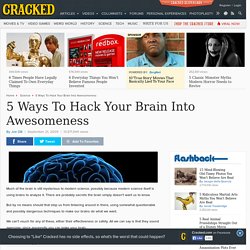
Much of the brain is still mysterious to modern science, possibly because modern science itself is using brains to analyze it.
There are probably secrets the brain simply doesn't want us to know. But by no means should that stop us from tinkering around in there, using somewhat questionable and possibly dangerous techniques to make our brains do what we want. We can't vouch for any of these, either their effectiveness or safety. All we can say is that they sound awesome, since apparently you can make your brain... #5. So you just picked up the night shift at your local McDonald's, you have class every morning at 8am and you have no idea how you're going to make it through the day without looking like a guy straight out of Dawn of the Dead, minus the blood... hopefully. "SLEEEEEEEEEP... uh...
What if we told you there was a way to sleep for little more than two hours a day, and still feel more refreshed than taking a 12-hour siesta on a bed made entirely out of baby kitten fur?