
Remake / Submissions. I will be updating this post with all the submissions to our “Remake” project.

Check back here to see work as it comes in and make sure yours is added! Full details about this project are here. “Composition With Red, Blue and Yellow” remake by Katie Jackson “Composition With Red, Blue and Yellow” by Mondrian “Weeping Woman” remake by Frances Adair Mckenzie “Weeping Woman” by Picasso “The Two Fridas” remake by Claire Ball “The Two Fridas” by Frida Kahlo “Le Désespéré” remake by Stefano Telloni “Le Désespéré” remake by Dani Catao “Le Désespéré” by Gustave Courbet.
May It Please the Court - NYTimes.com. Pomegranate,+victor+wang.jpg (JPEG Image, 319 × 400 pixels) THE COLLECTOR’S GUIDE: La Granada - The Pomegranate in New Spain. Most frequently the pomegranate is a symbol of fertility, birth and eternal life, owing to its abundance of seeds.
Its deep blood red color has led to its interpretation as a symbol of death. It also represents unity, illustrated by the many seeds bound together in a single skin. It is a symbol of royalty, owing to its crown-like terminal atop an orb. St. John of God, whose attribute is the pomegranate, brought additional significance to the fruit. In art, the pomegranate may be depicted in blossom as well as in immature and mature states. 108032_f496.jpg (JPEG Image, 496 × 372 pixels) Google Image Result for. Google Image Result for. Madonna of the Pomegranate - Sandro Botticelli Gallery - Religious Painting Art. Kaishien_gaden_pomegranates2.jpg (JPEG Image, 387 × 300 pixels)
PomegranateChina.jpg - Wikipedia, the free encyclopedia. Madonna of the Pomegranate. Rosetti02.jpg - Wikipedia, the free encyclopedia. Ebers Papyrus. The manuscript[edit] The papyrus was written in about 1500 BC, but it is believed to have been copied from earlier texts, perhaps dating as far back as 3400 BC.[1] The Ebers Papyrus is a 110-page scroll, which is about 20 meters long.[2] Along with the Kahun Gynaecological Papyrus (c. 1800 BC), the Edwin Smith papyrus (c. 1600 BC), the Hearst papyrus (c. 1600 BC), the Brugsch Papyrus (c. 1300 BC), the London Medical Papyrus (c. 1300 BC), the Ebers Papyrus is among the oldest preserved medical documents.
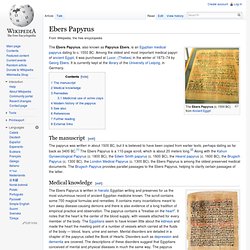
The Brugsch Papyrus provides parallel passages to the Ebers Papyrus, helping to clarify certain passages of the latter. Medical knowledge[edit] Ebers Papyrus The Ebers Papyrus is written in hieratic Egyptian writing and preserves for us the most voluminous record of ancient Egyptian medicine known. Remedies[edit] Ebers Papyrus treatment for asthma: a mixture of herbs heated on a brick so that the sufferer could inhale their fumes.
The Pomegranates in Bible and Quran. The Book of Exodus, Chapter 39. The Fisherman and His Soul - A Fairy Tale by Oscar Wilde (from A House of Pomegranates) With illustrations by Jessie M. King Every evening the young Fisherman went out upon the sea, and threw his nets into the water. When the wind blew from the land he caught nothing, or but little at best, for it was a bitter and black-winged wind, and rough waves rose up to meet it. But when the wind blew to the shore, the fish came in from the deep, and swam into the meshes of his nets, and he took them to the market-place and sold them. Every evening he went out upon the sea, and one evening the net was so heavy that hardly could he draw it into the boat.
But no fish at all was in it, nor any monster or thing of horror, but only a little Mermaid lying fast asleep. Her hair was as a wet fleece of gold, and each separate hair as a thread of fine gold in a cup of glass. So beautiful was she that when the young Fisherman saw her he was filled with wonder, and he put out his hand and drew the net close to him, and leaning over the side he clasped her in his arms. 'Alas! 'Away! 'Come!