
CJCS_Mission_Command_White_Paper_2012_a. OODA loop. Diagram of a decision cycle known as the Boyd cycle, or the OODA loop Overview[edit] The OODA loop has become an important concept in litigation,[1] business[2] and military strategy.
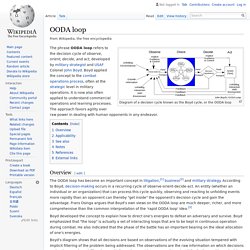
According to Boyd, decision-making occurs in a recurring cycle of observe-orient-decide-act. An entity (whether an individual or an organization) that can process this cycle quickly, observing and reacting to unfolding events more rapidly than an opponent can thereby "get inside" the opponent's decision cycle and gain the advantage. Frans Osinga argues that Boyd's own views on the OODA loop are much deeper, richer, and more comprehensive than the common interpretation of the 'rapid OODA loop' idea.[3] Boyd developed the concept to explain how to direct one's energies to defeat an adversary and survive.
Boyd’s diagram shows that all decisions are based on observations of the evolving situation tempered with implicit filtering of the problem being addressed. Applicability[edit] See also[edit] Notes[edit] Air Force: JSF Will Redefine Age Old Doctrine for Fighters. The advent and upcoming operational use of new Joint Strike Fighter (JSF)-aircraft cockpit information technology is likely to generate new paradigms for implementing the widely known Observe, Orient, Decide, Act OODA-loop concept made famous in the 1970’s by former Air Force Fighter Pilot Col. John Boyd, Air Force officials said. Boyd, who flew F-86 Sabre aircraft during the Korean War and went on to be a military theorist and Pentagon consultant, conceived of the OODA-loop notion as a method of winning a dogfight against an enemy fighter jet by, in part, more quickly anticipating fast-changing circumstances, orienting, observing, deciding and “acting.”
In essence, a thrust of the idea was to synthesize information rapidly and make accurate and impactful decisions more quickly than an opponent. “We’re becoming much more efficient in terms of how we use information,” Davis explained. “Thing are becoming a much more holistic battle, maybe, than when Boyd was flying his F-86. Influence OP. EBAO-Canadian_Perspectives. OP Art - Canadian Perspectives. CFJP 5.0. Bryant - OPP. Operations Planning Process Advanced Decision Support. Advanced Decision Support Tools embedded into Collaborative Operations Planning Systems (COPlanS) Center of Gravity Analysis Decisive Point Analysis Risk Management Criteria Management Dynamic Link Management Decision-Matrix Management Plan Management What is OPP-ADS?

Operations Planning Process Advanced Decision Support (OPP-ADS) is a suite of advanced decision-support tools added to Collaborative Operations Planning Systems (COPlanS) to support operational planning as part of a Joint, Net-Enabled Collaborative Environment to achieve Decision Superiority. OPP-ADS supports planners in the design of campaign plans as well as in the use of contingency plans to reduce the time required to produce executable plans. OPP-ADS Functions Technology and Interoperability OPP-ADS tools are embedded into COPlanS. Execution Management and Plan Adaptation (EMPA): EMPA monitors the plans developed by COPlanS. Procedural interaction with other JCDS21 tools is also possible. The Way Ahead. IOPP. Joint Operation Planning. Game Theory in IR. Game Theory IR. Manueljeux.
Systems Thinking in Campaign Design. C2 Systems Thinking. Systems Thinking and Senior Level Leadership. Battlefield System Thinking. The Real Origins of Realpolitik. IN 1934, a young British historian published his first book, The Italian Problem in European Diplomacy, 1847–1849.

In it, he announced that a nation’s foreign policy “is based upon a series of assumptions, with which statesmen have lived since their earliest years and which they regard as so axiomatic as hardly to be worth stating.” It was the duty of the historian, he wrote, “to clarify these assumptions and to trace their influence upon the course of every-day policy.” By that apodictic verdict A. J. P. For what does this portentous Teutonic word actually mean and what implications, if any, does it hold for the assumptions of contemporary Western statesmen?
The reasons for the most recent return of realpolitik are no mystery. As periodically happens when the world becomes a more challenging place, a slew of new books on Niccolò Machiavelli have appeared on both sides of the Atlantic, including offerings by Jonathan Powell (Tony Blair’s former chief of staff) and Philip Bobbitt.