
Amazon’s $23,698,655.93 book. A few weeks ago a postdoc in my lab logged on to Amazon to buy the lab an extra copy of Peter Lawrence’s The Making of a Fly – a classic work in developmental biology that we – and most other Drosophila developmental biologists – consult regularly.
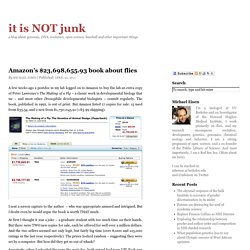
The book, published in 1992, is out of print. But Amazon listed 17 copies for sale: 15 used from $35.54, and 2 new from $1,730,045.91 (+$3.99 shipping). I sent a screen capture to the author – who was appropriate amused and intrigued. But I doubt even he would argue the book is worth THAT much. At first I thought it was a joke – a graduate student with too much time on their hands. Amazingly, when I reloaded the page the next day, both priced had gone UP! On the day we discovered the million dollar prices, the copy offered by bordeebook was1.270589 times the price of the copy offered by profnath. Once a day profnath set their price to be 0.9983 times bordeebook’s price. But two questions remained. But, alas, somebody ultimately noticed. How to Avoid 10 Costly Cognitive Biases. The psychology of money: post-purchase rationalisation, the relativity trap, rosy retrospection, the restraint bias and more… We all make mistakes with money, some more than others.
And in this economy, who needs it? But many of these mistakes are avoidable if we can understand how we think about money. Here are 10 biases that psychological research has shown affect our judgement…and how to avoid them. 1. One of the biggest reason people lose out financially is they stick with what they know, despite much better options being available.
Research on investment decisions shows this bias (e.g. It’s hard to change because it involves more effort and we want to avoid regretting our decision. 2. After we buy something that’s not right, we convince ourselves it is right. Most people refuse to accept they’ve made a mistake, especially with a big purchase. Fight it! 3. We think about prices relatively and businesses know this. The relativity trap is also called the anchoring effect. InFact: Organic Food Myths. Everyone says organic food is better for you, and better for the environment. But is that true, or is it just eco-marketing rhetoric? Organic food is now a huge market segment, driven by consumer demand for food that's healthier. The biggest misconception held by many organic lovers is that organic produce is not grown with fertilizers or pesticides. That's simply wrong.
Organic fertilizers and pesticides are manufactured by all the major producers. Married Man Sex Life.