
A Sense of History: Some Components: SaferSurf active [cpye6krk] By Gerald W.
![A Sense of History: Some Components: SaferSurf active [cpye6krk]](http://cdn.pearltrees.com/s/pic/th/sense-history-some-components-4714420)
Schlabach All students who graduate from a liberal arts college should take with them an indelible awareness of the following: 1. Some things happened before other things. Studying history is much more than the memorization of dates. 2. Athens is in Greece, of course. For a human being to exist in a "place," however, also means to exist in a particular community, society, and culture. 3.
Let's say we read the word "virtue" in an English translation of a text that the Christian thinker Tertullian wrote 200 years after the birth of Jesus. If nothing else, we must should remember that Tertullian wrote in Latin, whereas Aristotle wrote in Greek. More importantly, words get their meanings from the times, places, and cultures in which people use those words. Lesson: there are no short cuts to reading, and reading carefully.
Hint: unless you really want to aggravate your professors, never begin a history paper with Webster's definition of "virtue" or any other word. 4. 5. Sports results can affect election results. Anyone currently following the World Cup, Wimbledon, or any of the many sporting events around the world will know the emotional highs and lows that they can produce.

But these events wield even more power than we think. According to Andrew Healy from Loyola Marymount University, sports results can even swing the outcome of an election. In the US, if a local college football team wins a match in the ten days before a Senate, gubernatiorial or even presidential election, the incumbent candidate tends to get a slightly higher proportion of the vote. This advantage is particularly potent if the team has a strong fan-base and if they were the underdogs. Healy’s study provides yet more evidence that voting decisions aren’t just based on objective and well-reasoned analysis, despite their importance in democratic societies. Healy says that a victory by a local team puts sports fans in a generally positive frame of mind. These stats support Healy’s idea that it’s all about emotions. Anthropomorphism. Anthropomorphism, or personification, is attribution of human form or other characteristics to anything other than a human being.
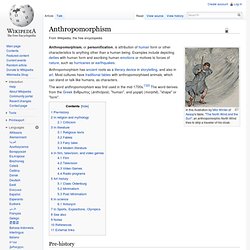
Examples include depicting deities with human form and ascribing human emotions or motives to forces of nature, such as hurricanes or earthquakes. Anthropomorphism has ancient roots as a literary device in storytelling, and also in art. Most cultures have traditional fables with anthropomorphised animals, which can stand or talk like humans, as characters. The word anthropomorphism was first used in the mid-1700s.[1][2] The word derives from the Greek ἄνθρωπος (ánthrōpos), "human", and μορφή (morphē), "shape" or "form". Pre-history From the beginnings of human behavioural modernity in the Upper Paleolithic, about 40,000 years ago, examples of zoomorphic (animal-shaped) works of art occur that may represent the earliest evidence we have of anthropomorphism. In religion and mythology Anthropomorphism in this case is referred to as anthropotheism.[6] Criticism Fables.