
Infection risk posed by cats revealed. 4 September 2012Last updated at 17:29 GMT By Michelle Roberts Health editor, BBC News online Cats harbour the parasite Experts say more research is needed into a disease spread by cats after figures show an estimated 350,000 people a year in the UK become infected with toxoplasmosis.
Although only a minority of people - between one and two in every 10 - has symptoms, advisers say extra measures to control the disease may be needed. The disease is spread by direct contact with cats or eating contaminated food. The Food Standards Agency has released an official report. Cat owners are assured that the risks can be managed with good basic hygiene and common sense. British Veterinary Association past president and veterinary surgeon Harvey Locke said: "The biggest threat is to pregnant women and those who are immuno-compromised, which we have known for some time. Zombie Controversy" At first glance, Davis's research seems promising.
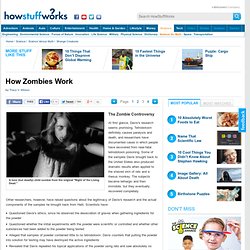
Tetrodotoxin definitely causes paralysis and death, and researchers have documented cases in which people have recovered from near-fatal tetrodotoxin poisoning. Some of the samples Davis brought back to the United States also produced dramatic results when applied to the shaved skin of rats and a rhesus monkey. The subjects became lethargic and then immobile, but they eventually recovered completely. Other researchers, however, have raised questions about the legitimacy of Davis's research and the actual components of the samples he brought back from Haiti. Zombie. ZombieWorld by John_Deadstock A zombie is traditionally an undead person in the Caribbean spiritual belief system of voodoo.
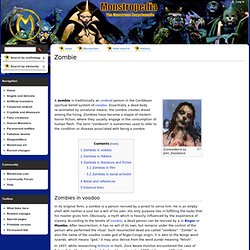
Essentially a dead body re-animated by unnatural means, the zombie creates dread among the living. Zombies have become a staple of modern horror fiction, where they usually engage in the consumption of human flesh. The term "zombism" is sometimes used to refer to the condition or disease associated with being a zombie. Draugr, mythical creature. Awesome (117 votes).
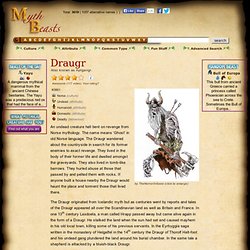
Your rating? #3861 Norse (culture) Undead (attribute) Humanoid (attribute) Domestic (attribute) Deadly (behaviour) An undead creature hell bent on revenge from Norse mythology. The name means ‘Ghost’ in old Norse language. The Draugr wandered about the countryside in search for its former enemies to exact revenge. The Draugr originated from Icelandic myth but as centuries went by reports and tales of the Draugr appeared all over the Scandinavian land as well as Britain and France. The more recent creatures are associated with the sea rather than land. To prevent the dead from rising people would drag a dead body feet first surrounded by a thick crowd so that the dead corpse did not know where it was going.
Draugr has been viewed 20247 times Previous: Impundulu Next: Athena's Owl. Zombie1.jpg 474×313 pixels. Fatal attraction in rats infected with - PubMed Mobile. Schizophrenic-delusion.jpg 320×320 pixels. Voodoo zombies. Origin: Haïtian beliefs and supersitions The word 'voodoo' (vodou, vaudou, vodoun or vodun) derives from the word 'vodu' in the Fon language of Dahomey meaning 'spirit' or 'god’ and describes the complex religious and belief system that exist in Haïti, an island of the West Indies.
The foundations of voodoo were established in the seventeenth century by slaves captured primarily from the kingdom of Dahomey, which occupied parts of today's Togo, Benin, and Nigeria in West Africa, it combines features of African religion with the Roman Catholicism of the European settlers. Today over 60 million people practice voodoo worldwide. Religious similar to voodoo can be found in South America where they are called Umbanda, Quimbanda or Candomble.
It is widely practiced in Benin, Haiti and within many black communities of the large cities in North America. The voodoo religion involves belief in a supreme god (bon dieu) and a host of spirits called loa which are often identified with Catholic saints. Toxoplasma Gondii Parasite Mind Control. Toxoplasma Gondii Parasite Mind Control.
The Return of the Puppet Masters. The Loom: A blog about life, past and future. Are brain parasites altering the personalities of three billion people?
The question emerged a few years ago, and it shows no signs of going away. I first encountered this idea while working on my book Parasite Rex. I was investigating the remarkable ability parasites have to manipulate the behavior of their hosts. The lancet fluke Dicrocoelium dendriticum, for example, forces its ant host to clamp itself to the tip of grass blades, where a grazing mammal might eat it. It's in the fluke's interest to get eaten, because only by getting into the gut of a sheep or some other grazer can it complete its life cycle. Those parasites were weird enough, but then I got to know Toxoplasma gondii. 5 Scientific Reasons a Zombie Apocalypse Could Actually Happen. That, ladies and gentlemen, is what we like to call a real, live, undead fucking zombie.
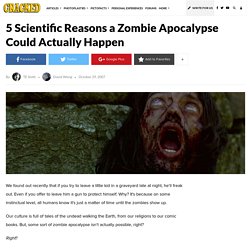
So there. Chances this could cause a zombie apocalypse: Think about it. Under every legal system in the world, all rights and responsibilities are terminated at death. All it takes is someone with resources and a need for a mindless workforce of totally obedient slave labor. How long until somebody tries this? As seen in... What are they?