
I See Mars Faces… Everywhere. The two suspect shapes spotted by Mars conspiracy theorists.
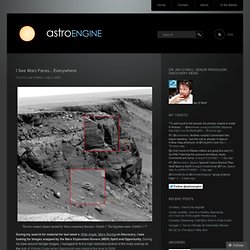
Exhibit 1: The Egyptian statue. Exhibit 2: ?? During my search for material for last week’s Wide Angle: Mars Roving on Discovery, I was looking for images snapped by the Mars Exploration Rovers (MER) Spirit and Opportunity. During my trawl around Google Images, I managed to find a high-resolution picture of the rocky outcrop on the side of Victoria Crater when Opportunity was imaging the area in 2006. I’ve always loved these Victoria images; you can easily see layering in the exposed rock and boulders strewn below.
Or is it? One version of the Opportunity image can be found on a conspiracy website, where a ‘study’ has been carried out. Oh yes, apparently a Martian civilization worshiped the pharaohs of ancient Egypt, carving a statue more commonly associated with pyramids into the crater wall (“Exhibit A” in the image above). Please. So have a look at this, I impressed myself (note the outstanding use of Photoshop): Mars faces: Solar Cycle Prediction: “None of Our Models Were Total. Predicting space weather is not for the faint-hearted.

Although the Sun appears to have a predictable and regular cycle of activity, the details are a lot more complex. So complex in fact, that the world’s greatest research institutions have to use the most powerful supercomputers on the planet to simulate the most basic of solar dynamics. Once we have a handle on how the Sun’s interior is driven, we can start making predictions about how the solar surface may look and act in the future. Space weather prediction requires a sophisticated understanding of the Sun, but even the best models are flawed. Today, another solar cycle prediction has been released by the guys that brought us the “$2 trillion-worth of global damage if a solar storm hits us” valuation earlier this month. Although this may be considered to be a “weak” solar maximum, the Sun still has the potential to generate some impressive flares and coronal mass ejections (CMEs).
The same goes for our Sun. Like this: “Moon” Movie Trailer Now Online. Why didn’t I know about this movie?

I have no clue how I didn’t notice this film was in the works, but it would appear I’m not quite as well plugged into the sci-fi pulse as I used to be. Announced last year, “Moon” is set on the lunar surface where a lone contractor is manning the Helium-3 mining operation. Acted by Sam Rockwell, the setting looks like a visual treat, bound to get any science fiction enthusiast’s taste buds excited. However, yesterday the trailer was released ahead of its June 12th release… and it looks good… Directed by Duncan Jones (David Bowie’s son), Moon was aired at the Sundance Film Festival in January. And I’m excited. After spending three years on the moon as a solitary miner, Sam Bell (Rockwell) is almost ready to return home to his wife and daughter. From there on in, it looks like Sam goes through a desperate battle to keep his sanity after he rescues a younger “Sam” from the lunar surface.
Check out the movie website » Like this: Like Loading... The Universe Could Soon Be 6,000 Years Old… In Texas. Yesterday, some strange stuff went down in Texas.

It may not be a surprising development, especially if you have been following Phil Plait’s articles at Bad Astronomy, but it is still… strange. I don’t usually discuss creationism on Astroengine.com as I’ve always considered much of the wrangling to be an evolution/intelligent design “debate” (debate? Really? Which century are we in again?). To be honest, I’m glad I work and write in a field that can sidestep a lot of creationist bunkum.
That’s the problem, there isn’t a scientific alternative. Guess what kids, the Universe is somewhere between 6,000 to 13,730,000,000 years old. “So, the Big Bang is a robust scientific theory that gathers evidence from a wide variety of sources,” she says boldly. The teacher then leafs through the textbook in front of her, noting the new section, just after “Big Bang Theory”.