
Personal development. Personal development includes activities that improve awareness and identity, develop talents and potential, build human capital and facilitate employability, enhance quality of life and contribute to the realization of dreams and aspirations.
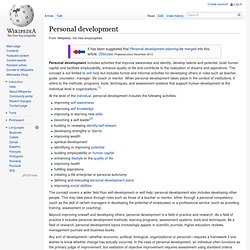
The concept is not limited to self-help but includes formal and informal activities for developing others in roles such as teacher, guide, counselor, manager, life coach or mentor. When personal development takes place in the context of institutions, it refers to the methods, programs, tools, techniques, and assessment systems that support human development at the individual level in organizations.[1] At the level of the individual, personal development includes the following activities: The concept covers a wider field than self-development or self-help: personal development also includes developing other people.
Beyond improving oneself and developing others, personal development is a field of practice and research. Origins[edit] Contexts[edit] Self-knowledge (psychology) Self-knowledge is a term used in psychology to describe the information that an individual draws upon when finding an answer to the question "What am I like?

". The self-concept is thought to have three primary aspects: The cognitive selfThe affective selfThe executive self The affective and executive selves are also known as the felt and active selves respectively, as they refer to the emotional and behavioral components of the self-concept. Self-knowledge is linked to the cognitive self in that its motives guide our search to gain greater clarity and assurance that our own self-concept is an accurate representation of our true self;[citation needed] for this reason the cognitive self is also referred to as the known self.
The cognitive self is made up of everything we know (or think we know about ourselves). Self-theories have traditionally failed to distinguish between different source that inform self-knowledge, these are episodic memory' and semantic memory. In 1963, John W. Mirror test. A human child exploring his reflection The mirror test is an experiment developed in 1970 by psychologist Gordon Gallup Jr. to determine whether an animal possesses the ability to recognize itself in a mirror.[1] It is used as an indicator of self-awareness in non-human animals, marking entrance to the mirror stage by human children in developmental psychology.

Overview[edit] The classic mirror test is performed by surreptitiously marking the animal with two scentless dye spots. The "test" spot is put on a part of the animal that would only be visible to it through use of a mirror; the "control" spot is on an accessible but completely visually hidden part of the animal's body. If the animal reacts in a manner consistent with awareness that the test dye is located on its own body, yet ignores the control dye, it can be arguably concluded that the animal recognizes the mirror as an image of itself. Baboon looking in mirror History[edit] Charles Darwin[edit] Gordon Gallup Jr. Rouge test[edit] Self-awareness. Self-awareness is the capacity for introspection and the ability to recognize oneself as an individual separate from the environment and other individuals.[1] It is not to be confused with consciousness.
While consciousness is being aware of one’s environment and body and lifestyle, self-awareness is the recognition of that consciousness.[2] Neurobiological basis[edit] There are questions regarding what part of the brain allows us to be self-aware and how we are biologically programmed to be self- aware. V.S. Ramachandran has speculated that mirror neurons may provide the neurological basis of human self-awareness.[3] In an essay written for the Edge Foundation in 2009 Ramachandran gave the following explanation of his theory: "... Animals[edit] Studies have been done mainly on primates to test if self-awareness is present. The ‘Red Spot Technique’ created and experimented by Gordon Gallup[6] studies self-awareness in animals (primates).
Psychology[edit] Developmental stages[edit]