
Developmental Phases - Grass Growth and Regrowth for Improved ManagementDevelopmental Phases - Grass Growth and Regrowth for Improved ManagementDevelopmental Phases - Grass Growth and Regrowth for Improved ManagementDevelopmental Phases - Grass Growth and. Hay. E N Boeke, P E Bartholomew, C I Macdonald and T M du Plessis Hay is one form of conserved feed that can be fed to farm animals when other forms of forage are in short supply.

In the main, hay is fed during the winter months (May to August). Hay is made from pastures during the summer months (November to February). Certain grass crops are grown specifically for hay conservation purposes, whereas grazed pastures could be mown for hay, should there be surplus growth. CHAPTER II HAYMAKING. Haymaking turns green, perishable, forage into a product that can be safely stored and easily transported without danger of spoilage, while keeping losses of dry matter and nutrients to a minimum.

This involves reducing its moisture content from 70 - 90% to 20 - 25% or less. Techniques for natural pasture, sown pasture and crops specifically cultivated for conservation at three levels of technology are considered: manual haymaking; simple mechanization with draught animal power or small tractors; and fully mechanized systems. It is, of course, possible to have some or all of the operations of haymaking done mechanically under contract, provided that the fields are big enough to warrant it; this is feasible where the climate at harvest time can be relied on. Definitions of Feed Manufacturing and Livestock Nutrition Terms. PDF Version (182 KB) This Factsheet is designed to provide the reader with definitions of terms used in nutrition-related articles, feed analysis reports and feed tags.

The following list of terms is provided for information purposes only. In the event of overlap in the terminology defined here and that used elsewhere, the legal definition should be used. Use of trade names does not constitute endorsement of the product. Template. V95_183. Veld / Habitat management - Bush encroachment on Game Ranches,Carying capacity, veld condition assesent. Sportsturf Management - Specialist Cricket Pitch Contractors.
Grass. Grass Grasses, or more technically graminoids, are monocotyledonous, usually herbaceous plants with narrow leaves growing from the base.
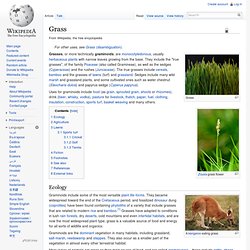
They include the "true grasses", of the family Poaceae (also called Gramineae), as well as the sedges (Cyperaceae) and the rushes (Juncaceae). The Cool-Season Turfgrasses: Basic Structures, Growth and Development — Center for Turfgrass Science — Penn State University. Turfgrasses are narrow-leaved grass species that form a uniform, long-lived ground cover that can tolerate traffic and low mowing heights (usually two inches or below).

Only a few grass species produce acceptable turf in the northern U.S. These grasses are referred to as the cool-season turfgrasses. (Warm-season turfgrasses include species that are best adapted to southern areas of the U.S. and are not discussed in this publication.) This publication covers the basic structures of grass plants, how they grow and develop, and how to identify the different species of cool-season turfgrasses. Introduction. Grass sheath node root - Google Images. Grass sheath node root - Google Images. TurfFiles:Glossary:All. Nitrogen is the most important element in turfgrass culture.

Nelson Mandela Metropolitan University: engaged, people-centred tertiary education. Kikuyuryegrass.pdf (application/pdf Object) Fodder Production Planning for the Dairy Herd. R I JonesCedara Agricultural Development Institute The dominant variable on any livestock farm is the supply of feed. Frequently, because of poor planning aggravated by inefficient production practices and adverse weather conditions, basic feed supplies are erratic and inadequate.
It is not economic to plug these gaps with concentrates. With the price ratio of milk:concentrate currently near 1:1, it is more important than ever to realize that concentrates are supplementary feeds and not staples. Template. The large variation in climate and topography in KwaZulu-Natal gives rise to 23 Bioresource Groups (see Production Guideline 7.1 of this series). These Bioresource Groups represent various vegetation types which can broadly be grouped into the sourveld and sour/mixed veld of Bioresource Groups 1 to 12, 14, 15 and 17; mixed veld in Bioresource Groups 13, 16 and 18 to 20; and sweetveld in Bioresource Groups 20 to 23. The principles that may be applied to veld management in the sweetveld, mixed veld and sourveld will vary in importance, but the approach to the planning of veld management programmes is essentially similar.
The main steps to consider in planning are: Template. Template. Template. More_milk_from_grass.pdf (application/pdf Object) Feeding_and_Management04.pdf (application/pdf Object) Template. Rehabilitation.pdf (application/pdf Object) PastureScience. Pasture science Pasture science is the study of the management of natural rangelands as well as planted pastures with the objective of producing the maximum amount of animal products such as meat, milk and wool with no detrimental effects on the pastures.

Animal unit. The concept of an animal unit (AU) has traditionally been used in North America to facilitate planning, analysis and administration of forage use by grazing livestock, but the term has also had other applications (in relation to odor control regulation, feedlot size, manure management, etc.).

The term has been variously defined by regulation in different jurisdictions, and by livestock management specialists, rangeland resource managers and others. Consequently, when using or interpreting the term, care is needed to ensure that a definition appropriate for the purpose is being used. Most (but not all) definitions are based on the concept that a 1000-pound (454 kg) cow, with or without an unweaned calf, is one animal unit, with such a cow being assumed to consume 26 pounds (about 12 kg) of forage dry matter per day. Grazing livestock[edit] In the USA, the federal grazing fee, which applies to Federal lands in 16 Western states on public lands managed by the BLM and the U.S. Other[edit]
Power (Exponential) Calculator.