
You Arent Gonna Need It. YouArentGonnaNeedIt (often abbreviated YAGNI, or YagNi on this wiki) is an ExtremeProgramming practice which states: "Always implement things when you actually need them, never when you just foresee that you need them.

" Even if you're totally, totally, totally sure that you'll need a feature later on, don't implement it now. Usually, it'll turn out either a) you don't need it after all, or b) what you actually need is quite different from what you foresaw needing earlier. This doesn't mean you should avoid building flexibility into your code. It means you shouldn't overengineer something based on what you think you might need later on. "OK, Sam, why do you want to add it now?
" "Well, Ron, it will save time later. " But unless your universe is very different from mine, you can't 'save' time by doing the work now, unless it will take more time to do it later than it will to do now. "We will be able to do less work overall, at the cost of doing more work now. " Keep it simple. P.S. Others: ArticleS.UncleBob.PrinciplesOfOod. The Principles of OOD What is object oriented design?
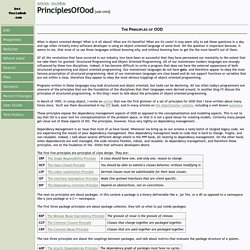
What is it all about? What are it's benefits? What are it's costs? It may seem silly to ask these questions in a day and age when virtually every software developer is using an object oriented language of some kind. Of all the revolutions that have occurred in our industry, two have been so successful that they have permeated our mentality to the extent that we take them for granted.
Programs written in these languages may look structured and object oriented, but looks can be decieving. In March of 1995, in comp.object, I wrote an article that was the first glimmer of a set of principles for OOD that I have written about many times since. These principles expose the dependency management aspects of OOD as opposed to the conceptualization and modeling aspects. Dependency Management is an issue that most of us have faced.
The first five principles are principles of class design. The next six principles are about packages. Robert, Denis. The Principles of Object-Oriented Design « Talking about C. At this moment, a lot of source code are been writing by thousands and thousands of programmers all around the world.

Most of them uses an object-oriented language, but probably just a few have knowledge of the ODD, which I consider crucial for a reusable and extensible project. What are The Principles of Object-Oriented Design In March of 1995 UncleBob wrote an article that was the first glimmer of a set of principles for OOD. These principles expose the dependency management aspects of OOD. When dependencies are well managed, the code remains flexible, robust, and reusable. The first principles are about class design, which are: The Single Responsability Principle In the context of the SRP, responsability is defined as a reason to change.
A good design is to separate two responsabilities in two completely different classes. The Open-Closed Principle This principle is about Rigidity, which is the tendency for a software to be difficult to change, even in simple ways. See you – Fernando.