
Home. Would We Have Drugged Up Einstein? How Anti-Authoritarianism Is Deemed a Mental Health Problem. February 20, 2012 | Like this article?
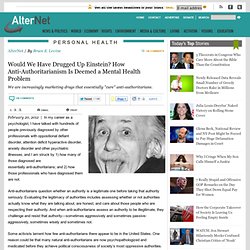
Join our email list: Stay up to date with the latest headlines via email. In my career as a psychologist, I have talked with hundreds of people previously diagnosed by other professionals with oppositional defiant disorder, attention deficit hyperactive disorder, anxiety disorder and other psychiatric illnesses, and I am struck by 1) how many of those diagnosed are essentially anti-authoritarians; and 2) how those professionals who have diagnosed them are not. Anti-authoritarians question whether an authority is a legitimate one before taking that authority seriously.
Some activists lament how few anti-authoritarians there appear to be in the United States. Why Mental Health Professionals Diagnose Anti-Authoritarians with Mental Illness. Trailer for "OPEN DIALOGUE," an alternative Finnish approach to healing psychosis. Letters from the Front Lines. Bob– An encounter from this week: I saw a 24 year-old theater actress who was started on Lexapro nine months ago for a one-time “panic attack” and has gained sixty pounds since.

This is extremely distressing to her as her physical appearance and fitness is essential to her job. She suspected the weight gain was being caused by the medicine, and so she went to her prescribing family doctor and he said that, no, it wasn’t from the Lexapro. She couldn’t account for any other lifestyle changes that would cause such dramatic weight gain. At a subsequent visit, she asked him straight-up if she could stop the medicine, and he said no, because it was working so well to control her panic attacks that she should stay on it at least a year and maybe indefinitely.
Familial Linkage between Neuropsychiatric Disorders and Intellectual Interests. From personality to neuropsychiatric disorders, individual differences in brain function are known to have a strong heritable component.

Here we report that between close relatives, a variety of neuropsychiatric disorders covary strongly with intellectual interests. We surveyed an entire class of high-functioning young adults at an elite university for prospective major, familial incidence of neuropsychiatric disorders, and demographic and attitudinal questions. Students aspiring to technical majors (science/mathematics/engineering) were more likely than other students to report a sibling with an autism spectrum disorder (p = 0.037).
Conversely, students interested in the humanities were more likely to report a family member with major depressive disorder (p = 8.8×10⁻⁴), bipolar disorder (p = 0.027), or substance abuse problems (p = 1.9×10⁻⁶). Figures Citation: Campbell BC, Wang SS-H (2012) Familial Linkage between Neuropsychiatric Disorders and Intellectual Interests. Introduction. History, Science and Psychiatry. The Taint of Eugenics In NIMH-Funded Research Today. Recently, Thomas Insel, director of the National Institute of Mental Health, identified the “NIMH’s Top 10 Research Advances of 2011.”

He wrote: “This has been a year of exciting discoveries and scientific progress . . . Here are 10 breakthroughs and events of 2011 that are changing the landscape of mental health research.” His words fit neatly into a larger narrative in psychiatry, which is that of science on the march. Children’s A.D.D. Drugs Don’t Work Long-Term. Behind the Locked Doors of Inpatient Psychiatry. Gene Watch Page. Schizophrenia researcher Timothy Crow wrote in 2008 that molecular genetic researchers investigating psychotic disorders such as schizophrenia had previously thought that "success was inevitable-one would 'drain the pond dry' and there would be the genes!

" But as Crow concluded, "The pond is empty. "1 Four years later the psychiatric disorder and psychological trait "gene ponds" appear to have been completely drained, and there are few if any genes to be found. Twenty years ago, however, leading behavioral geneticists had high expectations that molecular genetic research would soon "revolutionize" the behavioral sciences. During that heady period of the early-1990s, leading behavioral genetic researchers such as Robert Plomin attempted to shift the field's focus towards gene finding efforts.
Critics, on the other hand, have argued all along that both twin studies and family studies are unable to disentangle the potential roles of genes and environment. Conclusion Endnotes 1. 2. Inside the Battle to Define Mental Illness. Photo: Garry Mcleod; Origami: Robert Lang Every so often Al Frances says something that seems to surprise even him.

Just now, for instance, in the predawn darkness of his comfortable, rambling home in Carmel, California, he has broken off his exercise routine to declare that “there is no definition of a mental disorder. It’s bullshit. I mean, you just can’t define it.” Then an odd, reflective look crosses his face, as if he’s taking in the strangeness of this scene: Allen Frances, lead editor of the fourth edition of the American Psychiatric Association’s Diagnostic and Statistical Manual of Mental Disorders (universally known as the DSM-IV), the guy who wrote the book on mental illness, confessing that “these concepts are virtually impossible to define precisely with bright lines at the boundaries.”
One influential advocate for diagnosing bipolar disorder in kids failed to disclose money he received from the makers of the bipolar drug Risperdal.