
ariadne09
e-learning Masters uni graduate, passionate primary school teacher, ICT enthusiast/consultant mother to 2 men & 2 boys and wife to lifelong academic.
Technology Driving Widespread Shift in Teaching Models. Ed Tech Trends | Research Technology Driving Widespread Shift in Teaching Models Over the last two years, nearly half of faculty have moved away from a traditional lecture model and adopted a range of technology-driven teaching practices, according to new research released in the last week.
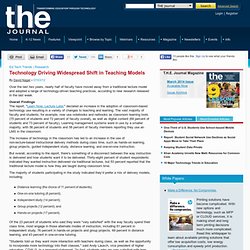
Overall Findings The report, "Learn Now, Lecture Later," declared an increase in the adoption of classroom-based technology use resulting in a variety of changes to teaching and learning. The vast majority of faculty and students, for example, now use notebooks and netbooks as classroom learning tools (75 percent of students and 72 percent of faculty overall), as well as digital content (69 percent of students and 73 percent of faculty). Learning management systems were in use by a smaller majority, with 56 percent of students and 58 percent of faculty members reporting they use an LMS in the classroom. Ways to Evaluate Educational Apps. I am conducting a series of workshops in Florida and was asked to share a rubric to help teachers evaluate educational apps as part of the workshop.
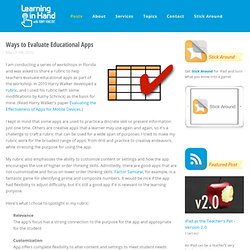
In 2010 Harry Walker developed a rubric, and I used his rubric (with some modifications by Kathy Schrock) as the basis for mine. (Read Harry Walker's paper Evaluating the Effectiveness of Apps for Mobile Devices.) I kept in mind that some apps are used to practice a discrete skill or present information just one time. Others are creative apps that a learner may use again and again, so it's a challenge to craft a rubric that can be used for a wide span of purposes.
Technology Integration Matrix. What is the Arizona Technology Integration Matrix?
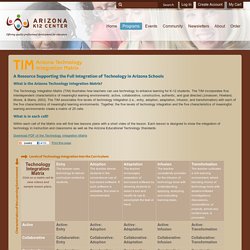
The Technology Integration Matrix (TIM) illustrates how teachers can use technology to enhance learning for K-12 students. The TIM incorporates five interdependent characteristics of meaningful learning environments: active, collaborative, constructive, authentic, and goal directed (Jonassen, Howland, Moore, & Marra, 2003). Web2.0 tools. TPACK. Technology Integration Matrix.
Pearltrees tips.