
Blog. Today I turn 35 years old.
And I couldn’t be more excited than I am right now to share my new book, The PBL Playbook. Over the past few years I’ve been lucky enough to work with teachers, instructional coaches, and school leaders all around the world, both face-to-face and online. What I’ve found (over and […] Teaching is not always easy. And learning can be a struggle for many of our students. I want to tell you a story. “What I know for sure is that you feel real joy in direct proportion to how connected you are to living your truth.” My good friend (and co-author) John Spencer, shared this on Twitter a few days ago: Teaching is an exhausting gig. Terrific Tips for Planning Top Project-Based Learning Ideas. When considering project-based learning ideas, it’s best to start by thinking about where you want to go, and what you want to accomplish with your students.
Although technology may play a huge role in how the projects are put together and utilized, when dealing with project-based learning you want to keep it tangible. Here are a few tips: Start with the end in mind You should always have an idea of how your activity will look. Knowing the outcome when you’re in the planning process will save a lot of time. Start small. Project, Problem, and Passion-Based Learning (PBL) Resources. PBL CONSULTING. Science Technology Engineering Math (STEM) K12 Programs. Why We Love Project Based Learning (And You Should, Too!) Project Based Learning?
“We’ve been doing that for years!” We can hear you say. Science projects, musical performances, etc. We give our kids a goal and then they do it. So what’s the big deal? Frankly, there’s more to project based learning (PBL) than this. If you don’t know what it is, the video above explains it nicely. In a nutshell, it is students working together, doing projects that they care about, taking ownership of their education, and becoming lifelong learners. Edutopia. Edutopia. As an "Instructional Innovator" in my district, I was asked to implement project-based learning in my classroom.
As a new teacher, currently in my second year of teaching fifth grade, I was nervous and excited at this prospect. The Project Thinking about the purpose of PBL, which is to have students gain deep knowledge through exploration of real-world problems, I developed a project for my class that focused on a problem I had observed the previous year: waste in my classroom. Our trashcan and recycling bin overflowed daily, with no distinction between the two. Students routinely threw away half-used pieces of paper, perfectly good pencils, and food they didn’t want. So with this idea in mind, I developed a PBL unit that explored waste, the effect of waste on our community and planet, and the different ways that we, as a class, could reduce waste in our classroom.
I next posed our inquiry question to my class: "How can we reduce waste in our classroom? " The Process The Outcome. Project Rubric. An Interesting Chart on The Difference Between Projects and Project Based Learning. Project based learning is “ an instructional approach built upon authentic learning activities that engage student interest and motivation.
These activities are designed to answer a question or solve a problem and generally reflect the types of learning and work people do in the everyday world outside the classroom.” taken from PBL Online. Projects and activities are the keys to a better understanding of PBL. They are no longer tasks that students need to finish after a traditionally-taught unit but rather a set of learning experiences and tasks that guide students in inquiry toward answering a central question, solving a problem, or meeting a challenge. Research has clearly proved that projects that are well-designed and based on students experiences improve students motivation to learn, help them see how school connects to the outside world by making learning relevant and meaningful, and promote greater civic participation and global awareness. Watch this video to learn more about PBL. A Great Project Based Learning Checklist for Teachers.
CELL at UIndy » PBL Resources. 12 Timeless Project-Based Learning Resources. 12 Timeless Project-Based Learning Resources by Shannon Dauphin Project-based learning is becoming increasingly popular as teachers look for a way to make lessons stick in the minds of their students.
According to Edutopia, studies have shown that students who use project-based learning remember the material much longer and have healthier attitudes toward education. Project Based Learning Resources. (image from education-world.com) Project Based Learning (PBL) is a great way to teach students content, 21st century skills, and engage them in something fun and educational.
I spoke more about PBL in an earlier blog ( and we had some great reader comments (Tech&Learning, May 2009, page 14). Today I'd like to give some tips and ideas on how to get started with PBL in your classroom. First of all, PBL can be used in any classroom, in any subject, at any grade level. Projects can be one class period, or take weeks to complete. PBL does take planning. Six Steps for Planning a Successful Project. Sure, King Middle School has some amazing projects, but the Portland school has been refining its expeditionary learning projects for nearly two decades.
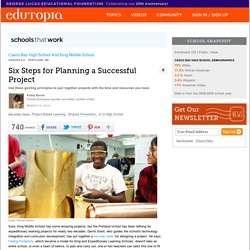
David Grant, who guides the school's technology integration and curriculum development, has put together a six-step rubric for designing a project. He says Fading Footprints, which became a model for King and Expeditionary Learning Schools, doesn't take an entire school, or even a team of twelve, to plan and carry out; one or two teachers can tailor this one to fit their time and resources. Six Steps to Planning a Project The Fading Footsteps project is a twelve-week interdisciplinary ecology unit centered around the guiding question: How does diversity strengthen an ecosystem? Using this project as an example, see how King Middle School creates an action plan around each step. How they do it: The 1-to-1 laptop program was a bonus when it came to creating a comprehensive final product.
Step 5: Coordinate calendars. Challenge Based Learning - Welcome to Challenge Based Learning! Research-Supported PBL Practices. At one New Tech Network high school, strategies backed by research make project-based learning effective and engaging for teachers and students.
At Manor New Technology High School in Manor, Texas, several research-based practices interact to promote successful inquiry-based learning: Manor New Tech is part of the New Tech Network, a nonprofit that works with schools and districts around the country providing services and support to help reform learning through project-based learning (PBL). Since opening its doors in fall 2007, the school has achieved several notable accomplishments: It has graduated two classes with an average annual graduation rate of 98 percent. All 39 students in the first senior class graduated, and 95 percent of the 74 students in the class of 2011 graduated. Project-Based Learning Research Review. Editor's Note: This article was originally written by Vanessa Vega, with subsequent updates made by the Edutopia staff.
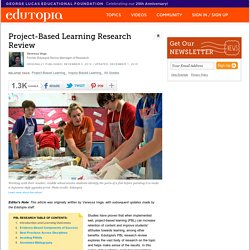
Studies have proven that when implemented well, project-based learning (PBL) can increase retention of content and improve students' attitudes towards learning, among other benefits. Edutopia's PBL research review explores the vast body of research on the topic and helps make sense of the results. ePals Global Community. Project Based Learning.
Project, Problem, and Passion-Based Learning (PBL) Resources. PBL Units. Project-Based Learning: Success Start to Finish. Internet Catalogue. Challenge Based Learning - Home Page. Stimulating Creativity. Edmodo PBL. Edutopia PBL PD Guide. An overview of the Edutopia professional development guide for teaching how to use project-based learning in the classroom. Edutopia.org's Project-Based Learning professional development guide can be used for a two- to three-hour session, or expanded for a one- to two-day workshop, and is divided into two parts. Part one is a guided process, designed to give participants a brief introduction to project-based learning (PBL), and answers the questions "Why is PBL important? ", "What is PBL about? ", and "How does PBL work? " Part two assigns readings and activities for experiential PBL.
Students Follow the Butterflies' Migration: Teacher Frances Koontz shows students a symbolic butterfly sent from children in Mexico. The Resources for PBL page includes a PowerPoint presentation (including presenter notes), which can be shown directly from the website or downloaded for use as a stand-alone slide show, and sample session schedules. Continue to the next section of the guide, Why Is PBL Important?