
antonio
Gtk+ a puntate. Glade/gtk. Designing a User Interface using Glade3 In part 1 of the GTK+ and Glade3 GUI Programming Tutorial series, we will be designing the graphical user interface (GUI) for a GTK+ text editor application (shown left) which will be used throughout these tutorials.
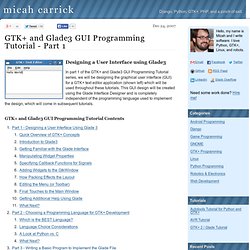
This GUI design will be created using the Glade Interface Designer and is completely independent of the programming language used to implement the design, which will come in subsequent tutorials. GTK+ and Glade3 GUI Programming Tutorial Contents Quick Overview of GTK+ Concepts If you have no experience with GTK+, you may struggle with some of the concepts I am going to cover. First of all, GTK+ is not a programming language. Although GTK+ itself is written in C, there are a multitude of language "bindings" allowing programmers to develop GTK+ applications in the language of their choice including C++, Python, Perl, PHP, Ruby, and many others. GTK+ and associated libraries implement an object oriented approach through GObject. <? In C. Ubuntu. Serial. 2.1.

Debugging The best way to debug your code is to set up another Linux box, and connect the two computers via a null-modem cable. Use miniterm (available from the LDP programmers guide ( in the examples directory) to transmit characters to your Linux box. Miniterm can be compiled very easily and will transmit all keyboard input raw over the serial port. Only the define statement #define MODEMDEVICE "/dev/ttyS0" has to be checked. To make a null-modem cable you have to cross the TxD (transmit) and RxD (receive) lines. It is also possible to perform this testing with only one computer, if you have two unused serial ports. 2.2. The devices /dev/ttyS* are intended to hook up terminals to your Linux box, and are configured for this use after startup. All parameters can be easily configured from within a program.
This file also includes all flag definitions. 2.3. Here three different input concepts will be presented. Serial POSIX. 5th Edition, 6th Revision Copyright 1994-2005 by Michael R. Sweet Permission is granted to copy, distribute and/or modify this document under the terms of the GNU Free Documentation License, Version 1.2 or any later version published by the Free Software Foundation; with no Invariant Sections, no Front-Cover Texts, and no Back-Cover Texts.
A copy of the license is included in Appendix C, GNU Free Documentation License . Introduction Chapter 1, Basics of Serial Communications Chapter 2, Configuring the Serial Port Chapter 3, MODEM Communications Chapter 4, Advanced Serial Programming Appendix A, Pinouts Appendix B, ASCII Control Codes Appendix C, GNU Free Documentation License Appendix D, Change History. MAX232. PIC16F628. ADC0808. Description The ADC0808M is a monolithic CMOS device with an 8-channel multiplexer, an 8-bit analog-to-digital (A/D) converter, and microprocessor-compatible control logic.

The 8-channel multiplexer can be controlled by a microprocessor through a 3-bit address decoder with address load to select any one of eight single-ended analog switches connected directly to the comparator. The 8-bit A/D converter uses the successive-approximation conversion technique featuring a high-impedance threshold detector, a switched capacitor array, a sample-and-hold, and a successive- approximation register (SAR). Detailed information on interfacing to most popular microprocessors is readily available from the factory. The comparision and converting methods used eliminate the possibility of missing codes, nonmonotonicity, and the need for zero or full-scale adjustment. The ADC0808M is characterized for operation over the full military temperature range of -55°C to 125°C.
Features Products You Recently Viewed. LM35. RC 74ls14. 555 Calculator.
Inseguitore eliotropico. Energia Alternativa forum. Usb to serial. Sm^2. Spreeder. NextMe.