
Hierarchical modulation. Hierarchical modulation, also called layered modulation, is one of the signal processing techniques for multiplexing and modulating multiple data streams into one single symbol stream, where base-layer symbols and enhancement-layer symbols are synchronously overplayed before transmission.
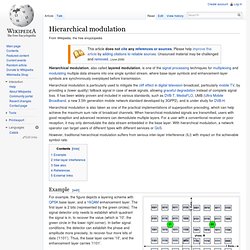
Hierarchical modulation is particularly used to mitigate the cliff effect in digital television broadcast, particularly mobile TV, by providing a (lower quality) fallback signal in case of weak signals, allowing graceful degradation instead of complete signal loss. It has been widely proven and included in various standards, such as DVB-T, MediaFLO, UMB (Ultra Mobile Broadband, a new 3.5th generation mobile network standard developed by 3GPP2), and is under study for DVB-H.
Hierarchical modulation is also taken as one of the practical implementations of superposition precoding, which can help achieve the maximum sum rate of broadcast channels. RFC 5168 - XML Schema for Media Control. [Docs] [txt|pdf] [draft-levin-mmusi...] [Diff1] [Diff2] INFORMATIONAL Network Working Group O. Levin Request for Comments: 5168 Microsoft Corporation Category: Informational R.
Even Polycom P. Hagendorf RADVISION March 2008 Status of This Memo This memo provides information for the Internet community. RFC 5168 Media Control March 2008 Table of Contents 1. 1. This document defines an Extensible Markup Language (XML) Schema for video fast update request in a tightly controlled environment, developed by Microsoft, Polycom, Radvision and used by multiple vendors. 2.
The key words "MUST", "MUST NOT", "REQUIRED", "SHALL", "SHALL NOT", "SHOULD", "SHOULD NOT", "RECOMMENDED", "MAY", and "OPTIONAL" in this document are to be interpreted as described in RFC 2119 [2]. Ip.hhi.de/imagecom_G1/assets/pdfs/csvt_overview_0305.pdf. MPEG-4 AVC. H.264/MPEG-4 Part 10 or AVC (Advanced Video Coding) is a video compression format, and is currently one of the most commonly used formats for the recording, compression, and distribution of video content.
The final drafting work on the first version of the standard was completed in May 2003. Home - theVideoUprising. Real World Video Compression - RWVC. Encoding Tips part 1 by Andy Beach. Andy Beach is a digital media professional whose knowledge of video post-production, compression and interactive design has attracted clients such as: Microsoft, Major League Baseball, Apple, and Adobe.
Andy has a book and a website devoted to Real World Video Compression, and he has done several webinars on video compression recently. I thought it would be a good topic to cover on this blog, so I asked Andy to share some of his encoding expertise with us on how to best set up and encode our screencast videos. So we start at the beginning… setting up a screen capture. RFC 5104 - Codec Control Messages in the RTP Audio-Visual Profile with Feedback (AVPF)
[Docs] [txt|pdf] [draft-ietf-avt-av...] [Diff1] [Diff2] PROPOSED STANDARD Network Working Group S. Wenger Request for Comments: 5104 U. Chandra Category: Standards Track Nokia M. Westerlund B. RFC 5104 Codec Control Messages in AVPF February 2008 Table of Contents 1. Real World Video Compression - RWVC. H.264/MPEG-4 AVC. H.264 or MPEG-4 Part 10, Advanced Video Coding (MPEG-4 AVC) is a video coding format that is currently one of the most commonly used formats for the recording, compression, and distribution of video content.
The final drafting work on the first version of the standard was completed in May 2003, and various extensions of its capabilities have been added in subsequent editions. Jointwave - Products. Products Since the inception, Jointwave has been focusing on video processing and codec IP design for ASIC and FPGA.
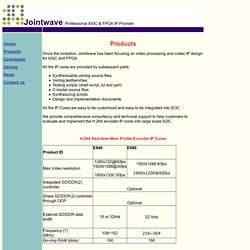
All the IP cores are provided by subsequent parts: Synthesizable verilog source files Verilog testbenches Testing scripts (shell-script, tcl and perl) C-model source files Synthesizing scripts Design and implementation documents All the IP Cores are easy to be customized and easy to be integrated into SOC. We provide comprehensive consultancy and technical support to help customers to evaluate and implement the H.264 encoder IP cores into large scale SOC. H264 WebCam HomePage (Video Surveillance System which Support USB camera, Network Camera, Video Capture Card.) RFC 5506 - Support for Reduced-Size Real-Time Transport Control Protocol (RTCP): Opportunities and Consequences.
Www.ietf.org/rfc/rfc3984.txt. RFC 6185 - RTP Payload Format for H.264 Reduced-Complexity Decoding Operation (RCDO) Video. MPEG-4. WebM. WebM — открытый формат мультимедиа, представленный компанией Google на конференции Google I/O 19 мая 2010 года[2].
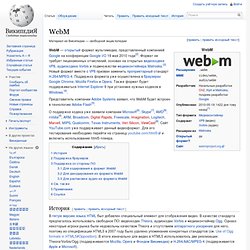
Формат не требует лицензионных отчислений, основан на открытых видеокодеке VP8, аудиокодеке Vorbis и подмножестве медиаконтейнера Matroska.[3] Новый формат вместе с VP8 призван заменить проприетарный стандарт H.264/MPEG-4. Поддержка формата уже осуществлена в браузерах Google Chrome, Mozilla Firefox и Opera. Также формат будет поддерживаться Internet Explorer 9 при установке нужных кодеков в Windows.[4]. Представитель компании Adobe Systems заявил, что WebM будет встроен в технологию Adobe Flash[5]. История[править | править исходный текст] В пятую версию языка HTML был добавлен специальный элемент для отображения видео. Для прекращения «войны форматов» Google купила компанию On2 (разработчика VP3, предшественника Theora и нового более качественного видео-кодека VP8).