
Future Workplace Formula = 1 person x 6 devices @ two-thirds of a desk. SANTA CLARA, Calif. » By 2020 organizations are set to reduce office space by almost a fifth (17 percent) according to a new study by Citrix, a leader in mobile and cloud technology.

The workplace of the future will provide just seven desks for every ten office workers, with each person accessing the corporate IT network from an average of six different computing devices. The figure for 2020 is as low as six desks for every ten workers in Singapore, the Netherlands, the USA and the UK. Some of the highest desk to worker ratios in 2020 will be in Japan (8.77), South Korea (7.95) and Germany (7.90).
Almost every organization says they will redesign office space to be more appealing. 'Generation Y' set to transform office life. Free running might not become an office staple, but greater flexibility and less lengthy meetings might become the norm.
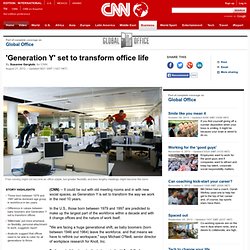
Those born between 1979 and 1997 will be dominant age group in workforce in ten years Difference in values between baby boomers and Generation Y set to transform offices'Millennials' put more emphasis on flexibility, personal attachment to work, suggests reportAnalysts suggest that offices need to be able to cater for all generations to thrive. Fun and innovative workspaces. A Kindergarten within the Organization! Is it a dream? The Herman Trend Alert - Way-Out Workplaces Engage Gens X and Y. The Herman Trend Alert August 8, 2012 Way-Out Workplaces Engage Gens X and Y.

Where You Spend The Most Creative Minutes Of Your Day. Not too long ago, as I was putting the final touches on a client presentation, I stumbled across a surprising observation. The best insights in my report didn’t emerge in my office, during conference calls, or at meetings. FrontPage. For Google, the office is key to worker success. Want to really boost innovation?

Designing office space for a world of web workers — Online Collaboration. As more and more people use the internet to make their work mobile and free themselves from being shackled to the office, it’s not just workers’ lifestyles that are going to change – our physical work spaces are bound to as well.

As we’ve covered before, when more workers spend more time away from company headquarters, the size of offices may shrink. But will campuses change in any other ways? It’s a question that the MIT Technology Review tackled recently via a photo gallery of innovative offices built to serve a more mobile and collaborative workforce. How Playful Workplaces Will Change The Future Of Work. After analysis of hundreds of data points collected around the evolution of work and collaboration, the PSFK Consulting Team noticed that businesses are designing their work environments around the philosophy that play and fun can help inspire their employees to design more innovative ideas, products and services.

Companies are filling their spaces with vibrant colors, games, interior gardens and, in some cases, large slides as a way tomstimulate the imaginations of their employees and reduce the stresses associated with meeting goals and deadlines. Below we’ve included several of the best examples that supported the theme of ‘Playful Workplaces.’ Millennial workers don't care about the size of their desks or offices. At online retailing giant Zappos, two of the top managers have no titles, and no one — except for two in-house lawyers — has an office.

Not even the CEO. The Nevada-based company's 1,300 workers (average age, 36), from the founders to programmers, mill about rooms without walls. Small cubicles serve as stations to park personal items, but work can be done anywhere — on couches, at shared tables or at the coffee shop down the street. Ear buds, not partitions, act as sound barriers. "They're more concerned about being around other people who do cool things than how big their desks are," says Zach Ware, a no-title Zappos executive. Tour Google’s London Coworking Space, Google Campus. A bit about the project from architects, Jump Studios: “Google Campus is a seven storey co-working and event space in the centre of London’s Tech City, otherwise known as Silicon Roundabout.

The project, run by Google UK, aims to fuel the success of London’s tech start up community. Working with partners Seedcamp, Tech Hub, Springboard and Central Working, the primary function of Campus will be to provide office space for startup companies, but the facilities will also host daily events, offer regular speaker series with leading technology and entrepreneurship experts, hold networking events and run a constant mentoring program where Google staff will share their experience and expertise with residents.
Non-residential registered users will have access to the cafe and co-working space on the lower ground floor. The Creativity Club. There are two black sheep in Sir John Hegarty’s office in Soho, London.

One of them is literal – a stuffed animal inspired by BBH’s first ad for Levi’s, which gave birth to a corporate logo and a typically catchy slogan: ‘When the world zigs, zag.’ The other sits at a desk scattered with the detritus of a 40-year career (framed images from successful ads; D&AD Yellow Pencil; CLIO award bedecked with multicolored wristbands), sporting a trademark checked suit and wry smile. Hegarty is an old sage in the global advertising game – responsible for legendary campaigns for the likes of Audi (‘Vorschprung durch Technik’ was his idea) and Johnnie Walker, as well as Levi’s, British Airways, and Google. But as digital technology ushers in a new era for the ad industry, he shows no sign of slowing down and letting younger men take over.
Indeed, Hegarty seems reinvigorated by the demands of the digital age. My big view of it is that the world is moving towards entertainment. How to ‘Millennialize’ the Office.