Alfred Lord Tennyson: A Brief Biography. Alfred Tennyson was born August 6th, 1809, at Somersby, Lincolnshire, fourth of twelve children of George and Elizabeth (Fytche) Tennyson.
The poet's grandfather had violated tradition by making his younger son, Charles, his heir, and arranging for the poet's father to enter the ministry. (See the Tennyson Family Tree.) The contrast of his own family's relatively straitened circumstances to the great wealth of his aunt Elizabeth Russell and uncle Charles Tennyson (who lived in castles!) Made Tennyson feel particularly impoverished and led him to worry about money all his life. He also had a lifelong fear of mental illness, for several men in his family had a mild form of epilepsy, which was then thought a shameful disease.
In 1827 Tennyson escaped the troubled atmosphere of his home when he followed his two older brothers to Trinity College, Cambridge, where his tutor was William Whewell — see nineteenth-century philosophy. Arthur Hallam's was the most important of these friendships. Lord Alfred Tennyson. Alfred Tennyson (1809-1892), English poet often regarded as the chief representative of the Victorian age in poetry. Tennyson succeeded Wordsworth as Poet Laureate in 1850. Alfred, Lord Tennyson was born on August 5, 1809 in Somersby, Lincolnshire. His father, George Clayton Tennyson, a clergyman and rector, suffered from depression and was notoriously absentminded.
Alfred began to write poetry at an early age in the style of Lord Byron. After spending four unhappy years in school he was tutored at home. His next book, Poems (1833), received unfavorable reviews, and Tennyson ceased to publish for nearly ten years. After marrying Emily Sellwood, whom he had already met in 1836, the couple settled in Farringford, a house in Freshwater on the Isle of Wight in 1853. Among Tennyson's major poetic achievements is the elegy mourning the death of his friend Arthur Hallam, "In Memoriam" (1850).
Tennyson died at Aldwort on October 6, 1892 and was buried in the Poets' Corner in Westminster Abbey. Lord Alfred Tennyson. Born on August 6, 1809, in Somersby, Lincolnshire, England, Alfred Tennyson is one of the most well-loved Victorian poets.

Tennyson, the fourth of twelve children, showed an early talent for writing. At the age of twelve he wrote a 6,000-line epic poem. His father, the Reverend George Tennyson, tutored his sons in classical and modern languages. In the 1820s, however, Tennyson's father began to suffer frequent mental breakdowns that were exacerbated by alcoholism. One of Tennyson's brothers had violent quarrels with his father, a second was later confined to an insane asylum, and another became an opium addict. Tennyson escaped home in 1827 to attend Trinity College, Cambridge. In 1830, Tennyson published Poems, Chiefly Lyrical and in 1832 he published a second volume entitled simply Poems.
At the age of 41, Tennyson had established himself as the most popular poet of the Victorian era. Alfred, Lord Tennyson. "Lord Tennyson" redirects here.
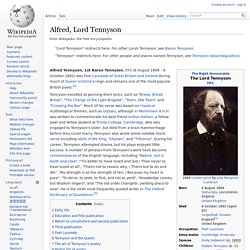
For other Lords Tennyson, see Baron Tennyson. Alfred Tennyson, 1st Baron Tennyson, FRS (6 August 1809 – 6 October 1892) was Poet Laureate of Great Britain and Ireland during much of Queen Victoria's reign and remains one of the most popular British poets.[2] Early life[edit] Tennyson was born in Somersby, Lincolnshire, England.[4] He was born into a middle-class line of Tennysons, but also had a noble and royal ancestry. An illustration by W. His father, George Clayton Tennyson (1778–1831), was rector of Somersby (1807–1831), also rector of Benniworth (1802–1831) and Bag Enderby, and vicar of Grimsby (1815).
Tennyson and two of his elder brothers were writing poetry in their teens, and a collection of poems by all three was published locally when Alfred was only 17. Education and first publication[edit] At Cambridge, Tennyson met Arthur Henry Hallam, who became his closest friend. Return to Lincolnshire and second publication[edit] Third publication[edit]