
Plastic statistics - PlasticsEurope. Plastics – the Facts 2012” report now available: More efforts towards zero plastics to landfill needed - PlasticsEurope. The plastics industry has set itself the challenging goal of reaching zero plastics going to landfill by 2020.

However, the efforts of all stakeholders towards turning waste into a valuable resource - be it through recycling or energy recovery - need to be increased. Latest data say that with a business as usual approach, zero plastics to landfill would only be reached by the year 2037. Achieving the 2020 objective would prevent an estimated 80 million tonnes of plastic waste from going to landfill, an amount representing about 1 billion barrels of oil or around €78 billion. This is one of the main conclusions drawn from the annual monitoring report "Plastics – the Facts 2012”, which is published by PlasticsEurope, representing Europe’s plastics producers, European Plastics Converters (EuPC), European Plastics Recyclers (EuPR) and the European Association of Plastics Recycling and Recovery Organisations (EPRO). Kodesaster ohne Ende?: Der Kampf gegen Plastik - Meere Ozeane Müll - Meere, Ozeane, Müll, Abfall, Wasser, Umweltgifte, DDT, PCB, POP, Kunststoff, Plastik, Müllhalde, Nordpazifikwirbel, Great Pacific Garbage Patch, Bermuda-Dreieck, Sargassosee,
Bio-Kunststoffe als Lösung gegen die Verschmutzung der Welt mit Plastik? Google. BBC Radio 4 - Costing the Earth, Plastic Pollution.
Drones + Machines. Can the oceans be cleared of floating plastic rubbish? 6 October 2010Last updated at 11:57 By Helen Lennard Producer, Costing the Earth Hundreds of millions of tonnes of plastic are estimated to litter the world's oceans Scientists are investigating ways of dealing with the millions of tonnes of floating plastic rubbish that is accumulating in our oceans.
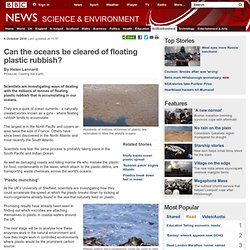
They are a quirk of ocean currents - a naturally created vortex known as a gyre - where floating rubbish tends to accumulate. The largest is in the North Pacific and covers an area twice the size of France. Others have since been discovered in the North Atlantic and most recently the South Atlantic. Scientists now fear the same process is probably taking place in the South Pacific and Indian Ocean. As well as damaging coasts and killing marine life who mistake the plastic for food, contaminants in the water, which attach to the plastic debris, are transporting waste chemicals across the world's oceans. 'Plastic munching' 'Diesel' plastic Recycling and prevention. Beyond the absurdity of a “Texas-sized Garbage Patch” Lies a Larger Menace of Plastic Pollution in the World’s Oceans.
By Marcus Eriksen, PhD, Co-founder 5 Gyres Institute/Director of Project Development, Algalita Marine Research Foundation Media is sometimes the tail that wags the dog of science.
One oceanographer described finding plastic in his relatively tiny Texas-size study area of the North Pacific Ocean, while another began describing these areas of concentration as “garbage patches”. A mis-information frenzie birthed a mis-conception of an island of trash. Hurry, someone plant a flag – sell real estate! Disappointing to the entrepreneurial spirit that aimed to fix it for a fee, there are no such islands. It’s a patchy patch. 1999 was not the first time scientist studied plastic pollution in the ocean. “Somebody do something,” cried the ocean advocates, artists, celebrities and politicians. But if no one cleans it up, will the garbage patches keep growing? We want to know a few things.