
Diag353. Elphel camera under the hood: from Verilog to PHP. Foreword: -- This paper describes the recent imaging advances by Elphel, supplier of open source (hardware and software) cameras to customers that include Google (for select Street View and book scanning projects). It should interest imaging engineers, fans of open source, and those curious about open source hardware. The paper was written by Dr. Andrey Filippov, the Russian physicist who founded Elphel in 2001. Filippov has contributed many papers to LinuxDevices through the years, as regular readers will be aware. This paper begins with some background on Elphel, and Filippov's decision to build a company around open source. Along the way, Filippov painstakingly explains recent work done to improve the data pathway in the camera.
It gets better after that, as Filippov includes a fairly mind-boggling description of the image compression algorithms used in Elphel cameras. (To visit Elphel on the web, click here ). Enjoy . . . ! Elphel camera under the hood: from Verilog to PHP by Andrey N. Elphel Development Blog. Elphel Development Blog. Elphel. Elphel model 353 with internal HDD Elphel, Inc. designs and manufactures open hardware[1] and free software[2] cameras primarily for scientific applications, though these products can easily be customised for many different uses.
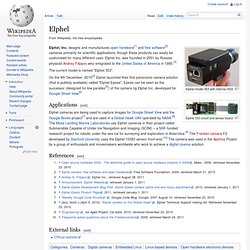
Elphel Inc. was founded in 2001 by Russian physicist Andrey Filippov who emigrated to the United States of America in 1995.[3] The current model is named "Elphel 353". On the 6th December, 2010[4] Elphel launched their first panoramic camera solution (that is publicly available) called "Elphel Eyesis". Eyesis can be seen as the successor (designed for low parallax[5]) of the camera rig Elphel Inc. developed for Google Street View[6] Elphel 333 circuit and sensor board Applications[edit] References[edit] External links[edit] Official website. Imaging solutions with Free software and open hardware. Theora Hardware - XiphWiki.
From XiphWiki This is a list of hardware of all categories, from chipsets to ready-to-use products, that support Ogg Theora.
Hardware support status for Ogg Theora is a new thing, but it seems it's sometimes included even if not advertised. If you can't find a suitable player come back next week, or ask your vendor if they could add support. If you know of any hardware or projects that are not yet mentioned here, please add them to the list. Consumer products These players support Ogg Theora either out of the box or after a firmware upgrade. COWON D2. According to Cowon America ( 2010-Sep-02 ), NO Cowon product supports Theora: "Our players do not support Theora video codec. KiSS DP-1500. Non-consumer products Encoder The Elphel 333 can encode a Theora stream. Decoder Currently there is a hardware decoder implementation being developed.
Here are two presentations that the author of the SOC 2006 proposal presented in his University: Architecture and current state of development Developers See also. Free Hardware Implementation of Theora Videoencoder. Andrey Filippov Elphel, Inc.

Copyright © 2005 by the Author(s) Abstract FPGA are excellent devices for advancing the achievements of the Free Software into the hardware world and Elphel model 333 camera is a project in this area. Being the next step to the previous Elphel design that used reconfigurable Xilinx FPGA for the fast JPEG/motion JPEG compression the model 333 uses new Xilinx Spartan 3 to implement more advanced Ogg Theora videoencoder that is capable of processing 1.3Mpix images at 30 fps, larger images (up to 4.5 MPix) can be served at proportionally lower frame rate. Free Hardware Implementation of Theora Videoencoder Andrey Filippov (andrey@elphel.com) Model 333 camera is the third generation of the cameras designed at Elphel, Inc. The next Elphel camera (model 313 in 2003) targeted more general network cameras applications, trying to combine the high resolution images from CMOS sensors with the highest frame rate they were able to provide. Requirements to an advanced camera. Apertus - open source cinema Project/Software/Hardware Introduction.
Apertus - Open Source Cinema.