
The Story of a Tweet. When you follow people, their Tweets instantly show up in your timeline.

Similarly, your Tweets show up in your followers' timelines. To see interesting Tweets, follow interesting people: friends, celebrities, news sources, or anyone whose Tweets you enjoy. Learn the lingo. Workshop Materials. Developing Self-Assessment with the Dual-Entry Rubric and Author’s Memo. If you don’t score essays with rubrics, you probably have good reason.

Maybe you don’t accept that all the qualities of an essay can be reduced to metrics, or resist the pressure to standardize students’ performances, or feel that rubrics are an overly legalistic means to cover yourself when students or parents protest a grade, or balk at the notion that evaluating essays is objective. If you do score essays with rubrics, you probably have good reason. Maybe you want to make essay evaluation more transparent to students, or feel that itemizing an essay’s strengths and weaknesses benefits writers, or believe in making essay scoring as objective as possible. I use rubrics on occasion and have experimented with different versions in an attempt to mitigate against some of a rubric’s drawbacks. The following section describes one type of rubric that I believe enhances students’ self-assessment skills. NoTosh learning. Welcome to ds106.
Snapshot of a Deeper Learning Classroom: Aligning TED Talks to the Four Cs. Edutopia is pleased to premiere the first blog in a new series designed to showcase compelling examples of how students are developing 21st century skills through a deeper-level of learning. Through this blog series, we hope to increase awareness and encourage replication of successful models. Chris Anderson, TED curator. (Photo credit: Pierre Omidyar via Wikimedia Commons) 'I Urge You to Drop E67-02': Course Syllabi by Famous Authors. This is what it'd be like to take a class taught by David Foster Wallace, Katie Roiphe, or Zadie Smith.
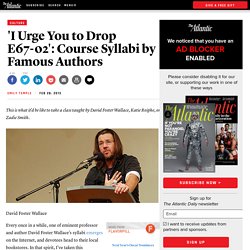
David Foster Wallace. 7 Ways to Use Technology With Purpose. Why are you using technology?
Or more importantly, how are you using technology to better the learning in your classroom and/or school? If you are like me, then you’ve had your fair share of technology screw ups. Projects that didn’t make sense (but used the tech you wanted to bring in). Activities that were ruined by a crashing website or some technological problem. Surprise Endings: Social Science and Literature. Course Description.
Surprise Endings: Social Science and Literature. Www9.georgetown.edu/faculty/bassr/tamlit/newsletter/4/Lauter.htm. This essay is adapted from a talk given last May at the American Literature Association Conference in San Diego.

I want to set down and illustrate a number of operational principles which I have found helpful in teaching a reconstructed or multicultural course in American literature. I will talk about voice, audience, function--three closely related elements--then about ethnography and context, and finally about what is to me central: comparative study. I don't suppose that these principles, much less the illustrations, are exhaustive or in many cases particularly new; I do think they can be useful, and also that they can stimulate other teachers to share their approaches to what, in real practice, is a relatively new discipline. One theoretical issue before I get down to cases.
The Age of the Essay. September 2004 Remember the essays you had to write in high school?
Topic sentence, introductory paragraph, supporting paragraphs, conclusion. The conclusion being, say, that Ahab in Moby Dick was a Christ-like figure. Oy. Topics in Faculty Focus. Academic Leadership Setting academic priorities, evaluating faculty, succession planning, making the transition from faculty to administrator, the issues and leadership responsibilities are many, and seem to grow daily.

Turn to Faculty Focus for academic leadership articles written to help deans, chairs, and other academic decision makers lead effectively. App Of The Week App of the Week is a new feature here on Faculty Focus written by Dave Yearwood, PhD, associate professor and chair of the technology department at the University of North Dakota. Dave is an avid collector of apps and is always on the lookout for new ones that can improve student learning or simply make academic life more organized, productive and fun. Video channel on TED.com. College Composition and Communication, Vol. 58, No. 2 (Dec., 2006), pp. 248-257.
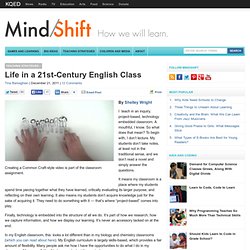
College Composition and Communication, Vol. 33, No. 2 (May, 1982), pp. 148-156. Bloom's Digital Taxonomy. What makes a great teacher? - A student says, "This!" Life in a 21st-Century English Class. Teaching Strategies Creating a Common Craft-style video is part of the classroom assignment.
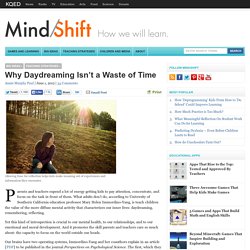
Why Daydreaming Isn’t a Waste of Time. Allowing time for refleciton helps kids make meaning out of experiences and information they encounter.
Parents and teachers expend a lot of energy getting kids to pay attention, concentrate, and focus on the task in front of them. What adults don’t do, according to University of Southern California education professor Mary Helen Immordino-Yang, is teach children the value of the more diffuse mental activity that characterizes our inner lives: daydreaming, remembering, reflecting. What Should Rubrics Measure? Rubrics are tools that help teachers and students generate feedback about student evidence and student work. They offer an alternative to “point-based” or “number-based” grading, and they are often paired with authentic assessment. In my experience, most teachers usually create rubrics long after they have crafted a worthy performance task. However, I wish to pose an important question: Shouldn’t we know what evidence we seek BEFORE we even begin to think about performance tasks? If the goal of a performance based assessment is to provide teachers with evidence that a student has achieved understanding, then the rubric criteria should be identified FIRST.
The Benefits of Making It Harder to Learn - Do Your Job Better. By James M. Lang In January 2011, a trio of researchers published the results of an experiment in which they demonstrated that students who read material in difficult, unfamiliar fonts learned it more deeply than students who read the same material in conventional, familiar fonts. Strange as that may seem, the finding stems from a well-established principle in learning theory called cognitive disfluency, which has fascinating implications for our work as teachers. As the researchers pointed out in their article in the journal Cognition, both students and teachers may sometimes judge the success of a learning experience by the ease with which the learner processes or "encodes" the new information. Bertrand Russell’s 10 Commandments for Teachers.
Business - Joel Rose - How to Break Free of Our 19th-Century Factory-Model Education System. A technology and education entrepreneur gazes into the future of the classroom Apple Marketing chief Phil Schiller speaks during a news conference; Reuters More than 150 years ago, Massachusetts became the first state to provide all of its citizens access to a free public education.
Learners or Students??? « Learning Out Loud. Beginning with the end in mind. Learningspaces (16)-uchicago by smaedli on Flickr (for illustrative purposes only – not a proposed design for my space)