
Let our Los Angeles Wrongful Termination Attorney Help! Wrongful termination might not mean what you think it does in the legal sense.

That’s because, what we, as considerate human beings, think is unfair or unethical treatment in the Los Angeles workplace, is not necessarily illegal for U.S. employers. As a rather expensive California labor lawyer once indicated to this writer, employment laws give them much more leeway than you might imagine. Www.dir.ca.gov/dosh/WebComplaintForm.pdf. How to File a Complaint with OSHA. Who Can Complain?

Employees or their representatives have a right to request an inspection of a workplace if they believe there is a violation of a safety or health standard, or if there is any danger that threatens physical harm, or if an "imminent danger" exists. Employee representatives, for the purposes of filing a complaint, are defined as any of the following: An authorized representative of the employee bargaining unit, such as a certified or recognized labor organization. An attorney acting for an employee. Public Interest Law - Guide to Legal Public Service Careers. What is Public Interest Law?

Public interest lawyers and non-lawyers provide legal services to individuals, groups and organizations that are historically unrepresented in society. Studies show that about 80% of the legal needs of the poor in the United States remain unmet, despite existing federal, state and volunteer programs that provide legal services to low income people. Public interest lawyers, paralegals, law students and legal professionals provide legal services free of charge or for a substantially lower fee to underserved segments of the public such as the indigent, the elderly and others who cannot afford legal services.
Public interest law professionals also fight for the underdog: they seek to enact policy change, advocate for civil liberties and fight for environmental protection, consumer rights and other causes for the betterment of society. Types of Public Interest Cases Skills and Characteristics A career in public interest law is not for everyone. Skills: New Approaches to Understand Why Women Earn Less. "A Shocking Instance of Brutal Employer Aggression": Antiunion Violence in a "Union-Free" Town. In the late 1940s, large labor unions and major corporations worked out an accord that guided labor-management relations for the next quarter century.

Organized Labor - Labor Reform in the Obama Era. Labor Center Conference Looks at Challenges Facing Pro-Worker Legislation What are the prospects for labor law reform under the Obama administration?

That was the question front and center at a UC Berkeley Labor Center/California Labor Federation forum in Oakland Jan. 5. Speakers focused on the Employee Free Choice Act (EFCA), labor’s number one legislative priority for 2009, and how its passage would enable workers to unionize without the interference, delays, and legal and illegal barriers put up by employers. What exactly is EFCA? The Employee Free Choice Act would allow workers to form a union when over 50 percent of the employees sign union membership cards. Regional Offices. The National Labor Relations Board has 26 regional offices and is headquartered in Washington, DC.

Hover over the map below to find a regional office, and click to go to the regional homepage for more information, including news and upcoming events. Boston 10 Causeway Street6th FloorBoston, MA 02222-1072Phone: (617) 565-6700TTY: (617) 565-6470Fax: (617) 565-6725Hartford 450 Main StHartford, CT 06103-3503Phone: (860) 240-3522TTY: (860) 240-3041Fax: (860) 240-3564 New York 26 Federal PlazaRoom 3614New York, NY 10278-0104Phone: (212) 264-0300TTY: (212) 264-4708Fax: (212) 264-2450 Buffalo Niagara Center Building130 S.
WorkplaceChoice.org — Your Source for Labor News. The Official Web Page of the United Farm Workers of America. The Official Web Page of the United Farm Workers of America. In 1938 he and his family moved to California.

He lived in La Colonia Barrio in Oxnard for a short period, returning to Arizona several months later. They returned to California in June 1939 and this time settled in San Jose. They lived in the barrio called Sal Si Puedes -"Get Out If You Can. " Cesar thought the only way to get out of the circle of poverty was to work his way up and send the kids to college. He and his family worked in the fields of California from Brawley to Oxnard, Atascadero, Gonzales, King City, Salinas, McFarland, Delano, Wasco, Selma, Kingsburg, and Mendota.
He did not like school as a child, probably because he spoke only Spanish at home. While his childhood school education was not the best, later in life, education was his passion. He joined the U.S. The Official Web Page of the United Farm Workers of America. In 1938 he and his family moved to California.
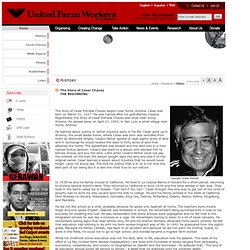
He lived in La Colonia Barrio in Oxnard for a short period, returning to Arizona several months later. They returned to California in June 1939 and this time settled in San Jose. They lived in the barrio called Sal Si Puedes -"Get Out If You Can. " Cesar thought the only way to get out of the circle of poverty was to work his way up and send the kids to college. Español. National Labor Relations Act. Congress enacted the National Labor Relations Act ("NLRA") in 1935 to protect the rights of employees and employers, to encourage collective bargaining, and to curtail certain private sector labor and management practices, which can harm the general welfare of workers, businesses and the U.S. economy.

Also cited NLRA or the Act; 29 U.S.C. §§ 151-169 [Title 29, Chapter 7, Subchapter II, United States Code] Section 1.[§151.] The inequality of bargaining power between employees who do not possess full freedom of association or actual liberty of contract and employers who are organized in the corporate or other forms of ownership association substantially burdens and affects the flow of commerce, and tends to aggravate recurrent business depressions, by depressing wage rates and the purchasing power of wage earners in industry and by preventing the stabilization of competitive wage rates and working conditions within and between industries.
Sec. 2. [§152.] [Pub. Sec. 3. [§ 153.] HOW TO START A UNION.