
Lean manufacturing. Overview[edit] The difference between these two approaches is not the goal itself, but rather the prime approach to achieving it.
The implementation of smooth flow exposes quality problems that already existed, and thus waste reduction naturally happens as a consequence. The advantage claimed for this approach is that it naturally takes a system-wide perspective, whereas a waste focus sometimes wrongly assumes this perspective. Both lean and TPS can be seen as a loosely connected set of potentially competing principles whose goal is cost reduction by the elimination of waste.[5] These principles include: Pull processing, Perfect first-time quality, Waste minimization, Continuous improvement, Flexibility, Building and maintaining a long term relationship with suppliers, Autonomation, Load leveling and Production flow and Visual control.
Origins[edit] Lean aims to make the work simple enough to understand, do and manage. A brief history of waste reduction thinking[edit] 20th century[edit] Design structure matrix. A sample DSM with 7 elements and 11 dependency marks.

Overview[edit] A design structure matrix lists all constituent subsystems/activities and the corresponding information exchange and dependency patterns. In other words, it details what pieces of information are needed to start a particular activity, and shows where the information generated by that activity leads. In this way, one can quickly recognize which other tasks are reliant upon information outputs generated by each activity. It has two main strengths. DSM analysis provides insights into how to manage complex systems or projects, highlighting information flows, task sequences and iteration.
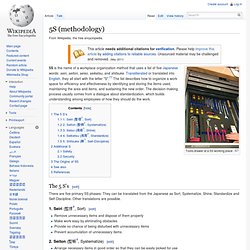
DSM analysis can also be used to manage the effects of change. Design[edit] A DSM is a square matrix. Two main categories of DSMs have been proposed: static and time-based. DSMs stem from diverse roots. Use[edit] The use of DSMs in both research and industrial practice increased greatly in the 1990s. References[edit] References[edit] 5S (methodology) Tools drawer at a 5S working place 5S is the name of a workplace organization method that uses a list of five Japanese words: seiri, seiton, seiso, seiketsu, and shitsuke.
Transliterated or translated into English, they all start with the letter "S".[1] The list describes how to organize a work space for efficiency and effectiveness by identifying and storing the items used, maintaining the area and items, and sustaining the new order. The decision-making process usually comes from a dialogue about standardization, which builds understanding among employees of how they should do the work. There are five primary 5S phases: They can be translated from the Japanese as Sort, Systematize, Shine, Standardize and Self-Discipline. Other translations are possible. Remove unnecessary items and dispose of them properlyMake work easy by eliminating obstaclesProvide no chance of being disturbed with unnecessary itemsPrevent accumulation of unnecessary items The phase, "Security", can also be added. PDCA. PDCA (plan–do–check–act or plan–do–check–adjust) is an iterative four-step management method used in business for the control and continuous improvement of processes and products.
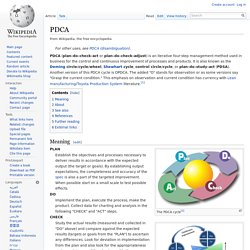
It is also known as the Deming circle/cycle/wheel, Shewhart cycle, control circle/cycle, or plan–do–study–act (PDSA). Another version of this PDCA cycle is OPDCA. The added "O" stands for observation or as some versions say "Grasp the current condition. " This emphasis on observation and current condition has currency with Lean manufacturing/Toyota Production System literature.[1] Meaning[edit] Continuous quality improvement with PDCA Establish the objectives and processes necessary to deliver results in accordance with the expected output (the target or goals).
Implement the plan, execute the process, make the product. Study the actual results (measured and collected in "DO" above) and compare against the expected results (targets or goals from the "PLAN") to ascertain any differences. About[edit] See also[edit]