
Ordorise.html. Amazing Egg Experiments at Steve Spangler Science. Squeeze an Egg Without Breaking It Eggs are amazingly strong despite their reputation for being so fragile.

Place an egg in the palm of your hand. Close your hand so that your fingers are completely wrapped around the egg. Squeeze the egg by applying even pressure all around the shell. To everyone's amazement (mostly your own) the egg will not break. If you're a little nervous about the outcome, try sealing the raw egg in a zipper-lock bag before putting the squeeze on it, or hold the egg over the sink if you're in the super-brave category.
Now hold the egg between your thumb and forefinger and squeeze the top and bottom of the egg. Finally, hold the egg in the palm of your hand. The egg's unique shape gives it tremendous strength, despite its fragility. Hardboiled or Raw? Science Junction - Egg-cellent Adventures. The Good Egg Project Education Station. Math Brain Teaser. "Scrambled Egg" Math. If you’re like most parents in today’s environmentally conscious world, you’re always looking for ways to reuse, reduce or recycle containers, boxes, bottles or egg cartons.
Here's yet another use for an egg carton that can provide your first grader with the opportunity to practice the important math skills of number recognition and sequencing in an independent, fun-filled way. What You Need: Plastic egg carton Markers 2 small plastic chips, lima beans or pennies for game tokens Paper Pencil What You Do: Using markers, write a different number from 1 to 9 in each section of the egg carton (three numbers must be written twice. With practice games like this, kids build their confidence in recognizing numbers that they may consider big and daunting. Victoria Hoffman, M.A., is an elementary school teacher, writer and mother from Leonardtown, Maryland.
“Easter Egg Math” reviews addition and subtraction. Title – Easter Egg Math By – Sylvia Garza Subject – Math Grade Level – Pre-K – 1 Usually, springtime is a good time for kindergarten children to review and practice some of the skills that they’ve been taught and this can be a fun interactive way of doing so.
Objective: Review addition, subtraction, and learn problem-solving skills. Materials: An Easter Basket, Easter grass and several plastic eggs. Activity: Place 2-10 eggs in the basket. Select 1-2 children to look for the eggs. The children can help solve this problem and may write the equation on the chalkboard to resolve the problem. After all the eggs have been found you may repeat the activity using other children.
You may direct this activity to be for either adding or subtracting or to teach inverse addition and subtracting, or for missing addends. Individual follow-up activities for independent practice could include a worksheet of Easter Eggs with equations written inside. This would also serve as an evaluation. E-Mail Sylvia ! Egg Math. 1.
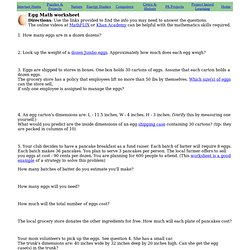
How many eggs are in a dozen dozens? 2. Look up the weight of a dozen Jumbo eggs. Approximately how much does each egg weigh? Chickscope 1.5: Explore: EggMath. EggMath: Welcome to EggMath This is the EggMath version 1.5, a collection of web modules (including many interactive applets) covering different topics in mathematics related to eggs; it is intended for use in K-12 classrooms, as in the Chickscope project at the Beckman Institute.
The current modules deal with: EggMath was created by Professors Steve Bradlow and John Sullivan of the UIUC Math Department, with Stuart Levy of the NCSA, and Brian Klamik. NEW! A version of the EggMath web pages for local installations. .zip file (467K) For Windows '95/'98/NT, but also expanable by many UNIX systems, and Macintosh systems running Stuffit Expander 5.1.3. .sea file (474K) Self-extracting archive for Macintosh systems only. .hqx file (662K) Binhexed version of the .sea file. .tar.gz file (412K) GZIP-ed TAR file for UNIX systems. We're always open to other suggestions. . - Page 1 of 15 -
Easter Lapbook, Resurrection Lapbook.