
Here Come the Crowd-Sorcerers: How Technology is Disrupting the Humanitarian Space and How Easy It Is. I’ve recently been cc’d on an email thread in which a humanitarian group has started to “air out some latent issues and frustrations” vis-a-vis the use of crowdsourcing in emergencies.

I applaud them for speaking up and credit them for coining the fantastic term “crowd-sorcerers” which is brilliant! The group is apparently preparing to publish a report concerning Humanitarian Information Management in Haiti. I really hope to appear in their chapter on “The Crowd-Sorcerers.” I wonder which kind of sorcerer I am... I too prefer candid conversations over diplomatic pillow talk. I’ll first lay out some of the frustrations aired by the Muggles in their own words so I don’t misrepresent their concerns—some of which are obviously valid (but not necessarily new).
Muggles: Unless there are field personnel providing “ground truth” data, consumers will never have reliable information upon which to build decision support products. Map of volunteer locations Where were the Muggles then? Like this: Are You Being Left Behind as Technology Ushers In a Whole New Approach to Philanthropy? #CoFLA. Note From Beth: Just before I left for Rwanda, I caught some interesting discussion threads about organizational adoption of networked ways of working on Twitter coming from the #COFLA hashtag as a result of the Council on Foundations gathering in Los Angeles.

I discovered that it was Larry Eason from DotOrgPower and his colleague, Shelley Wenk, offered to write this summary of the discussion as a guest post.When I landed, I was able to get the guest post from Shelley via email and publish it because Rwanda has one of the better Internet connectivity infrastructures for the countries here in Africa, although it is like what I’m used in the US. It made reflect on the different challenges – access vs culture — why should the cultural barriers be just as difficult? Here’s a summary of the discussion. Are You Being Left Behind as Technology Ushers In a Whole New Approach to Philanthropy? #CoFLA Guest Post by Shelley Wenk You Are Not In Control Transparency and the Power of Public Failure. Your Nonprofit Tech Checklist. At the end of the Social Media for Social Good: A How-To Guide for Nonprofits is a nine-page “Nonprofit Tech Checklist” which I have copied and pasted below.
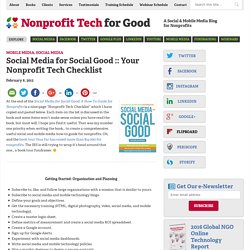
Each item on the list is discussed in the book and some items won’t make sense unless you have read the book, but most will. I hope you find it useful. That was my number one priority when writing the book… to create a comprehensive, useful social and mobile media how-to guide for nonprofits. Oh, and the book tour thus far has raised more than $14,000 for nonprofits. The IRS is still trying to wrap it’s head around that one… a book tour fundraiser. Getting Started: Organization and Planning Web 1.0 :: The Broadcast Web 1) Website 2) e-Newsletter 3) “Donate Now” Fundraising Web 2.0 :: The Social Web 1) Facebook Create a Facebook Page.Design custom tabs.Find your Facebook voice.Find and monitor your Facebook Community Page, if applicable.Claim your Facebook Places Page, if applicable. 2) Twitter 3) YouTube 4) Flickr 5) LinkedIn 7) Blogging.
How Collaboration helps and empowers NGO 2.0.