
Spathiphyllum. Spathiphyllum is a genus of about 40 species of monocotyledonous flowering plants in the family Araceae, native to tropical regions of the Americas and southeastern Asia.
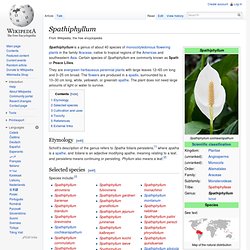
Certain species of Spathiphyllum are commonly known as Spath or Peace Lilies. They are evergreen herbaceous perennial plants with large leaves 12–65 cm long and 3–25 cm broad. The flowers are produced in a spadix, surrounded by a 10–30 cm long, white, yellowish, or greenish spathe. The plant does not need large amounts of light or water to survive. Etymology[edit] Schott's description of the genus refers to Spatha foliaris persistens,[1] where spatha is a spathe, and foliaris is an adjective modifying spathe, meaning relating to a leaf, and persistens means continuing or persisting.
Selected species[edit] Species include:[3] Cultivated hybrids include:[4] Spathiphyllum × clevelandii Cultivation and uses[edit] Several species are popular indoor houseplants. Orchidaceae. Etymology[edit] The name comes from the Ancient Greek ὄρχις (órkhis), literally meaning "testicle", because of the shape of the root in the type genus Orchis.[5][6] Carl Linnaeus classified the family as Orchidaceae.
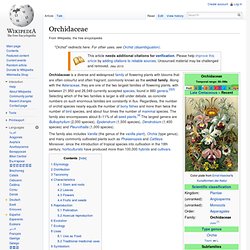
Orchid was introduced in 1845 by John Lindley in School Botany, in an attempt to extract a Latin stem (orchis) from Orchidaceae. These flowers were previously called Orchis, Satyrion (Satyrion feminina), or "ballockwort". Distribution[edit] The following list gives a rough overview of their distribution:[citation needed] Oceania: 50 to 70 generaNorth America: 20 to 26 generatropical America: 212 to 250 generatropical Asia: 260 to 300 generatropical Africa: 230 to 270 generaEurope and temperate Asia: 40 to 60 genera Taxonomy[edit] The taxonomy of this family is in constant flux, as new studies continue to identify more classificatory elements. Five subfamilies are recognised.
Characteristics[edit] Stem and roots[edit] Terrestrial orchids may be rhizomatous or form corms or tubers. Aquilegia canadensis. Description[edit] The caterpillars of Columbine Duskywing (Erynnis lucilius) feed on the leaves.

Cultivation[edit] The plant is easily propagated from seed and blooms the second year. It is relatively long lived in the garden. It grows well in shade, and in sun with proper moisture. The plant has gained the Royal Horticultural Society's Award of Garden Merit.[1] The cultivar 'Little Lanterns' is half the height of the species. Uses[edit] Native American tribes used various parts red columbine in herbal remedies. Toxicity[edit] Canada columbine contains a cyanogenic glycoside, which releases poisonous hydrogen cyanide when the plant is damaged.[2] Distribution[edit] USA (AL, AR, CT, DC, DE, FL, GA, IA, IL, IN, KS, KY, MA, MD, ME, MI, MN, MO, MS, NC, ND, NE, NH, NJ, NY, OH, OK, PA, RI, SC, SD, TN, TX, VA, VT, WI, WV), Canada (MB, NB, ON, QC, SK) Wetland Indicator Status[edit] Regions 1-5: Facultative Equally (FAC) likely to occur in wetlands or non-wetlands (estimated probability 34%-66%).