
Table of Contents. Axioms. Contents Contents | rgb Home | Philosophy Home | Axioms | Other Books by rgb: | The Book of Lilith | Axioms is a work that explores the true nature of human knowledge, in particular the fundamental nature of deductive and inductive reasoning.
It begins by embracing Hume's Skepticism and Descartes' one ``certain'' thing, and then looking for a way out of the solipsistic hell this leaves one in in terms of ``certain'' knowledge. Indeed, to the extent that philosophy in the past has sought to provide certain answers to virtually any question at all, philosophy itself proves to be bullshit - all philosophical arguments ultimately come back to at least one unprovable premise, usually unstated, and can be refuted by simply asserting ``I don't agree with your premises.'' The way out is to give up the idea of certain knowledge.
Axioms by Robert G. Dedication No book is written in a vacuum. Notice Copyright Notice Copyright Robert G. Lulu Press www.lulu.com. The Analysis of mind, by Bertrand Russell. Dan Dennett on our consciousness. Portal:Mind and Brain. Electroencephalography. Simultaneous video and EEG recording of two guitarists improvising.

Electroencephalography (EEG) is the recording of electrical activity along the scalp. EEG measures voltage fluctuations resulting from ionic current flows within the neurons of the brain.[1] In clinical contexts, EEG refers to the recording of the brain's spontaneous electrical activity over a short period of time, usually 20–40 minutes, as recorded from multiple electrodes placed on the scalp. Diagnostic applications generally focus on the spectral content of EEG, that is, the type of neural oscillations that can be observed in EEG signals. EEG is most often used to diagnose epilepsy, which causes obvious abnormalities in EEG readings.[2] It is also used to diagnose sleep disorders, coma, encephalopathies, and brain death.
History[edit] Hans Berger In 1934, Fisher and Lowenback first demonstrated epileptiform spikes. In 1947, The American EEG Society was founded and the first International EEG congress was held. Alpha wave. Alpha waves are neural oscillations in the frequency range of 7.5–12.5 Hz[1] arising from synchronous and coherent (in phase or constructive) electrical activity of thalamic pacemaker cells in humans.
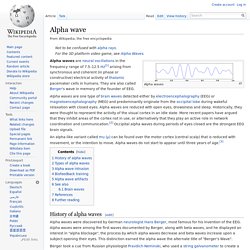
They are also called Berger's wave in memory of the founder of EEG. Alpha waves are one type of brain waves detected either by electroencephalography (EEG) or magnetoencephalography (MEG) and predominantly originate from the occipital lobe during wakeful relaxation with closed eyes. Alpha waves are reduced with open eyes, drowsiness and sleep.
Historically, they were thought to represent the activity of the visual cortex in an idle state. More recent papers have argued that they inhibit areas of the cortex not in use, or alternatively that they play an active role in network coordination and communication.[2] Occipital alpha waves during periods of eyes closed are the strongest EEG brain signals. History of alpha waves[edit] Types of alpha waves[edit] Alpha wave intrusion[edit] See also[edit] Hans Berger. Hans Berger (21 May 1873 – 1 June 1941) was a German neurologist, best known as the inventor of electroencephalography (EEG) (the recording of "brain waves") in 1924, coining the name,[1] and the discoverer of the alpha wave rhythm known as "Berger's wave".

Biography[edit] Berger was born in Neuses (now part of Coburg), Saxe-Coburg and Gotha, Germany. After attending Casimirianum, where he gained his abitur in 1892, Berger enrolled as a mathematics student at the Friedrich Schiller University of Jena with a view to becoming an astronomer. After one semester, he abandoned his studies and enlisted for a year of service in the cavalry. During a training exercise, his horse suddenly reared and he landed in the path of a horse-drawn cannon.
After obtaining his medical degree from Jena in 1897, Berger joined the staff of Otto Ludwig Binswanger (1852–1929) who held the Chair in psychiatry and neurology at the Jena clinic. Research[edit] An early EEG recording done by Berger Hans-Berger-Preis[edit]