
Numeracy. Children in Laos have fun as they improve numeracy with "Number Bingo.

" They roll three dice, construct an equation from the numbers to produce a new number, then cover that number on the board, trying to get 4 in a row. Numeracy is the ability to reason and to apply simple numerical concepts.[1] Basic numeracy skills consist of comprehending fundamental mathematics like addition, subtraction, multiplication, and division. For example, if one can understand simple mathematical equations such as, 2 + 2 = 4, then one would be considered possessing at least basic numeric knowledge.
Substantial aspects of numeracy also include number sense, operation sense, computation, measurement, geometry, probability and statistics. A numerically literate person can manage and respond to the mathematical demands of life.[2] By contrast, the lack of numeracy or innumeracy can have a negative impact if the skills are absent. Representation of numbers[edit] They are: Definitions and assessment[edit] Age[edit] How to Build a Memory Palace. <img alt="Image titled Build a Memory Palace Step 1" src=" width="728" height="546" class="whcdn">1Edit step1Decide on a blueprint for your palace.
While a memory palace can be a purely imagined place, it is easier to base it upon a place that exists in the real world and that you are familiar with or you can use some places of your favorite video game. A basic palace could be your bedroom, for example. Larger memory palaces can be based on your house, a cathedral, a walk to the corner store, or your town. The larger or more detailed the real place, the more information you can store in the corresponding mental space. <img alt="Image titled Build a Memory Palace Step 2" src=" width="728" height="546" class="whcdn">2Edit step2Define a route. <img alt="Image titled Build a Memory Palace Step 11" src=" width="728" height="546" class="whcdn">11Edit step11Build new palaces.
Method of loci. The method of loci (loci being Latin for "places") is a method of memory enhancement which uses visualizations with the use of spatial memory, familiar information about one's environment, to quickly and efficiently recall information.
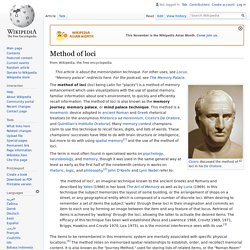
The method of loci is also known as the memory journey, memory palace, or mind palace technique. This method is a mnemonic device adopted in ancient Roman and Greek rhetorical treatises (in the anonymous Rhetorica ad Herennium, Cicero's De Oratore, and Quintilian's Institutio Oratoria). Many memory contest champions claim to use this technique to recall faces, digits, and lists of words. These champions' successes have little to do with brain structure or intelligence, but more to do with using spatial memory[1] and the use of the method of loci. 'the method of loci', an imaginal technique known to the ancient Greeks and Romans and described by Yates (1966) in her book The Art of Memory as well as by Luria (1969).
Contemporary usage[edit] Literature[edit] Bloom's Taxonomy of Learning Domains. Note: This site is moving to KnowledgeJump.com.
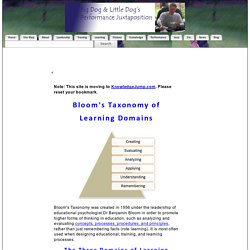
Please reset your bookmark. Bloom's Taxonomy was created in 1956 under the leadership of educational psychologist Dr Benjamin Bloom in order to promote higher forms of thinking in education, such as analyzing and evaluating concepts, processes, procedures, and principles, rather than just remembering facts (rote learning). It is most often used when designing educational, training, and learning processes.
The Three Domains of Learning The committee identified three domains of educational activities or learning (Bloom, et al. 1956): Cognitive: mental skills (knowledge) Affective: growth in feelings or emotional areas (attitude or self) Psychomotor: manual or physical skills (skills) Since the work was produced by higher education, the words tend to be a little bigger than we normally use. While the committee produced an elaborate compilation for the cognitive and affective domains, they omitted the psychomotor domain. Cognitive Domain Review.