
Emotions Are A Resource, Not A Crutch. Ever since Darwin, and perhaps long before him, it has been theorized that our emotions play a crucial role in adapting to our environment.
This means that emotions are not just an inconvenient byproduct of consciousness, but a form of higher cognition – an ability for living beings to experience their world in deeper and more complex ways. Wave of Emotions. Tracking the tell-tale signs of pure genius. The 10 Most Revealing Freudian Slips From Politicians.
Relationship Talk. Sex&love. 25 Acts of Body Language to Avoid. Our body language exhibits far more information about how we feel than it is possible to articulate verbally.
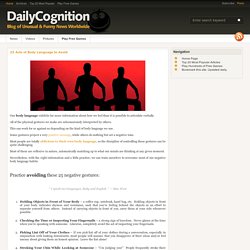
All of the physical gestures we make are subconsciously interpreted by others. This can work for or against us depending on the kind of body language we use. Some gestures project a very positive message, while others do nothing but set a negative tone. Most people are totally oblivious to their own body language, so the discipline of controlling these gestures can be quite challenging. Most of them are reflexive in nature, automatically matching up to what our minds are thinking at any given moment. Nevertheless, with the right information and a little practice, we can train ourselves to overcome most of our negative body language habits. Practice avoiding these 25 negative gestures: “ I speak two languages, Body and English. ” — Mae West. Emotional Skills Toolkit: Bring Your Life Into Balance. We often hear from people who feel overwhelmed by stress, family, work and relationship problems, health challenges, and painful emotions.
They’ve tried many approaches to help themselves feel better, but they just can’t seem to follow through, or what they’ve done hasn't helped them enough. If this sounds familiar, you know that it’s all too easy to become discouraged when you’re stuck. The problem is not willpower—all the willpower in the world won’t matter if you can’t manage stress or keep your emotions in balance. The good news: you can learn these important emotional skills, no matter your age or the obstacles you face. That’s what this free online program teaches. 12 Tips for “Psychological Selling” Emotions – How To Understand, Identify and Release Your Emotions. How can I successfully identify and release my emotions? - emotions meditation emotional. How can I successfully identify and release my emotions?

I experienced a very controlled childhood during which I needed to suppress my emotions and wants in order to avoid conflict. Emotional Intelligence. What is emotional intelligence?
Emotional intelligence (EQ) is the ability to identify, use, understand, and manage emotions in positive ways to relieve stress, communicate effectively, empathize with others, overcome challenges, and defuse conflict. Emotional Skills Toolkit. Revenge. The passion for revenge is strong and sometimes almost overwhelming.
EMONET - Emotions Network. 50 Things Men Wish Women Knew. I just came across this article and thought it would be great for all of us ladies on here.
I know my single friends and I always question what guys really want and this gives us a little more insight into that. Not to mention it's some great advice from men about what they wish we ladies knew/understood about them. Hope you enjoy!! (Also, be sure to check out our list of 50 Things Women Wish Men Knew) What He Wishes You Knew #1. Emotional Intelligence, Social Intelligence, Ecological Intelligence. EMONET - Emotions Network. Titre du site Web - GERG - Geneva Emotion Research Group. The Geneva Emotion Research Group, co-directed by Professors Klaus Scherer, David Sander, and Didier Grandjean is part of an multidisciplinary center for the affective sciences (Centre Interfacultaire en Sciences Affectives - CISA) at the University of Geneva.
The members of our group work on theoretical development and empirical research in the affective sciences. Emotional Intelligence. Eq. The Chameleon Outcast: When Social Mimicry Goes Awry. Two people are talking to each other.
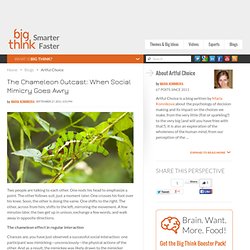
One nods his head to emphasize a point. The other follows suit, just a moment later. One crosses his foot over his knee. Soon, the other is doing the same. One shifts to the right. The chameleon effect in regular interaction Chances are, you have just observed a successful social interaction: one participant was mimicking—unconsciously—the physical actions of the other. However, for the effect to work, the nonconscious part is crucial: in a regular interaction, the behavior must be passive and unintentional. The phenomenon is simple; the social and interpersonal repercussions profound. When the chameleon effect goes wrong. Shadow Boxing: Understanding Projection & Your Shadow Side. Through the process of psychological development, we all develop an identity that allows us to identify with a certain personality type.
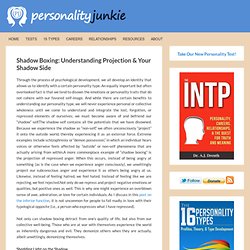
An equally important but often overlooked fact is that we tend to disown the emotions or personality traits that do not cohere with our favored self-image. And while there are certain benefits to understanding our personality type, we will never experience personal or collective wholeness until we come to understand and integrate the lost, forgotten, or repressed elements of ourselves; we must become aware of and befriend our “shadow” self.The shadow self contains all the potentials that we have disowned. Because we experience the shadow as “non-self,” we often unconsciously “project” it onto the outside world, thereby experiencing it as an external force. Not only can shadow boxing detract from one’s quality of life, but also from our collective well-being. Those who are at war with themselves experience the world as inherently dangerous and evil.