
The HyperWeb: it?s All About Connections. I recently came across this interesting graphic entitled Hierarchy of Visual Information.
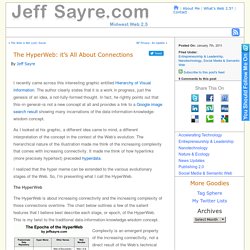
The author clearly states that it is a work in progress, just the genesis of an idea, a not-fully-formed thought. In fact, he rightly points out that this–in general–is not a new concept at all and provides a link to a Google image search result showing many incarnations of the data-information-knowledge-wisdom concept. As I looked at his graphic, a different idea came to mind, a different interpretation of the concept in the context of the Web’s evolution. The hierarchical nature of the illustration made me think of the increasing complexity that comes with increasing connectivity.
It made me think of how hyperlinks (more precisely hypertext) preceded hyperdata. I realized that the hyper meme can be extended to the various evolutionary stages of the Web. The HyperWeb The HyperWeb is about increasing connectivity and the increasing complexity of those connections overtime. My Related Articles. Intelligent Systems Development. [This "Protocal" is applicable to White Papers, Concept Papers, and Technical Papers; its participatory availability and modifications from time-to-time will be announced in "News")] Protocal Ai3inc, in its Open Participation, CoCreative mode, will originate, conduct, and distribute results of its Research, Technology and Product Development (RT&PD) via its autonomously formed and self-directed CogWebs.

A CogWeb™ is, by definition, a Network of MINDClones with an adaptation of the CoGnome for Network Decision-Making by IntelliSite-definted groups, organizations, communities and societies. Participation for TrueThinker.com subscribers is effected through a request to join a specific TrueThinker Community (AI3RT&PD) with an evolving KnowledgeBank formed from its Open Participants' RT&PD efforts. The collective discourse will be run using a process of Ai3inc's "seeding" the Community with ideas/themes (concepts), thereby creating spontaneous CogWebs™, smartswarms.
xWeb no blog Connectivism de George Siemens. This site has been created to foster discussion on how our thinking, learning, and organizational activities are impacted through technology and societal changes.
Since the original publication of Connectivism: A Learning Theory for the Digital Age, I've been approached by many people requesting additional thinking and discussion. Four tools are available to provide dialogue: Blog for my personal reflective thoughtsWiki for collaborative content creationDiscussion forums for discussion on issues impacted by a connectivist view of learningEmail list for discussions on technology, networks and learning Most resources on this site are intended for public viewing, but contributing to the wiki or discussion forums requires registration. Please create your account by clicking the "join" text on the top, right-hand corner. If you are interested in general learning and technology trends, please visit my elearnspace site. Did You Say Web 4.0? For the last few years the phrase 2.0 has been a technological buzzword.

Recently I read an article discussing the future of the Web, and the roadmap for Web 3.0 and beyond. I thought that I would share with you what I have learned. What is the difference between Web 1.0, Web 2.0, Web 3.0, and Web 4.0? Although the lines between them are blurred, here is my take on the differences. Web 1.0 When the Internet gained momentum, one of the primary benefits was the ability of people and organizations to share information. All of these Web sites, however, were separate and distinct sites that had little in common with each other. Some of the technologies developed during this stage of the Web include: File and Web Servers Content and Enterprise PortalsSearch Engines (AltaVista, Yahoo!) Web 2.0 It didn’t take long for companies and individuals to figure out the power of community.
Many of the mega “.com” companies grew out of the Web 2.0 era, including Facebook, MySpace, YouTube, eBay, and Flickr.