
TED Talks - PostRank - Google Docs. Free Online Textbooks, FlashCards, Exercises, RWA's, Simulations. Intro to Computer Science Class Online (CS101) When does the course begin?
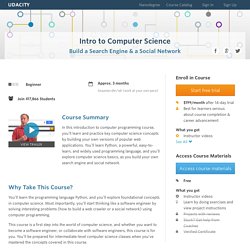
This class is self paced. You can begin whenever you like and then follow your own pace. It’s a good idea to set goals for yourself to make sure you stick with the course. How long will the course be available? This class will always be available! How do I know if this course is for me? Take a look at the “Class Summary,” “What Should I Know,” and “What Will I Learn” sections above. Can I skip individual videos? Yes! What are the rules on collaboration? Collaboration is a great way to learn. Why are there so many questions?
Udacity classes are a little different from traditional courses. What should I do while I’m watching the videos? Learn actively! UC Irvine - Bio Sci 93 - DNA to Organisms (Fall 2012) 500 Free Online Courses from Top Universities. Advertisment Take online courses from the world’s top universities for free.
Below, you will find 1,700 free online courses from universities like Yale, MIT, Harvard, Oxford and more. Our site also features collections of Online Certificate Programs and Online Degree & Mini-Degree Programs. Note: This page includes a lot of Massive Open Online Courses (MOOCs). If you want to enroll in a free version of a MOOC, please select the “Full Course, No Certificate” (edX) or “Audit” (Coursera) option. Humanities & Social Sciences Art & Art History Courses Classics Courses Communication Courses Economics & Finance Courses. MIT. Coursera. 21st Century University. RSA Animate - Changing Education Paradigms. Lets compile a list of the best online learning centers. We could all use a little education.
The Empathic Civilisation. The Coming Collapse of the Middle Class. PatrickJMT. Universe Sandbox. Axel Mellinger's Milky Way Panorama 2.0. BoxCar2D. Main Page - WikiManual. Avida-ED Home Page. John Conway's Game of Life. The Game The Game of Life is not your typical computer game.
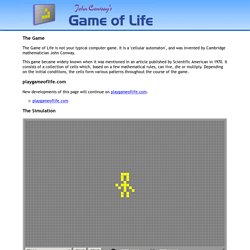
It is a 'cellular automaton', and was invented by Cambridge mathematician John Conway. This game became widely known when it was mentioned in an article published by Scientific American in 1970. It consists of a collection of cells which, based on a few mathematical rules, can live, die or multiply.
Depending on the initial conditions, the cells form various patterns throughout the course of the game. playgameoflife.com New developments of this page will continue on playgameoflife.com. playgameoflife.com The Simulation Figure from the XKCD RIP John Conway comic. The Rules For a space that is 'populated': Each cell with one or no neighbors dies, as if by solitude. Each cell with four or more neighbors dies, as if by overpopulation.
Each cell with two or three neighbors survives. For a space that is 'empty' or 'unpopulated' Each cell with three neighbors becomes populated. The Controls Development Edwin Martin <edwin@bitstorm.org> Swimbots. Cosmic Quandaries with Dr. Neil deGrasse Tyson. Dr. Neil deGrasse Tyson. Scientific Lectures (Hawking, Chomsky, et al) JamesBurkeWeb's Channel. Academic Earth. MIT OpenCourseWare. Khan Academy. Online Education. TED: Ideas worth spreading. RSA Animate - Drive: The surprising truth about what motivates us. RSA Animate - 21st century enlightenment. Juan Enriquez: Tech evolution will eclipse the financial crisis.
Stuart Brown says play is more than fun. John Hunter on the World Peace Game. World Peace Game. World Game. World Game, sometimes called the World Peace Game, is an educational simulation developed by Buckminster Fuller in 1961 to help create solutions to overpopulation and the uneven distribution of global resources.
This alternative to war games uses Fuller's Dymaxion map and requires a group of players to cooperatively solve a set of metaphorical scenarios, thus challenging the dominant nation-state perspective with a more wholistic "total world" view. The idea was to "make the world work for 100% of humanity in the shortest possible time through spontaneous cooperation without ecological damage or disadvantage to anyone",[1] thus increasing the quality of life for all people.
History and use[edit] Fuller first publicly proposed the concept as the core curriculum at the (then new) Southern Illinois University Edwardsville. He proposed it again in 1964 for the 1967 International and Universal Exposition in Montreal, Quebec. In 2001, a for-profit educational company named o.s. References[edit] Jennifer Government: NationStates.
TEDTalks List. TED. Sir Ken Robinson: Do schools kill creativity? Sir Ken Robinson: Bring on the learning revolution! Feynman on Scientific Method. Feynman on Elitist In-groups. Feynman 'Fun to Imagine' 4: Magnets (and 'Why?' questions...) Richard Feynman - The.Character of Physical Law - Part 1 The Law of Gravitation (full version) R. P. Feynman on the difference between knowing the name of something and knowing something.
Critical & Creative Education. S "The Reference Desk" - Business, Math, Science, Engineering, Technology, Language, Medical, Veterinary, Livestock, Gardening, Photography, Music, Recipes, etc.