
Redefining Smart: Multiple Intelligences. Edutopia reports on the resurgent relevance of Howard Gardner's ground-breaking theory, which changed the game for students and teachers.

Credit: iStockphoto Editor's Note (2013): There is no scientific evidence, as of yet, that shows that people have specific, fixed learning styles or discrete intelligences, nor that students benefit when teachers target instruction to a specific learning style or intelligence. Gardners Multiple Intelligence Ppp 1.
Gardner's Multiple Intelligences. Howard Gardner of Harvard has identified seven distinct intelligences.
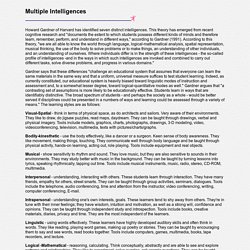
This theory has emerged from recent cognitive research and "documents the extent to which students possess different kinds of minds and therefore learn, remember, perform, and understand in different ways," according to Gardner (1991). According to this theory, "we are all able to know the world through language, logical-mathematical analysis, spatial representation, musical thinking, the use of the body to solve problems or to make things, an understanding of other individuals, and an understanding of ourselves.
Where individuals differ is in the strength of these intelligences - the so-called profile of intelligences -and in the ways in which such intelligences are invoked and combined to carry out different tasks, solve diverse problems, and progress in various domains. " The Learning Classroom: Theory Into Practice - Different Kinds of Smart-Multiple Intelligences. Kathy Schrock's Guide to Everything - Home Page.